

No single document can build a nation. No single leader can transform a society. No single generation can complete the work of nation-building. Every generation inherits unfinished work and leaves unfinished work behind. The future of Ambazonia is not contained within any book, plan, or vision statement. It lives in the choices its people make, the institutions they build, the values they uphold, the opportunities they create, and the courage with which they pursue a better future.
By Martin S. Mungwa, Ph.D., F.ASCE Author, of Ambazonia 2050 & Beyond, contributor The Independentist News
A Preview of a Larger Vision
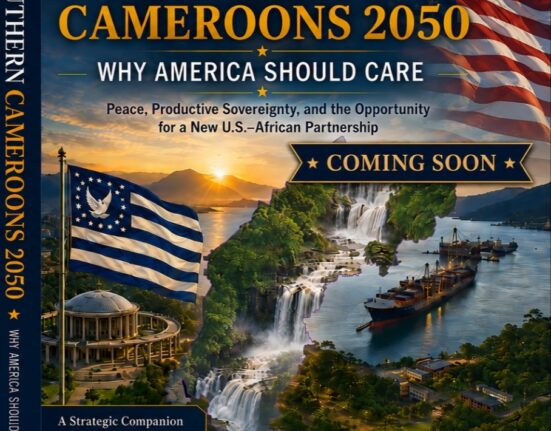
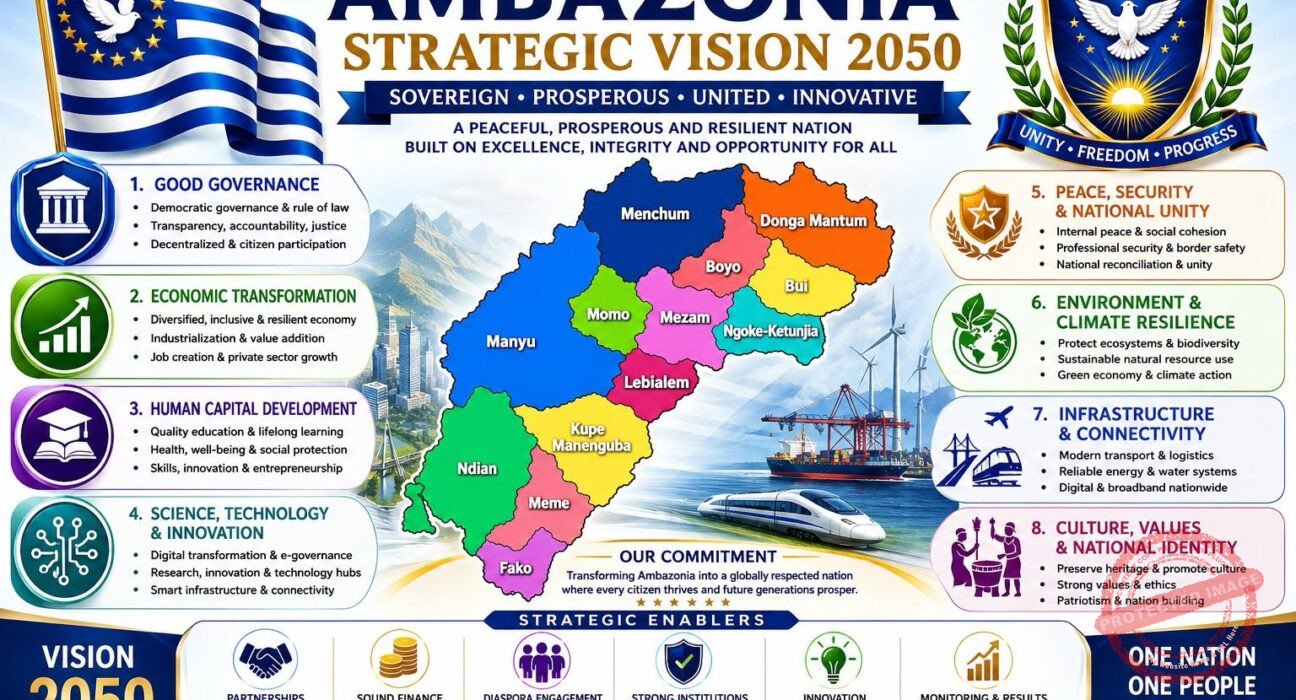
The framework presented below represents only a small portion of the ideas developed in Ambazonia 2050 & Beyond. The completed work explores in far greater depth the institutions, investments, infrastructure, educational systems, governance structures, innovation ecosystems, environmental strategies, and economic policies required to build a prosperous and resilient Republic. This article is intended as an invitation to conversation rather than a final blueprint. The full Executive Summary and complete manuscript will be released separately.
Every nation reaches defining moments in its history when it must decide whether it will merely react to events or actively shape its own future. Such moments demand courage, vision, discipline, and the willingness to imagine possibilities beyond present circumstances. They require societies to look beyond immediate challenges and ask fundamental questions about what they wish to become and what legacy they hope to leave for future generations. Ambazonia stands at such a moment.
The challenges confronting our people are substantial. Political uncertainty, economic disruption, infrastructure deficits, institutional weaknesses, and social pressures have created obstacles that cannot be ignored. Yet history repeatedly demonstrates that nations are not defined by the difficulties they encounter. They are defined by the manner in which they respond to those difficulties.
Many of the world’s most successful societies began their modern journeys under conditions far more challenging than those they enjoy today. Singapore emerged as a small island nation with few natural resources and significant uncertainty about its future. South Korea rose from the devastation of war to become one of the world’s leading industrial and technological powers. Estonia transformed itself into a global model of digital governance and innovation. Botswana demonstrated how prudent leadership and strong institutions could convert potential into prosperity. Rwanda showed that strategic planning and institutional reform could accelerate national renewal within a single generation.
The lesson is clear. Prosperity is not predetermined. Development is not accidental. Successful nations are built through vision, effective institutions, investment in people, innovation, entrepreneurship, and disciplined execution sustained over time.
The purpose of Ambazonia 2050 & Beyond is to explore how Ambazonia can become a prosperous, democratic, innovative, sustainable, and globally connected Republic by the middle of the twenty-first century and continue advancing throughout the century beyond. It is not a political manifesto, nor is it simply a development plan. It is a framework for national transformation grounded in the experiences of successful societies around the world and adapted to the realities and aspirations of Ambazonia.
The central premise of the work is simple. The future of Ambazonia will not be determined primarily by geography, natural resources, or historical circumstance. It will be determined by the quality of its institutions, the capabilities of its people, the competitiveness of its economy, the resilience of its infrastructure, and the choices it makes across generations.
At the heart of this vision lies a commitment to good governance. Throughout history, nations have prospered when they built institutions capable of creating trust, enforcing the rule of law, protecting individual rights, and providing a stable environment for economic and social progress. Institutions are the invisible infrastructure of development. They determine whether citizens trust government, whether businesses invest, whether contracts are enforced, and whether opportunities are fairly distributed.
For Ambazonia, constitutional governance, transparency, accountability, judicial independence, and respect for fundamental rights must become pillars of national development. Strong institutions are not merely political ideals. They are practical necessities for prosperity. Capital seeks certainty. Innovation flourishes where freedom exists. Citizens invest in their future when they trust the systems that govern them.
Equally important is the development of human capital. The most valuable resource available to any nation is not found beneath its soil but within its people. Education, healthcare, skills development, scientific research, and lifelong learning determine a nation’s capacity for innovation, productivity, and resilience.
The Ambazonia envisioned in this work is one in which every child has access to quality education, every citizen has access to healthcare, and every individual has the opportunity to develop his or her talents to the fullest extent possible. Universities should become engines of innovation and economic development. Research institutions should generate solutions to national challenges. Technical and vocational education should equip citizens with the skills required to compete in an increasingly complex global economy.
Economic transformation represents another cornerstone of the vision. Sustainable prosperity requires more than economic activity. It requires productivity, diversification, entrepreneurship, and wealth creation. The future economy of Ambazonia must be built upon multiple pillars, including agriculture, manufacturing, energy, technology, logistics, tourism, financial services, and knowledge-based industries.
Agriculture must evolve from subsistence to productivity and value addition. Manufacturing must increase the nation’s capacity to create wealth rather than simply export raw materials. Entrepreneurship must become a national culture. Innovation must become a national habit. Investment must be viewed not as an external gift but as a partnership in national development and wealth creation.
One of Ambazonia’s greatest untapped assets is its global diaspora. Across North America, Europe, Africa, and beyond, Ambazonians have distinguished themselves as engineers, physicians, educators, scientists, entrepreneurs, investors, and professionals. Their expertise, networks, capital, and experience represent an extraordinary resource for national development. Mobilizing diaspora talent and investment could become one of the most important drivers of future growth and transformation.
Infrastructure will also play a decisive role in shaping the future Republic. Roads, railways, ports, airports, energy systems, water infrastructure, and digital networks are not merely construction projects. They are the foundations upon which opportunity is built. Modern infrastructure connects communities, reduces costs, improves productivity, attracts investment, and expands economic possibilities.
The vision presented in Ambazonia 2050 & Beyond therefore emphasizes the development of integrated transportation systems, reliable energy networks, digital connectivity, modern urban centers, and resilient public infrastructure capable of supporting long-term growth and competitiveness.
At the same time, the twenty-first century will increasingly be defined by technology and innovation. Artificial intelligence, biotechnology, advanced manufacturing, digital finance, robotics, and other emerging technologies are reshaping economies across the globe. Nations that successfully adapt to these changes will enjoy significant advantages in productivity, competitiveness, and economic opportunity.
Ambazonia has an opportunity to position itself not merely as a consumer of technology but as a contributor to the knowledge economy. By investing in research, innovation, entrepreneurship, and technological capability, the Republic can create new industries, attract investment, and expand opportunities for future generations.
Environmental sustainability must remain central to this vision. The Republic’s forests, rivers, mountains, coastlines, biodiversity, and agricultural lands represent invaluable assets. Protecting these resources is not an obstacle to development; it is a prerequisite for sustainable development. Climate resilience, renewable energy, sustainable agriculture, conservation, and responsible resource management should become integral components of long-term national planning.
The future of Ambazonia should be measured not merely by economic growth but by the opportunities available to its people. Development is ultimately about creating a society in which individuals can pursue meaningful lives, contribute productively to their communities, and participate fully in the nation’s progress. A Republic of opportunity is one in which talent is nurtured, innovation is rewarded, and future generations inherit a stronger nation than the one that exists today.
This vision is ambitious. But ambition should not be confused with impossibility. Every great achievement in history began as an idea that challenged prevailing assumptions. The nations that transformed themselves did so because they dared to think beyond immediate circumstances and commit themselves to long-term goals.
The future cannot be predicted with certainty. Technological breakthroughs, geopolitical shifts, demographic changes, and unforeseen events will reshape the global landscape in ways no one can fully anticipate. The objective is therefore not prediction. The objective is preparation.
Successful nations do not prepare for a single future. They build the capacity to succeed under many possible futures. They cultivate adaptability, resilience, innovation, and strategic foresight. They invest in knowledge and strengthen institutions capable of responding effectively to change.
The vision presented in Ambazonia 2050 & Beyond is offered in that spirit. It is an invitation to think beyond present challenges and consider what is possible when a society commits itself to excellence, innovation, opportunity, and long-term nation-building. It is an invitation to engage in a broader conversation about the future of Ambazonia and the responsibilities that accompany the opportunity to shape that future.
No single document can build a nation. No single leader can transform a society. No single generation can complete the work of nation-building. Every generation inherits unfinished work and leaves unfinished work behind. The future of Ambazonia is not contained within any book, plan, or vision statement. It lives in the choices its people make, the institutions they build, the values they uphold, the opportunities they create, and the courage with which they pursue a better future.
The work continues. The Republic remains unfinished. And the future awaits.
Martin S. Mungwa, Ph.D., F.ASCE Author, of Ambazonia 2050 & Beyond, contributor The Independentist News