


This is why VOICE → OWNERSHIP → ACCOUNTABILITY has potential beyond the three books themselves. It can become a framework for thinking about Ambazonian intellectual and institutional development. Writers should know what they are saying. Scholars should be able to prove what they know. Institutions should know who is responsible for what they decide.
By The Independentist News editorial desk
Martin S. Mungwa’s three-book series is more important to the Ambazonia community than its titles initially suggest. On the surface, the trilogy concerns artificial intelligence, writing, scholarship, and institutional accountability. At a deeper level, however, it addresses three questions that every community seeking to preserve its history, strengthen its intellectual class, communicate internationally, and build credible institutions must eventually answer: Who is speaking? Who owns the ideas being advanced? Who accepts responsibility when those ideas become institutional decisions?
That progression gives the trilogy unusual relevance to Ambazonia. A community contesting historical narratives, producing scholarship about its past, communicating through diaspora media, advocating internationally, educating younger generations, and imagining future governmental, professional, and economic institutions cannot afford weak standards of authorship. Its writers must sound like identifiable human beings rather than interchangeable political voices. Its scholars must distinguish documented history from inherited assertion. Its media institutions must distinguish reporting, advocacy, allegation, evidence, and interpretation. Its emerging institutions must eventually understand that a document carrying institutional authority cannot be owned by everyone and therefore by no one. The trilogy moves deliberately through these levels: VOICE → OWNERSHIP → ACCOUNTABILITY.
The Human Signature — Voice
The Human Signature is the most accessible of the three books and provides the natural entry point into the series. Its governing question is whether the human being remains recognizable inside AI-assisted writing.
For the Ambazonia community, this question has particular importance because its public discourse is produced across continents by academics, journalists, activists, clergy, engineers, healthcare professionals, political organizations, businesspeople, students, diaspora groups, and ordinary citizens. Artificial intelligence can help these writers organize ideas, improve language, translate material, and communicate more effectively. The danger is not simply that AI may generate text. The deeper danger is that distinctive experiences begin to sound identical.
Ambazonian knowledge is partly carried through lived experience. Someone raised in Bamenda, Buea, Victoria, Tiko, Mamfe, Kumba, or another community may encounter history differently from an outside researcher. An engineer sees institutional failure differently from a historian. A teacher remembers educational systems differently from a diplomat. A farmer, physician, entrepreneur, journalist, refugee, or community elder possesses another form of knowledge. Technology can assist in communicating those experiences, but it should not erase the differences that make them valuable.
The book’s particular contribution to Ambazonia is therefore cultural as well as technological. It argues for preservation of the human signature at precisely the moment when technology makes imitation easy. A future Ambazonian intellectual culture will require writers whose voices remain their own rather than documents that all sound as though they came from the same system. Ambazonia Community Score: 94/100
Authorial Integrity — Ownership
If The Human Signature asks whether the writer remains present, Authorial Integrity asks a more demanding question: Can the scholar demonstrate ownership of the argument, evidence, and contribution?

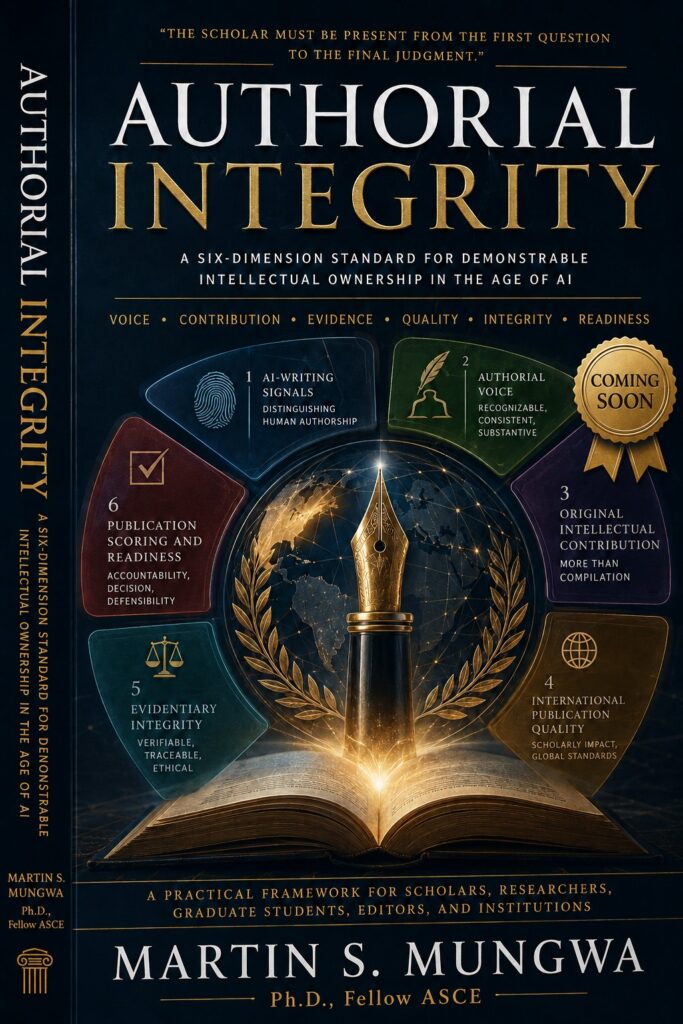
For the Ambazonia community, this may be the trilogy’s most important scholarly volume. Southern Cameroons history involves colonial records, United Nations documents, constitutional interpretation, competing political narratives, oral histories, archival materials, international law, academic scholarship, journalism, diplomatic statements, and decades of political repetition. Within such an environment, a proposition can gradually become accepted because it has been repeated rather than because its original evidentiary foundation has been tested.
Authorial Integrity addresses precisely this danger. Its distinction between information and intellectual contribution is especially relevant. Ambazonian scholarship cannot advance indefinitely by assembling familiar quotations about colonialism, 1961, federation, constitutional rupture, conflict, international responsibility, or marginalization. Serious scholarship must ask what new framework is being advanced, what evidence supports it, what competing explanation has been examined, where interpretation begins, and what the scholar is contributing beyond compilation.
The book’s standard of demonstrable intellectual ownership is equally important in the age of artificial intelligence. A doctoral candidate, professor, historian, policy researcher, journalist, or author should be capable of explaining the thesis beyond the precise sentences appearing on the page. If the author cannot explain why the evidence was selected, why an interpretation was adopted, what limitations remain, or how the argument responds to competing evidence, fluent prose alone cannot establish intellectual ownership.
This principle could significantly strengthen Ambazonian scholarship because the community’s claims will not be judged internationally only by sympathetic readers. Serious historical, constitutional, political, economic, and legal arguments must survive skeptical and sometimes hostile scrutiny. A strong argument should therefore be verifiable even when the reader does not share the author’s political conclusion.
The book also provides an important corrective to excessive reliance on AI-detection software. The serious question should not be whether software assigns a document a particular probability of AI involvement. The serious question is whether the named scholar understands the work, owns the argument, can verify the evidence, and can defend the contribution. Ambazonia Community Score: 97/100
The Accountable Author — Accountability
For the future institutional development of Ambazonia, The Accountable Author may ultimately become the most consequential volume of the trilogy. Its governing proposition is simple but far-reaching: the institution must remain inside the decision.

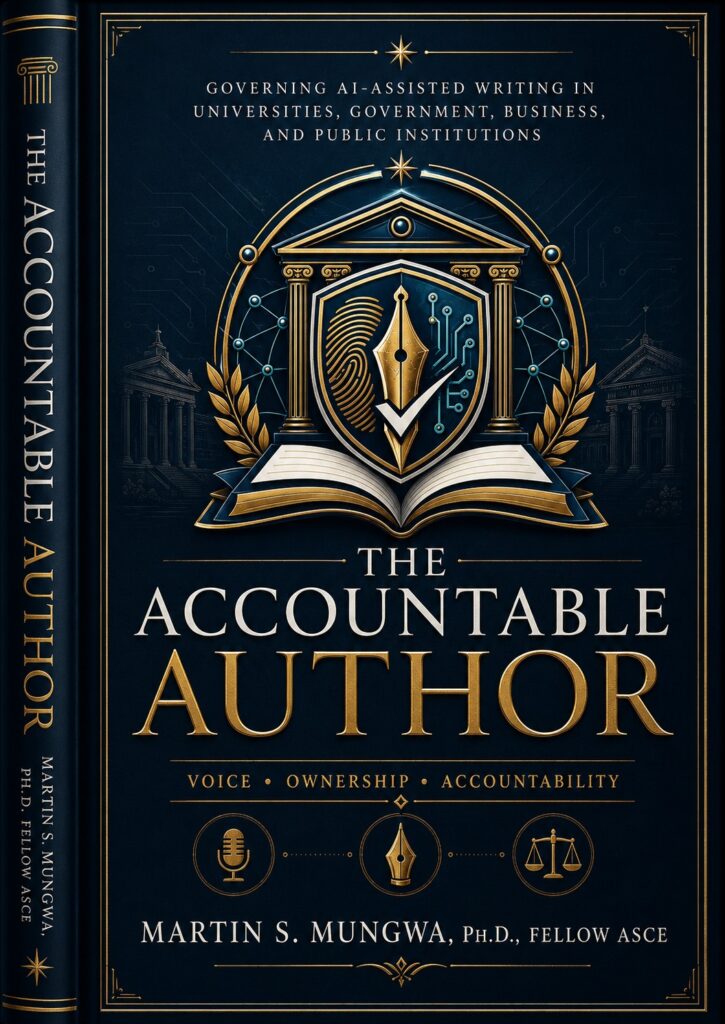
Ambazonian political and civic life involves political organizations, advocacy groups, media platforms, diaspora structures, humanitarian organizations, professional associations, churches, scholars, diplomats, businesses, and individuals speaking with varying degrees of claimed institutional authority. Within such an environment, one question becomes critical: who actually owns the institutional judgment?
The Human Accountability Chain developed in the book offers a practical answer. A consequential institutional claim should have an identifiable origin. Evidence should have a verifier. Analysis should have an accountable analyst. Professional matters should receive competent professional review. Recommendations should be consciously adopted by a legitimate decision authority. Public documents should have an identifiable release authority. Ultimately, a person or properly constituted institution should be able to accept responsibility for the consequence.
For Ambazonia, this principle could transform institutional culture. Consider a policy paper concerning natural resources, infrastructure, public finance, security, education, international law, humanitarian conditions, investment, or diplomacy. It is not enough for the document to look professional. Someone should know where the numbers came from, who verified them, which assumptions were used, whether qualified specialists reviewed the work, what disagreement existed, and who possessed authority to approve the recommendation.
The framework is equally important for journalism and public communication. A claim originating from one organization should not become independent evidence merely because numerous outlets repeat it. A statistic should not become more credible simply because it appears in several documents that all ultimately trace back to one unverified source. The book’s treatment of press releases, derivative reporting, source verification, and institutional repetition has direct relevance to an information environment in which political claims can circulate quickly through diaspora media and social platforms.
Its application to humanitarian advocacy is equally important. Claims involving casualties, displacement, humanitarian need, human-rights violations, or vulnerable populations may have serious diplomatic and moral consequences. Advocacy can be strong without becoming careless. Documented fact, testimony, allegation, estimate, interpretation, and institutional judgment should remain distinguishable because credibility is itself a strategic resource.
The engineering and professional chapters carry another message of particular importance for future nation-building. Electricity systems, transportation networks, water supply, telecommunications, public buildings, finance, healthcare, education, and national infrastructure cannot be governed by political enthusiasm alone. Qualified professionals must remain accountable for technical judgments even when AI and sophisticated analytical tools assist the work.
The book’s greatest relevance to Ambazonia may therefore lie beyond AI. It offers an approach to institutional readiness. Most established states spend decades trying to repair dysfunctional bureaucratic systems. A community contemplating new institutions has the unusual opportunity to think about accountability before those institutions become entrenched. Ambazonia Community Score: 99/100
Overall Assessment of the Trilogy
Dimension The Human Signature, Authorial Integrity, and The Accountable Author
Relevance to Ambazonia 94 98 100
Originality 95 98 98
Practical usefulness 95 97 100
Academic value 90 99 97
Institutional value 88 95 100
Accessibility 98 89 93
Long-term community value 95 98 100
Overall 94/100 97/100 99/100
Overall Trilogy Score for the Ambazonia Community: 97/100
The trilogy’s strongest feature is that it does not repeat the same argument three times. Each book changes the unit of responsibility. The Human Signature begins with the individual and asks whether the human being remains recognizable in the writing. Authorial Integrity moves to the scholar and asks whether intellectual ownership can be demonstrated through thesis, evidence, reasoning, and original contribution. The Accountable Author moves outward to the institution and asks whether institutional authority can be traced through understanding, verification, professional judgment, approval, and consequence.
That architecture is particularly appropriate for Ambazonia because the development of a serious community follows a similar progression. A people first requires authentic voices capable of preserving and communicating its experience. It then requires scholars capable of converting experience, archives, evidence, and interpretation into defensible knowledge. Finally, it requires institutions capable of converting knowledge into responsible decisions.
The three books can therefore be read simultaneously as a guide to writing, a standard for scholarship, and a philosophy of institutional governance. Their relevance extends far beyond artificial intelligence because AI is principally the technological condition that makes these older questions more urgent. The deeper subjects are truth, intellectual ownership, professional judgment, evidence, responsibility, and public trust.
For the Ambazonia community, the trilogy’s central lesson can be stated simply: a liberation community needs an authentic voice; a serious intellectual community needs ownership of its knowledge; and a functioning nation needs accountability for its decisions.
This is why VOICE → OWNERSHIP → ACCOUNTABILITY has potential beyond the three books themselves. It can become a framework for thinking about Ambazonian intellectual and institutional development. Writers should know what they are saying. Scholars should be able to prove what they know. Institutions should know who is responsible for what they decide.
The Human Signature provides the human foundation. Authorial Integrity establishes the scholarly standard. The Accountable Author carries those principles into institutional life. None is fully complete without the other two.
Taken together, the trilogy makes a compelling proposition for the Ambazonia community: authentic nation-building begins before constitutions, ministries, budgets, and infrastructure. It begins with the quality of the thinking, evidence, judgment, and responsibility that will eventually govern them.
VOICE establishes presence. OWNERSHIP establishes intellectual legitimacy. ACCOUNTABILITY establishes responsibility for consequence.
The Independentist News editorial desk