

Cape Coast demonstrated that Britain can look backward at an acknowledged historical wrong. Southern Cameroons asks whether British institutions can look directly at an unresolved one. That is the harder test. And that is why the journey should not end with photographs, church services, official welcomes, and departure ceremonies. Canterbury has walked through the geography. It is time to meet the history.
By Timothy Enongene, Associate Editor-in-chief The Independentist News
Two senior Christian leaders came to Cameroon in 2026. Both carried global religious authority. Both spoke the language of faith, human dignity, reconciliation, and service. Both entered a country living with an unresolved conflict in the former British Southern Cameroons. Yet the public character of their visits raises an uncomfortable question about institutional memory and moral responsibility. Pope Leo XIV went directly to Bamenda. Archbishop of Canterbury Sarah Mullally went to Buea and Limbe.
The difference is not geographical trivia. It tells us something important about how institutions encounter history, particularly when that history belongs partly to them. The comparison should not be turned into a contest between Roman Catholicism and Anglicanism, nor should it become a personal attack on Archbishop Mullally. The Church of England is not the British government, and the Archbishop of Canterbury cannot be held personally responsible for decisions made by colonial officials decades before her birth. Pope Leo XIV has not endorsed Ambazonian independence, and neither should his peace mission be appropriated as though he had done so.
But Christian institutions speak repeatedly about truth, repentance, justice, memory, reconciliation, and the dignity of the human person. When they enter places where historical political arrangements have produced continuing conflict, those principles deserve to be tested against what they actually do. Southern Cameroons presents such a test.
Pope Leo Went to Bamenda
On April 16, 2026, Pope Leo XIV traveled from Yaoundé to Bamenda for what the Vatican officially designated a “Meeting for Peace with the Community of Bamenda.” This was not an accidental stop on a ceremonial tour. Bamenda stands at the center of the conflict that has devastated the English-speaking Northwest and Southwest regions for nearly a decade. The Pope entered that geography deliberately. He listened to traditional, Christian, Muslim, religious, and displaced-community representatives. He spoke openly about a region that had suffered greatly. He described the land beneath the feet of those before him as bloodstained, fertile, and mistreated. That matters.
Before his arrival, Anglophone separatist factions announced a temporary cessation of hostilities. Whatever one thinks of the political movement or its internal divisions, the fact that armed actors altered their conduct for the visit demonstrated the unusual moral space the Pope had created. The pontiff used that space to speak about peace, but he did not reduce peace to silence imposed upon the weaker party. He spoke about suffering. He spoke about justice. He spoke about rebuilding.
He condemned those who manipulate religion for military, economic, or political purposes. He challenged the grotesque contradiction in which enormous resources can be mobilized rapidly for destruction while communities wait years for the resources required to heal. At Mass in Bamenda, he spoke of fundamental rights and human dignity. He also criticized forms of external exploitation that plunder Africa while leaving populations without the full benefit of their resources. None of this amounted to recognition of Ambazonia. It did something perhaps more immediately important. The Pope acknowledged the wound.
Canterbury Arrived Carrying a Different History
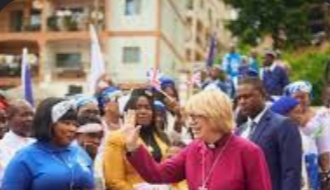
Only a few months later, the Archbishop of Canterbury, the Most Reverend and Right Honourable Dame Sarah Mullally, undertook her first pastoral journey to Africa since becoming Archbishop of Canterbury. Her West African itinerary included Ghana and Cameroon. The official Anglican announcement described a pastoral visit centered on worship, healthcare, clergy, Anglican institutions, young people, and relationships within the Church of the Province of West Africa.
In Cameroon, her published itinerary included Yaoundé, Douala, Buea, and Limbe. She was scheduled to visit Biaka University in Buea and the Doctor Biaka Memorial Foundation, meet Anglican clergy in Limbe, worship in Douala, and hold a courtesy meeting with the Government of Cameroon in Yaoundé. These are legitimate pastoral activities. But Buea and Limbe are not politically neutral dots on a map. They are cities within the former British Southern Cameroons. And the Archbishop of Canterbury does not enter them carrying the same historical relationship that Pope Leo carries.
Canterbury arrives from Britain.
That changes the moral question. The Church of England Is Not Britain, but Neither Is It Historically Unrelated to Britain The distinction must be made carefully. The Archbishop of Canterbury did not administer the United Nations Trust Territory of the Cameroons under British administration. The Church of England did not negotiate the 1961 plebiscite arrangements. Lambeth Palace did not sign the diplomatic correspondence governing Britain’s withdrawal.Those responsibilities belonged to political institutions. But historical institutions do not exist in sealed compartments.
The Church of England is England’s established church. The Archbishop of Canterbury has occupied a position close to the British Crown and national life across centuries in which British power expanded throughout the world. Anglican institutions traveled through imperial networks, colonial territories, missionary structures, schools, hospitals, and administrative societies shaped by British rule. This does not make Anglican clergy equivalent to colonial administrators. It does mean that Canterbury cannot enter a former British-administered territory as though Britain were merely another distant country.
Southern Cameroons developed its educational, judicial, parliamentary, administrative, linguistic, and civic traditions under British rule and trusteeship. Whatever judgment one reaches concerning independence today, Britain was a central institutional actor in the political history that brought Southern Cameroons to October 1961. That history follows Canterbury into Buea.
The Cape Coast Question
The contrast becomes even more striking because Archbishop Mullally’s journey to Cameroon came immediately after a visit to Cape Coast Castle in Ghana. Cape Coast Castle is one of the most haunting physical monuments of the Atlantic slave trade. Enslaved Africans were confined there before being transported across the Atlantic, including on British slave ships.
The Archbishop’s visit there was appropriate. Christian institutions should confront the places where human beings were degraded and where European commercial, political, and religious worlds intersected with systems of exploitation. But Cape Coast creates a difficult question for Canterbury.
If the Archbishop of Canterbury can enter a fortress associated with Britain’s involvement in slavery and recognize the need for historical memory, what happens when she travels days later into another former British-administered African territory whose unresolved political crisis cannot be understood without examining Britain’s role in decolonization?
Slavery and the Southern Cameroons question are not identical historical events. They should not be collapsed into each other. But one principle connects them: institutions should have the courage to examine the consequences of the historical systems in which they participated. Cape Coast asks Britain to remember a past almost everyone now agrees was morally indefensible. Southern Cameroons asks something harder. It asks Britain to examine a past whose consequences remain politically alive.
It Is Easier to Repent of a Dead Injustice
There is a strange comfort in condemning wrongs after everybody responsible for them has disappeared. Britain can condemn the Atlantic slave trade without threatening a contemporary colonial economy. It can acknowledge imperial excesses in India decades after independence. Churches can lament historical racial injustice when no government asks them to defend slavery.
Southern Cameroons is more difficult because the argument is unfinished. The political consequences are alive. Questions remain about the 1961 transition, the termination of trusteeship, constitutional arrangements, the federal period, the subsequent concentration of state authority, the preservation or dismantling of inherited institutions, representation, language, education, law, resource control, military force, and self-determination. These matters remain contested. That is precisely why moral courage matters.
The easiest history to condemn is history that costs nothing in the present. The harder test is whether an institution can examine the consequences of historical decisions when present governments, diplomatic relationships, and political interests make that examination uncomfortable.
Pope Leo Has Set a Difficult Standard
Pope Leo XIV has recently provided an unusually relevant model of institutional memory. In his 2026 encyclical Magnifica Humanitas, he confronted the historical relationship between Christian institutions and slavery. He acknowledged that ecclesiastical institutions had owned enslaved people, that the Apostolic See had at times participated in regulating and legitimizing forms of subjugation, and that the Church had taken far too long to reach an unequivocal condemnation of slavery. He then did something institutions often resist. He asked pardon in the name of the Church.
The intellectual importance of that act lies in the distinction between inherited personal guilt and institutional responsibility. Leo was not saying that a Catholic born today personally enslaved someone centuries ago. He was saying that an institution with historical continuity can examine its record honestly. That is a profound principle.
Institutions are perfectly willing to inherit the achievements of their predecessors. They inherit properties, traditions, authority, archives, titles, reputations, diplomatic privileges, ceremonies, wealth, and institutional memory. They cannot logically claim historical continuity when inheriting honor while declaring historical discontinuity whenever responsibility appears.
Southern Cameroons should ask Britain—and institutions historically connected to Britain—to apply the same principle. Britain Need Not Be Demonized to Be Questioned. This discussion becomes intellectually weak whenever it is reduced to the proposition that Britain deliberately engineered every subsequent problem of Southern Cameroons.
History is more complicated. The United Nations had a role. Political leaders in Southern Cameroons had agency. Political actors in the Republic of Cameroon had agency. Regional politics mattered. Cold War circumstances mattered. Internal Southern Cameroons divisions mattered. France’s relationship with the Republic of Cameroon mattered. Later constitutional decisions mattered. Present-day government policies matter.
Separatist organizations have also made decisions for which they must be accountable. Recognizing complexity does not remove Britain from the historical structure. Britain was the administering authority. Britain possessed the records. Britain participated in the process through which trusteeship ended. Britain’s officials evaluated Southern Cameroons’ economic and political options. Britain’s withdrawal was part of the architecture from which the subsequent constitutional order emerged. The question is therefore not whether Britain alone created the present conflict. The better question is whether Britain has adequately examined the long-term consequences of the decolonization arrangement in which it played such a central role. That is a fair historical question. Canterbury should be able to ask it.
The Published Anglican Itinerary Leaves the Question Open Care must be taken here. It would be irresponsible to claim, without evidence, that Archbishop Mullally privately ignored the Southern Cameroons conflict. Her published itinerary cannot tell us everything discussed in private meetings with clergy, local people, government officials, or other interlocutors. It is entirely possible that difficult questions were raised away from cameras. The defensible criticism is narrower.
Based on the official Anglican material publicly available, the Cameroon leg of Archbishop Mullally’s visit was framed primarily as a pastoral journey involving worship, church communities, healthcare institutions, clergy, and government courtesy meetings. The public framing did not present an intervention comparable to Pope Leo’s explicitly designated Bamenda peace encounter. That distinction matters. Pope Leo did not merely pass through an Anglophone city. He publicly defined his encounter around the wound.
Canterbury entered Southern Cameroons geography while its published program remained principally pastoral. The question is not whether pastoral work is unimportant. The question is whether pastoral presence is sufficient when a church with Britain’s historical symbolism enters a land whose political trauma remains deeply connected to the unfinished history of British decolonization.
The Government’s Welcome Also Deserves Attention. Cameroon’s Ministry of External Relations prepared for Archbishop Mullally’s visit at senior governmental level. The July 20 preparatory meeting included the Minister of External Relations, the Minister Delegate responsible for Commonwealth cooperation, British diplomatic representation, and other officials.
The Ministry referred to the Archbishop as the Head of State’s “Very Esteemed Host.” Again, there is nothing inherently improper about diplomatic protocol. Governments welcome major international religious figures. But religious leaders entering unresolved political conflicts must recognize that states understand the value of symbolism.
A visiting spiritual leader photographed with government officials may become part of the state’s presentation of legitimacy, stability, normalcy, and international acceptance—even if that was never the visitor’s intention. That risk applies to Rome, Canterbury, Washington, London, the Commonwealth, and every major international institution.
Religious diplomacy must therefore ask not only, “Whom did we meet?” It must also ask, “Whom did we hear?” Did internally displaced families have access? Did victims of state abuses have access? Did victims of separatist abuses have access? Were lawyers, teachers, clergy, traditional leaders, women, business owners, students, and civil-society figures able to speak freely? Was the historical question itself permitted into the room? A courtesy visit cannot answer those questions.
If Canterbury Can Listen in Palestine, It Can Listen in Southern Cameroons
Archbishop Mullally has demonstrated elsewhere that pastoral leadership can include difficult political realities. That makes the Southern Cameroons question fair, not hostile. Christian witness cannot be geographically selective. If Anglican leadership recognizes the importance of listening to wounded communities elsewhere, then Buea, Limbe, Bamenda, Kumba, Kumbo, Mamfe, and other communities affected by this conflict deserve the same moral curiosity. And Canterbury has an additional reason to listen. Britain was there. That historical connection should produce more engagement, not less.
Rome and Canterbury Should Not Become Rivals
There would be little value in turning Pope Leo XIV and Archbishop Sarah Mullally into opposing religious symbols for rival political camps. Indeed, Catholic–Anglican dialogue continues, and Pope Leo welcomed Mullally’s installation as Archbishop of Canterbury with an appeal to continued engagement “in truth and love.” That phrase provides an appropriate standard for Southern Cameroons.
Truth and love.
Truth without love can become vengeance. Love without truth can become avoidance. Reconciliation without truth becomes ceremony. Peace without justice becomes an interval between conflicts. Dialogue without the disputed question becomes managed conversation. Southern Cameroons needs something more serious.
The Anglican Opportunity
Canterbury still has an opportunity that should not be wasted. The Archbishop of Canterbury does not need to endorse Ambazonian independence to make an important contribution. She could call for unrestricted historical research into Britain’s administration of Southern Cameroons. She could encourage fuller access to British archival records. She could invite Southern Cameroonian scholars, clergy, historians, lawyers, women, young people, former public servants, and civil-society representatives to Canterbury for a structured listening process. She could ask how the churches themselves behaved during colonialism, trusteeship, reunification, federalism, centralization, and the present conflict. She could support independent documentation of abuses by all sides. She could insist upon protection of civilians, schools, churches, hospitals, humanitarian workers, and displaced families. She could encourage dialogue in which constitutional status itself is discussable rather than prohibited before the conversation begins. She could urge Britain to listen to the people of a territory it once administered.
None of these actions requires the Church of England to become the foreign ministry of an independence movement. They require only moral seriousness. Ambazonians Must Accept the Same Standard There is a danger in demanding historical accountability from Britain while excusing misconduct committed in the name of Ambazonia. That cannot be the standard.
If the movement invokes human dignity against state violence, it must defend human dignity when civilians are threatened by separatist actors. If it condemns arbitrary detention, it cannot excuse kidnapping. If it demands educational freedom, it cannot tolerate attacks on teachers and schools. If it demands political choice, it must permit political disagreement among Southern Cameroonians themselves.
If it asks Britain, Rome, Canterbury, the Commonwealth, or the United Nations to confront institutional responsibility, Ambazonian institutions and leaders must be prepared to confront their own. A future republic cannot be built upon selective accountability. The behavior of a liberation movement before sovereignty tells the world something about the institutions it may create after sovereignty. Historical grievance establishes a reason to be heard. It does not automatically establish readiness to govern.
The Difference Between Visiting a Place and Meeting Its History
This is ultimately what distinguishes the moral challenge before Canterbury. A religious leader can visit Buea without encountering Southern Cameroons. One can drive through Limbe without confronting British history. One can meet government officials in Yaoundé, worship with clergy, dedicate facilities, praise healthcare workers, and depart with photographs of fellowship. All of those things may be valuable. But history remains waiting outside the program.
Pope Leo demonstrated another possibility. He went to Bamenda and made the wound itself part of the visit. That is why the contrast matters. Rome did not arrive carrying Britain’s particular historical responsibility, yet Rome entered the wound publicly. Canterbury carries a much closer historical connection, yet its publicly announced visit was framed principally around pastoral institutions and relationships. This should not produce hostility toward Archbishop Mullally. It should produce an invitation. Come back. Come not merely as the head of an international communion. Come as the Archbishop of Canterbury. Come prepared to listen to the history that attaches itself to that name. Cape Coast Was Yesterday; Southern Cameroons Is Still Happening Cape Coast Castle stands as a monument to something humanity should never repeat. Southern Cameroons is more difficult because the argument is still alive. People are still displaced. Families remain divided. Schools and communities continue to bear the effects of insecurity.
The state insists upon territorial unity. Independence advocates insist upon restoration of sovereignty. Civilians live between political narratives and armed power. The international community repeatedly calls for dialogue while avoiding some of the historical questions that made dialogue necessary. This is precisely where churches should matter. The church should be capable of entering spaces where governments become defensive and movements become absolutist. It should be able to ask uncomfortable questions without becoming the propaganda arm of either side.
It should be able to say to the Cameroon government: military control cannot substitute permanently for political legitimacy. It should be able to say to separatist movements: a just claim does not license injustice against civilians. It should be able to say to Britain: your withdrawal from administrative responsibility did not erase the historical record. It should be able to say to the people of Southern Cameroons: your history deserves truth, but the future requires institutions worthy of the sacrifices made in its name. That would be moral leadership. The Unfinished Test of Christian Institutional Memory
Pope Leo XIV’s willingness to acknowledge historical Church failures concerning slavery has changed the moral vocabulary available to institutions. He has demonstrated that acknowledging institutional wrongdoing does not destroy an institution. It can strengthen it. Truth is not institutional suicide. Repentance is not weakness. Historical examination is not necessarily an admission of contemporary legal liability.
And listening to people who challenge an established political narrative does not automatically mean endorsing their preferred solution. These distinctions matter enormously for Southern Cameroons. Britain can examine its role without automatically recognizing Ambazonia. Canterbury can listen without becoming a separatist institution. The United Nations can revisit its historical record without declaring its previous resolutions void.
The Government of Cameroon can engage the constitutional origins of the dispute without agreeing beforehand to independence. Ambazonian leaders can acknowledge internal failures without abandoning self-determination. The purpose of truth is not to predetermine every answer. It is to make dishonest answers more difficult.
Two Visits, One Question
Pope Leo went to Bamenda. Archbishop Mullally went to Buea and Limbe. Neither journey should be reduced to a political slogan. But together they produce one unavoidable question: What does moral leadership require when a religious institution encounters a people whose present suffering is connected to a history in which institutions associated with that religious tradition were themselves embedded?
Rome has shown one response: enter the wound, listen publicly, acknowledge suffering, speak about dignity, condemn exploitation, and insist upon peace grounded in justice. Canterbury now has the opportunity to go further than pastoral courtesy. For Southern Cameroons, the question is not whether the Archbishop of Canterbury visited. She did. The question is whether Canterbury is prepared to encounter the history beneath the visit.
Cape Coast demonstrated that Britain can look backward at an acknowledged historical wrong. Southern Cameroons asks whether British institutions can look directly at an unresolved one. That is the harder test. And that is why the journey should not end with photographs, church services, official welcomes, and departure ceremonies. Canterbury has walked through the geography. It is time to meet the history.
Timothy Enongene, Associate Editor-in-chief The Independentist News