

Justice, in this case, is not only about redress for those affected. It is about prevention. It is about ensuring that the next bridge, the next project, the next temporary solution does not become another site of avoidable loss.
By Ghainwi Akamentsu The Independentist Contributor
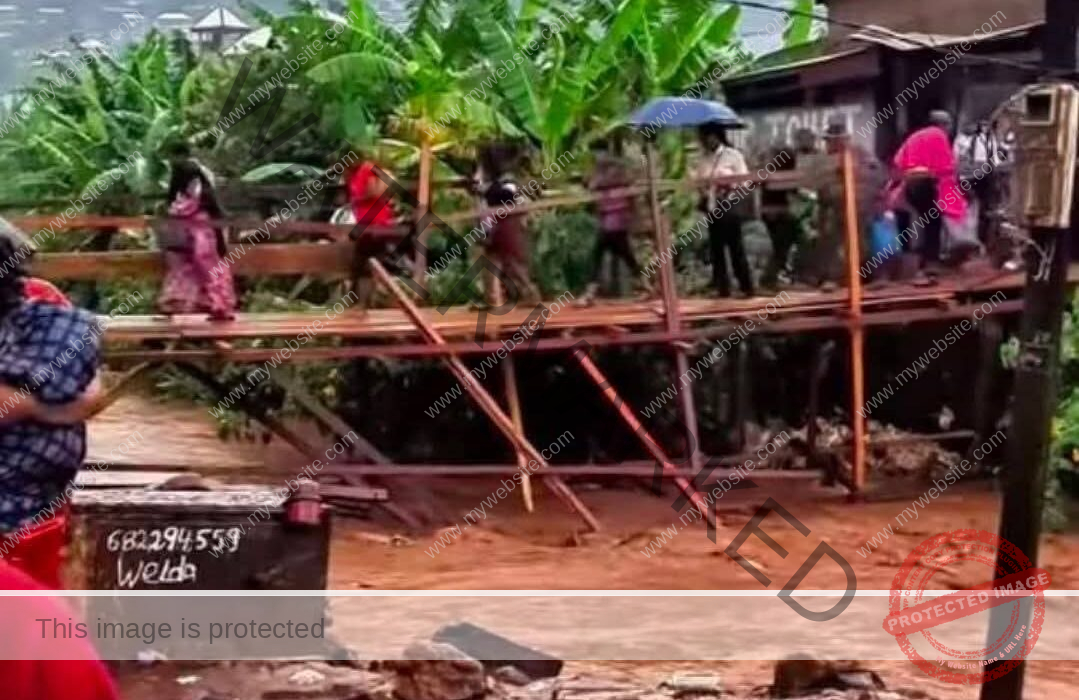
The collapse of the temporary pedestrian crossing at Mile 2 in Bamenda is not just an unfortunate incident. It is a tragedy that demands answers, accountability, and justice.
At the heart of this event are ordinary people—workers returning home after a long day, traders closing their businesses, parents trying to reach their families. They stepped onto what they believed was a functional crossing. Instead, it failed beneath them, sending many into the water below. Reports indicate that approximately twenty people are dead or unaccounted for, with at least fifteen others injured. Behind these numbers are families whose lives have been irreversibly altered.
Eyewitness accounts raise troubling questions about the conditions under which this temporary structure was being used. There were no visible signs indicating the load capacity of the bridge. There were no clear warnings to regulate its use. There appeared to be no personnel present to control the flow of pedestrians, even during periods of heavy traffic. These are not minor details. They are basic safety measures that are expected wherever public infrastructure—temporary or permanent—is put into use.
It would be premature to assign legal responsibility without a proper investigation. However, it would be equally irresponsible to ignore the visible failures that have already come to light. A temporary crossing in a densely populated urban area carries predictable risks. Those risks must be anticipated, communicated, and managed. When they are not, the consequences can be fatal.
This is why the Mile 2 collapse must be treated with the seriousness it deserves. An independent and credible inquiry is essential. Such an investigation must examine the design of the structure, its intended load capacity, the materials and construction methods used, and whether appropriate safety measures were implemented. It must also assess the role of supervisory authorities and determine whether proper inspections and oversight were carried out.
Accountability must follow where responsibility is established. If negligence is found—whether on the part of the construction company, supervising engineers, or public authorities—then the law must take its course. This includes not only legal consequences but also meaningful compensation for the victims and their families. In many parts of the world, when preventable failures in public works lead to loss of life, those responsible are held to account through the courts. The same standard must apply here.
This tragedy also raises a broader issue. Too often, incidents like this are followed by expressions of sympathy, symbolic gestures, and then silence. That cycle must end. Public safety cannot be treated as optional, and human life cannot be valued less than the cost of infrastructure.
Justice, in this case, is not only about redress for those affected. It is about prevention. It is about ensuring that the next bridge, the next project, the next temporary solution does not become another site of avoidable loss.
The people of Bamenda—and indeed all who rely on public infrastructure—deserve to know that their safety is not an afterthought. They deserve systems that protect life, not endanger it.
The Mile 2 tragedy must not be forgotten. It must be investigated. It must be answered. And where fault is found, it must be punished. Only then can justice begin.
Ghainwi Akamentsu