Editorial commentary

The Dangerous Misreading of the Ambazonian Conflict: Why the “Anglophone Pressure Group” Narrative Continues to Fail

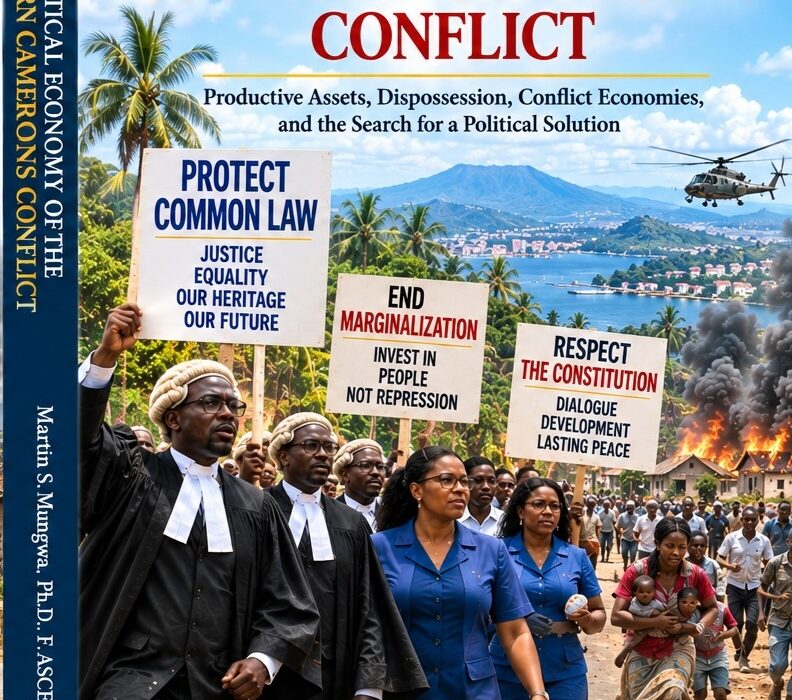
The Ambazonian conflict has evolved far beyond the framework through which many still attempt to interpret it. Until that reality is honestly confronted, the cycle of misunderstanding will continue — and with it, the instability consuming both Ambazonia and Cameroon itself. History has entered a new phase. And no amount of outdated terminology can reverse

Read More
Commentary

THE LACK OF FOUNDATION LEADS TO DRIFT: Why the Ambazonian Quest Must Be Rooted in Moral, Spiritual, and Strategic Consciousness

The survival of Ambazonia will therefore depend not only on resistance in the field, diplomacy abroad, or political negotiation. It will also depend on the preservation of clarity within the soul of the people. And perhaps this is now the deeper challenge before Ambazonia: not simply how to resist externally — but how to remain

Read More
Commentary

Reclaiming the Narrative: Why We Reject “Anglophone” Conferences and Stand with the Federal Republic of Ambazonia

A significant segment of the Ambazonian movement no longer views the conflict through the lens of minority rights within Cameroon. Instead, it views the crisis as a question of national self-determination and political separation. By Carl SandersGuest Writer, The Independentist News, Soho, London9 May 2026 At moments of political uncertainty, old political formulas often return

Read More
Editorial commentary

The Falling Baobabs: Nature’s Coup and the Succession Shadow-Play in Yaoundé

The giants are falling. The political forest in Yaoundé is changing The Falling Baobabs: Nature’s Coup and the Succession Shadow-Play in Yaoundé the eyes of the nation and the world. Figures once considered permanent are disappearing with startling speed, while new succession mechanisms rise in their place. By Kemita Ashu The Independentist News contributor Yaoundé

Read More
Editorial series

The Twilight of a Dynasty: Cameroon and the Structural End of the Biya Era

Whether the eventual transition unfolds through orderly succession, elite negotiation, military influence, or broader national instability remains unknown. What is increasingly clear, however, is that Cameroon is approaching the structural end of the Biya era. And an entire nation is now waiting to discover what comes next. By Timothy EnongeneGuest Editor-in-Chief, The Independentist News8 May

Read More
News commentary

The Succession Shadow-Play: Why Ambazonia Must Guard Against Yaoundé’s Coming “Peace” Offensive

Whether such fears ultimately prove justified remains uncertain. What is undeniable, however, is that succession in Cameroon is no longer viewed merely as an internal leadership matter. It is increasingly understood as a defining moment that could reshape the future of the conflict itself. By Carl SandersGuest Writer, The Independentist News8 May 2026 As May

Read More
Science & Development

FOUNDATIONS OF AMBAZONIAN RECONSTRUCTION — PART V: Faith, Culture, and Identity: The Soul of a Nation

A people grounded in faith, rooted in culture, and confident in their identity cannot be easily shaken. Ambazonia must protect its soul as carefully as it builds its systems. Because in the end, it is not systems alone that sustain a nation—it is the spirit of its people. By Dr. Martin Mungwa, PhD., F.ASCEGuest Contributor

Read More
Editorial series

SIGNALS OF STRAIN: What the Nsimalen Incident Reveals About Elite Coordination in Cameroon

The grounding of a Prime Minister at the point of departure is an unusual event in any political system. In a centralized and transition-sensitive environment, it becomes analytically significant. By Timothy EnongeneGuest Editor-in-Chief, The Independentist News Editor’s Note: Timothy Enongene serves as Guest Editor-in-Chief for this special analysis series, bringing independent, policy-focused perspective to critical

Read More
Editorial series

THE SUCCESSION ARCHITECTURE: How Controlled Disruption Masks Power Transition in Cameroon

The recent changes in Cameroon’s National Assembly are not best understood as the beginning of a reform cycle. They are part of a succession architecture designed to ensure continuity within an established system of power. In such systems, disruption is often controlled, reform is frequently symbolic, and transition is carefully engineered. By Timothy EnongeneGuest Editor-in-Chief,

Read More
Commentary

The Vatican’s Quiet Signal: Why Pope Leo XIV’s Visit May Mark a Turning Point for Cameroon A Subtle Diplomatic Shift That Could Reshape International Perceptions of Governance, Legitimacy, and the Conflict in Ambazonia

Whether intentionally or not, Pope Leo XIV may have accelerated that transition in global perception. The visible structures of power in Cameroon remain standing. But internationally, the moral and diplomatic terrain beneath those structures may now be shifting. By Ali Dan Ismael Editor-in-Chief The Independentist News At first glance, the visit of Pope Leo XIV

Read More