Communique

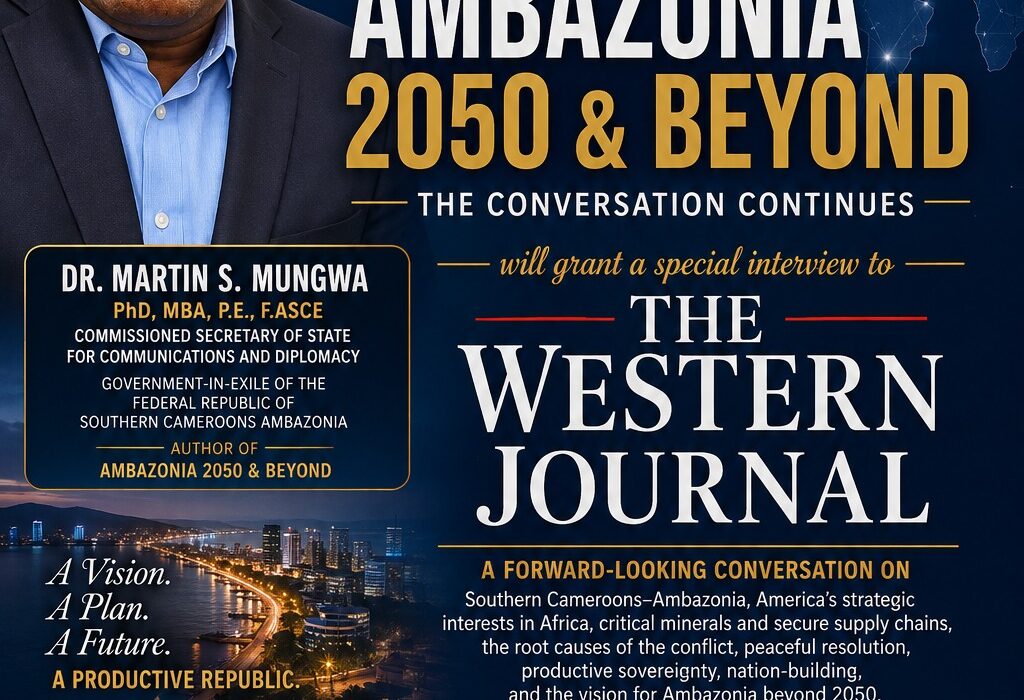
A must read for all Ambazonians with volume 1 scheduled for release in September 2026: AMBAZONIA 2050 & BEYOND (The Former British Southern Cameroons) From Survival to Significance A Blueprint for Nation-Building, Economic Transformation, and Shared Prosperity

A Four-Volume National-Development WorkApproximately 1,620 Pages by Martin S. Mungwa, PhD, MBA, P.E., F.ASCE VOLUME I — FOUNDATIONS OF THE INNOVATION REPUBLIC. History, Constitutional Government, Human Development, Economic Sovereignty, and National Renewal Chapters 1–10 | Approximately 470 Pages Scheduled Release: September 2026. Volume I establishes the historical, constitutional, intellectual, institutional, human, and productive foundations of

Read More
Letters to the Editor

A fervent and concerned reader of The Independentist News, writes to the editor raising concerns on the continuous resistance of the people of the Southern Cameroons.

Letter to the Editor Subject; Southern Cameroonians Continue to Resist Assimilation and Seek a Lasting Political Solution Dear Editor, More than six decades after the 1961 unification of the former British Southern Cameroons with La République du Cameroun, many Southern Cameroonians remain deeply concerned that the institutions, traditions, and political identity they inherited under British

Read More
Commentary

THE INTELLECTUALS WHO INHERITED THE COLONIAL STATE Part II: How Elite Brokerage Hollowed Out Africa’s Political Independence

Ambazonia. Political independence will be hollow if a new elite merely occupies institutions inherited from Britain and La République du Cameroun. A new Republic must not reproduce secrecy, centralization, personality worship, foreign dependency, political patronage, extractive taxation, or intellectual obedience. By M. C. CrytonGuest Writer, The Independentist News Part I of this series examined how

Read More
Commentary

THE CLASSROOMS OF DEPENDENCE Part I: How Colonial Education Preserved Africa’s Machinery of Extraction

The African intelligentsia then completed the system by treating credentials as evidence of progress. The professor counted graduates. The minister counted schools. The administrator counted certificates. The donor counted enrollment. Few asked whether education had reduced dependency. By M. C. CrytonGuest Writer, The Independentist News Africa did not lose the substance of its political independence

Read More
Commentary

50 Days of Shadows: The Cost of the Invisible Presidency in Yaoundé

The cost of an invisible presidency extends beyond political embarrassment. It weakens public trust. It undermines constitutional legitimacy. It encourages factional competition. It raises doubts about military command. It damages investor confidence. It intensifies succession fears. It exposes the fragility of state institutions. By Carl SandersGuest Writer, Independentist NewsSoho, LondonFifty Days Without Public Proof LONDON

Read More
Commentary

THE GHOST SIGNATURES OF ETOUDI: Absentee Leadership, Questions Over Presidential Authority, and the Conflict in Ambazonia

Governments are strongest when authority is transparent, constitutional processes are respected, and citizens are not left to speculate about who is making decisions in their name. Until greater clarity emerges, questions surrounding executive authority are likely to persist, not only within Cameroon but also among regional observers and the international community. By Carl SandersGuest Writer,

Read More
Church and society

WHEN RELIGION BETRAYS ETHICS Part II: The Cameroonian and Ambazonian Reckoning Political Accommodation, Religious Wealth, Traditional Spiritual Revival, and a New Ethical Economy of Trust

To connect with God is not merely to attend more services, donate more money, or repeat more religious language. It is to become more truthful, more courageous, more accountable, more compassionate, more productive, more committed to justice, and more determined to leave behind a functioning moral and economic inheritance for the generations yet unborn. That

Read More
Commentary

WHEN THE PEOPLE BECOME THE COUNTERINTELLIGENCE NETWORK Part IV: When the People Become the Intelligence Network From the Sahel and Senegal to the Takembeng Wall Around John Fru Ndi

The peoples of the Sahel understood part of it when they began questioning foreign arrangements that appeared incapable of delivering security or sovereignty. Their continuing responsibility is to scrutinize those who replaced the old order with equal determination. Ambazonia must gather these lessons into a disciplined system. The Home Front should observe without becoming a

Read More
Commentary

WHO IS “MONSIEUR AFRIQUE”? Arnaud Suquet and the Reinvention of French Power on a Changing Continent. A Portrait of France’s New Man for Africa

France now speaks of listening, humility, partnership and reciprocity. Its representatives engage youth groups, entrepreneurs, artists, academics and technology leaders. They increasingly operate beyond the traditional Francophone sphere. Some are learning African languages. These changes should not be dismissed. Diplomacy evolves, and meaningful cultural engagement can create genuine understanding. By Ali Dan Ismael, Editor-in-chief The

Read More
Commentary

THE PRODUCTIVE REPUBLIC SERIES Part III: Who Benefits from Bamenda’s Economy?The Main Market, Colonial Extraction, Public Assets, and the Struggle to Restore Economic Power to the People

Bamenda’s recovery cannot be measured only by reconstructed buildings, reopened roads, new power lines, rehabilitated markets, or recommissioned machinery. It must also recover public trust. It must recover local accountability. It must recover the principle that public borrowing creates public value. It must recover the dignity of work. It must recover confidence that rules will

Read More