

Empires rise. Empires decline. But history remembers. And history eventually asks every empire the same question: Was the wealth worth the cost? The answer may determine how future generations remember Britain—not as Britain remembers itself, but as the world remembers it.
By Ali Dan Ismael
Editor-in-Chief, The Independentist News
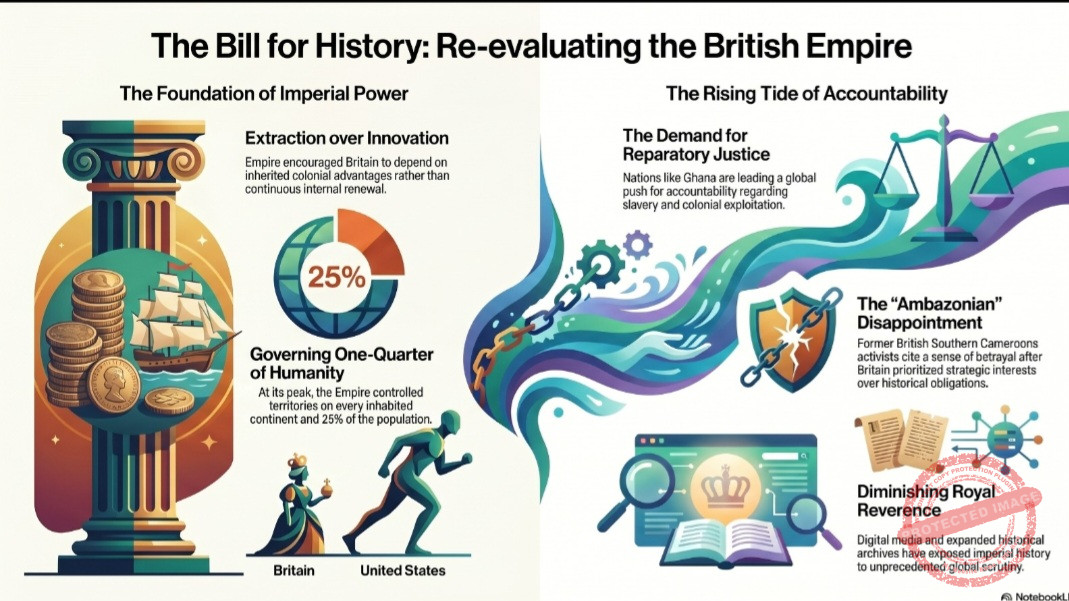
For centuries, Britain stood at the centre of the world. Its navy ruled the seas. Its merchants controlled global commerce. Its financiers shaped international markets. Its language became the language of diplomacy, trade, and power. At its height, the British Empire governed nearly one-quarter of humanity and controlled territories on every inhabited continent. For generations, Britain presented its empire as a force for civilisation, order, and progress.
Yet from India to Ghana, from South Africa to the Caribbean, and from the former British Southern Cameroons to countless other territories, many remember a different story. They remember slavery. They remember exploitation. They remember resource extraction. They remember broken promises. They remember arbitrary borders. And increasingly, they are asking whether the bill for empire has finally arrived.
The Empire That Built Britain
No serious historian can deny that empire contributed enormously to Britain’s rise. The wealth of London did not emerge in isolation. It was connected to colonies, trade routes, plantations, mines, ports, and markets that stretched across the globe. Resources moved outward. Wealth moved inward. The empire provided Britain with advantages few nations in history have ever possessed. Yet empires often develop dangerous habits. They learn to extract rather than innovate. They learn to manage rather than create. They learn to depend upon inherited advantages rather than continuous renewal. The consequences may not appear immediately. Sometimes they take generations to emerge.
Today Britain finds itself confronting rising debt, sluggish productivity, infrastructure challenges, political fragmentation, and growing uncertainty about its place in an increasingly multipolar world. The nation that once financed the world is searching for a new source of renewal.
The Empire’s Greatest Success—and Its Greatest Irony
Perhaps the greatest irony of British imperial history is not found in India, Africa, or the Caribbean. It is found in America. The United States began as a British colony. Its legal traditions, language, institutions, and commercial culture emerged largely from British foundations. In many respects, America became Britain’s most successful colonial creation. Yet history has a sense of irony. The colony became the superpower. The student surpassed the teacher. The empire that once dominated the Atlantic eventually found itself overshadowed by its own offspring.
Following the Second World War, Britain emerged victorious but financially exhausted. America emerged stronger than ever. The Bretton Woods system, the dominance of the dollar, and America’s expanding military reach transferred the centre of gravity of the Western world from London to Washington. The Crown no longer sat at the apex of global power. The White House did. The greatest success of British imperial expansion may have been creating the very power that replaced Britain itself. History rarely produces a more profound irony.
The Rise of the Former Colonies
One of history’s greatest reversals is unfolding before our eyes. Many of the territories once governed by Britain are becoming increasingly influential. India has emerged as a technological, industrial, and geopolitical giant. African nations are demanding greater control over their resources and political futures. The Caribbean is increasingly organised around questions of reparatory justice. The Global South is finding its voice. The former colonies are no longer waiting for permission to define their future. They are writing it themselves.
Ghana and the Reparations Debate
Few countries better illustrate this transformation than Ghana. For decades, discussions about slavery and reparations remained largely academic. Today they have entered mainstream international politics. Ghana has emerged as one of the leading voices calling for a serious examination of slavery, colonialism, and historical accountability. Its challenge is simple.
If wealth was accumulated through exploitation, can history simply move on without accountability? If entire peoples suffered dispossession and extraction, can time alone erase responsibility? These questions are resonating across the Caribbean, Africa, and beyond. Ghana may be only the tip of the iceberg. Behind it stand generations of people asking difficult questions about empire.
The Voices That Were Nearly Silenced
Perhaps the greatest tragedy of colonial expansion occurred in the Americas and the Caribbean. Entire Indigenous civilizations experienced catastrophic losses through disease, warfare, displacement, and colonial domination. Many Indigenous peoples survived and continue their struggle for recognition and justice.
Yet countless communities, languages, traditions, and cultures disappeared forever. The dead cannot testify.The vanished cannot seek reparations. The destroyed cannot tell their story. History often remembers the powerful because so many of the powerless were erased. That reality imposes a special responsibility upon those who survived slavery, colonialism, and imperial rule. They remain among the living witnesses of an age whose consequences still shape the modern world.
The Monarchy Under Scrutiny
Another sign of changing times is the evolving perception of the British monarchy. During the reign of Queen Elizabeth II, the Crown commanded extraordinary respect across much of the world. For many, the Queen represented continuity, stability, and duty. That era is fading. Historical archives are being opened. Academic research is expanding. Digital media has exposed imperial history to unprecedented scrutiny. Questions are increasingly being asked about empire, privilege, inherited wealth, and accountability. Whether justified or not, the automatic reverence once afforded to the monarchy has diminished in many parts of the world. The issue is larger than the Royal Family. The issue is the legacy of empire itself.
The British Silence and the Ambazonian Memory
For many Ambazonians, the most painful aspect of Britain’s legacy is not what happened during colonial rule. It is what happened afterwards. When the crisis in the former British Southern Cameroons intensified during the early years of the Ambazonian uprising, many activists, lawyers, clergy, and community leaders instinctively looked toward Britain. Southern Cameroons had been administered by Britain. Its common law system, parliamentary traditions, educational institutions, and political culture bore the unmistakable imprint of British administration.
Many believed Britain would help address what they viewed as an unresolved decolonisation question. Letters were written. Petitions were submitted. Appeals were made. Yet many Ambazonians came away disappointed. Instead of the leadership they expected from the former administering authority, they perceived distance and reluctance. Whether one agrees with this interpretation or not, it has become deeply embedded within Ambazonian political consciousness.
From the Spitfire to Southern Cameroons
Among many Ambazonians, few memories generate more bitterness than the contrast between wartime loyalty and post-war political reality. Southern Cameroons contributed resources, labour, and revenue to Britain’s wartime effort during the Second World War. Like millions across the Empire, they participated in a struggle they believed was defending freedom and civilisation. Many Ambazonians therefore ask: What became of that loyalty? The generation that supported Britain’s war effort believed they were subjects of the Crown.
Yet many feel that when history reached its decisive moment, strategic interests prevailed over historical obligations. This perception recalls the famous words of Lord Palmerston: “Nations have no permanent friends, only permanent interests.” To many Ambazonians, those words explain the entire relationship. Britain pursued British interests. France pursued French interests. La République du Cameroun pursued its interests. The people of Southern Cameroons were left to live with the consequences.
Yet history has a habit of turning the logic of power back upon those who once exercised it. India has interests. Ghana has interests. South Africa has interests. The Caribbean has interests. Southern Cameroons (Ambazonia) has interests. And increasingly, the world Britain once organised around imperial priorities is organising itself around its own.
The Commonwealth Question
Britain frequently presents itself as a champion of democracy, human rights, and the rule of law. These are noble principles. Yet critics increasingly ask whether those principles are applied consistently. Why is self-determination defended vigorously in some circumstances and ignored in others? Why are some historical injustices acknowledged while others remain politically inconvenient? These questions continue to echo across the former Empire.
Is the Tide Reversing?
This is not a story about Britain’s collapse. Britain remains an important global power. Its universities are world-class. Its institutions remain influential. Its culture continues to shape global society. This is a story about accountability. For centuries Britain shaped the destinies of others. Today many of those same peoples are helping shape the judgment of history. The descendants of the colonised are speaking. The former colonies are rising. The voices once ignored are becoming impossible to ignore.
Empires rise. Empires decline. But history remembers. And history eventually asks every empire the same question: Was the wealth worth the cost? The answer may determine how future generations remember Britain—not as Britain remembers itself, but as the world remembers it.
Ali Dan Ismael
Editor-in-Chief, The Independentist News