










Commentary

We are home to news on Cameroon and the CEMAC region. We are dedicated to honest and reliable reporting. We are the voice of the Cameroonian people and their fight for freedom and democracy at a time when the Yaoundé government is silencing dissent and suppressing democratic voices.

For Ambazonia, however, the lesson is larger than the success or failure of one American president. Trump believes a country is not powerful merely because its currency dominates markets or its corporations earn enormous profits. It must possess the capacity to produce, build, feed, power and defend itself.
By The Independentist News editorial desk
Donald Trump’s economic programme is commonly described as protectionism, economic nationalism or “America First.” These labels capture part of the story, but they do not fully explain the scale of the transformation he is attempting.
Trump is seeking to overturn the economic bargain that shaped the United States for much of the period after the Second World War. Under that bargain, America opened its enormous consumer market, protected international trade routes and supported a global financial system in which the dollar became the dominant reserve currency.
In exchange, the United States gained geopolitical influence, access to inexpensive imports and command over much of the world’s financial infrastructure. American consumers benefited from lower prices, while Wall Street and multinational corporations expanded their global reach.
But many American industrial communities paid heavily. Factories closed, supply chains moved abroad and entire regions became dependent on imported manufactured goods. The gains from globalisation were real, but they were distributed unevenly. Trump’s answer is not merely to adjust this system. It is to change its governing principle.
In his vision, the American market is no longer a global public good. Access to it is a privilege for which other countries must pay—through tariffs, investment commitments, purchases of American products or the relocation of production to the United States. This is where the provocative idea of a “war against the British Empire” enters the argument.
Trump is not waging war against Britain as a country, nor is he attempting to destroy the United Kingdom. Britain remains one of Washington’s closest military and intelligence partners. The “British Empire” in this context is better understood as a metaphor for an older commercial order: one that places finance above production, celebrates unrestricted trade and allows capital to move across borders in search of the cheapest labour and highest return.
Trump’s revolution is a revolt against that order. But calling it British obscures an important historical fact: the modern system Trump is challenging was not imposed on America by London. Washington helped create, expand and police it.
From the British System to the American System
At the height of its power, the British Empire combined naval supremacy, commercial networks, control of strategic ports and the international influence of the City of London. Britain promoted free trade where it served imperial power and imposed restrictions where they protected British interests.
The empire was never a free-trade charity. Commerce, finance and military power worked together. After the Second World War, the United States inherited much of Britain’s international position. The dollar replaced sterling as the principal global reserve currency. The International Monetary Fund and World Bank emerged from the US-led Bretton Woods settlement.
American naval power protected major trade routes. American markets absorbed foreign exports. American financial institutions expanded across the world. This was not simply a continuation of British rule. It was a new, US-led international order carrying some of the commercial habits associated with the earlier British system.
American corporations learned that they could design products in the United States, manufacture them elsewhere and sell them around the world. Investors benefited from access to international labour and markets. Consumers received cheaper goods. Yet the system created a contradiction: what was profitable for an American multinational corporation was not always beneficial to an American industrial community.
A company could strengthen its balance sheet by moving production abroad while weakening the town from which it departed. National statistics could show growth even as particular regions experienced unemployment, declining tax bases and social disintegration. Trump built his political movement around this contradiction.
The American Market as a Weapon
Trump’s tariff strategy rests on a simple observation: the United States possesses the world’s most valuable national consumer market. Governments and companies want access to American buyers. Previous administrations generally treated tariffs as limited remedies for specific trade violations or strategically sensitive industries. Trump treats them as a central instrument of national power.
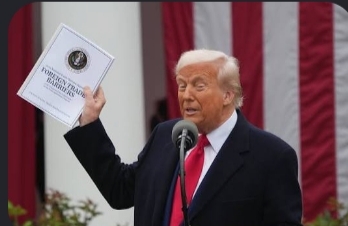
His administration’s America First Trade Policy calls for examining trade deficits, currency practices, industrial dependence and the effects of imports on national security. Its 2026 trade agenda argues that the American market has been more open than those of many trading partners and demands greater reciprocity. America First Trade Policy, 2026 US trade agenda
Under this approach, a tariff performs several functions at once. It protects selected domestic industries, raises revenue, pressures foreign governments and encourages companies to manufacture inside the United States. It also communicates that access to American consumers will no longer be granted without conditions. The administration has used tariffs and negotiations to pursue reciprocal trade arrangements with numerous countries. It has also expanded protection for industries it considers strategically important, including steel, aluminium and copper.
US presidential tariff actions, White House metals policy
Trump’s aim is to alter corporate calculations. If producing abroad and importing into America becomes more expensive, companies may conclude that building factories inside the United States is safer and more profitable. This is not classical free-market economics. It is state-directed economic nationalism carried out through tariffs, tax policy, deregulation, energy production and political pressure.
Production Before Financial Orthodoxy
The deepest conflict is not between Trump and Britain. It is between two ideas of economic power. The first measures national strength through financial markets, corporate profits, inexpensive imports and the freedom of capital to move internationally. The second measures strength through physical production: steel mills, energy systems, shipyards, farms, factories, transport networks and technological capacity. Trump favours the second.
In his worldview, a country that cannot manufacture essential goods is not truly secure, regardless of the size of its financial sector. Dependence on foreign steel, medicines, semiconductors, machinery or energy infrastructure becomes a national vulnerability.
The COVID-19 pandemic, competition with China and disruptions to global supply chains strengthened this argument. Economic efficiency could no longer be measured only by obtaining the lowest price. Governments also had to consider whether essential goods would remain available during war, disease or international confrontation. Trump’s strategy therefore connects economics to national security. Tariffs on strategic materials are defended not simply as commercial barriers but as measures intended to preserve industrial capacity.
This challenges decades of economic orthodoxy. For years, political and financial elites argued that countries should specialise in what they produced most efficiently and purchase other goods through global markets. Trump’s response is that a nation may need to produce certain goods even when importing them appears cheaper.
Is the Strategy Working?
The answer depends on what evidence is considered and the timescale used. The Trump administration says its policies have reduced goods-trade deficits, generated tariff revenue, encouraged investment and strengthened manufacturing. These are official claims and should be tested against independent, longer-term evidence. White House assessment
Official figures show that real US gross domestic product expanded at an annualised rate of 2.1 percent during the first quarter of 2026, following growth of 0.5 percent in the previous quarter. Private goods-producing industries grew more strongly than private services during that period. US Bureau of Economic Analysis, GDP by industry
Those numbers do not prove that tariffs caused the expansion. Investment, consumer demand, government activity, exports and monetary conditions all influence economic growth. Nor can an industrial transformation be measured over a few months. New factories require land, permits, machinery, trained workers, energy and transport infrastructure. Supply chains may take years to relocate. Trump’s approach also carries substantial risks.
Tariffs are collected from importers, and part of the cost may be passed to American businesses and consumers. Companies dependent on imported components can face higher production expenses. Trading partners may retaliate against American exports. Unpredictable changes can discourage investment by making future costs difficult to calculate. The central test is not whether tariffs cause any pain. They almost certainly do. The question is whether the industrial capacity they create will eventually outweigh their costs.
Britain Is Not the Principal Enemy
Describing Trump’s programme as a war against the British Empire may be intellectually provocative, but it becomes misleading when taken literally. The United Kingdom is neither the main source of America’s trade deficit nor the primary target of US industrial strategy. Britain’s modern economy is heavily based on services, including banking, insurance, technology and professional services. Goods tariffs consequently affect it differently from manufacturing-heavy exporters.
London and Washington also retain close military, intelligence and diplomatic ties. The real target is not Britain but a global economic doctrine shared by institutions and elites across many countries—including within the United States. Wall Street benefited from globalisation. American corporations relocated production. US administrations negotiated the agreements and maintained the security architecture that enabled international commerce.
Trump is therefore fighting an American establishment as much as any foreign power. He challenges the belief that the interests of multinational corporations automatically equal those of the American nation. He rejects the assumption that inexpensive imports must take priority over domestic production. He disputes the claim that trade deficits are harmless as long as foreign capital continues flowing into American assets. This is a rebellion within the American system—not a conventional war against Britain.
What This Means for Africa
African countries should study this transformation carefully. For decades, African governments were encouraged to open their markets, remove industrial protections and compete globally while continuing to export raw materials. Many imported finished goods that could potentially have been produced domestically. The result has often been economic dependence: exporting cocoa while importing chocolate, exporting crude oil while importing refined fuel, or exporting minerals while purchasing the finished technologies manufactured from them.
Trump’s doctrine sends a blunt message: powerful countries do not always practise the economic policies they recommend to weaker states. When the United States considers steel, energy, technology or manufacturing vital to national security, it protects those sectors. African governments should ask why their own strategic industries should be treated differently.
That does not mean copying every Trump tariff. Poorly designed protection can shelter inefficient monopolies, encourage corruption and raise prices. Industrial policy requires electricity, infrastructure, skills, financing and measurable performance standards. But Africa should reject the claim that remaining a permanent supplier of unprocessed materials represents economic success. The lesson is not that every import is an enemy. It is that political independence without productive capacity remains incomplete.
Where Ambazonia’s Strategic Interest Lies
Ambazonia’s strategic interest does not lie in automatically supporting Trump, opposing Britain or attaching its cause to any foreign political personality. States rarely recognise independence movements because of moral arguments alone. They act when justice, security and material interests begin to converge.
Ambazonian diplomacy must therefore understand what the United States wants—and demonstrate how a just and peaceful settlement could advance those interests. Trump’s economic doctrine emphasises secure supply chains, reliable access to strategic resources, competition with China, protection of American investment, reduced instability and agreements that produce measurable benefits for the United States. Ambazonia’s opportunity lies at the intersection of those priorities.
From Sympathy to Strategic Relevance
For years, Ambazonian advocacy has concentrated on history, international law, human-rights violations and the failures surrounding the 1961 political settlement. These remain essential foundations of the case. But historical and moral arguments alone rarely change the policies of major powers.
Washington will ask practical questions: Would engagement contribute to ending a destabilising conflict? Would it protect civilians and reduce displacement? Would it improve maritime security in the Gulf of Guinea? Would it produce a dependable economic partner? Would American companies receive transparent investment opportunities? Would the territory become more stable or more fragmented? Can Ambazonian leaders demonstrate political and institutional discipline? Can they prevent armed factions from threatening civilians and foreign interests? Ambazonia must be prepared to answer those questions. The objective should be to transform the cause from a distant humanitarian issue into a credible proposition for peace, security and mutually beneficial economic cooperation.
A Peace-and-Prosperity Offer
Trump’s foreign policy is strongly transactional. That does not require Ambazonia to abandon its legal and moral case. It means presenting that case alongside a practical offer. A serious Ambazonian approach to Washington could rest on four commitments. First, Ambazonia should offer itself as a peaceful, commercially open and strategically dependable partner on the Gulf of Guinea. Second, it should commit to transparent resource management, competitive contracts and legal protection for legitimate foreign and domestic investment. Third, it should present a credible programme for demobilisation, civilian protection, constitutional government and the rule of law. Fourth, it should demonstrate that a negotiated settlement would be less expensive, less dangerous and more sustainable than an indefinite war.
This would speak the language of Trump’s economic diplomacy: peace connected to trade, security and investment. The approach must not become an offer to exchange natural resources for political recognition. Ambazonia’s land, minerals and coastal assets belong to its people. They cannot legitimately be promised in secret by political organisations lacking a democratic mandate. The proper offer is a future system based on transparent contracts, public accountability, domestic value addition and mutually beneficial partnerships.
The Gulf of Guinea Advantage
Ambazonia’s geography is one of its strongest strategic assets. Its Atlantic coastline places it within the Gulf of Guinea, a region important to maritime commerce, fisheries, energy transportation and international security. Instability along this coastline affects shipping, insurance costs, organised crime and regional military planning.
A credible Ambazonian strategy should explain how a political settlement could contribute to: Maritime security and freedom of navigation
Protection of commercial infrastructure
Action against piracy, trafficking and illegal fishing Regional cooperation with Nigeria and neighbouring states. Reliable access to ports and transport corridors. Responsible energy and infrastructure investment. Environmental protection for coastal communities.
Geography alone creates no automatic entitlement to American support. Its strategic value depends upon whether Ambazonian institutions can present themselves as disciplined, democratic and capable of honouring international agreements.
Minerals Must Not Become Another Colonial Trap
The Trump administration has placed growing emphasis on securing critical-mineral supply chains. The United States describes its international minerals policy as an effort to expand financing, build dependable markets and reduce strategic supply vulnerabilities. US Critical Minerals Ministerial This creates an opportunity for resource-producing African territories. It also presents a danger.
Ambazonia must not escape political domination only to surrender its economic future through secret mining and infrastructure agreements. Any future resource partnership should require: Publication of contracts, Competitive licensing,
Parliamentary oversight, Environmental and community-impact assessments, Local employment and technical training, Domestic processing and value addition, Fair taxation and royalty arrangements, Protection of customary land rights, Independent auditing of public revenue
The strategic objective should not be merely to export more raw materials. Natural-resource revenue should finance electricity, roads, schools, hospitals, industry and technological capacity. That is the most important economic lesson Ambazonia can take from Trump’s programme: sovereignty without productive power remains fragile.
Cameroon’s Vulnerability Creates an Opening
Cameroon is not listed among the countries eligible for benefits under the African Growth and Opportunity Act. AGOA eligibility is connected to economic governance, corruption, worker protections and internationally recognised human rights. USTR eligibility list, AGOA criteria
This gives Ambazonian diplomacy an important argument: political repression and prolonged conflict carry economic consequences. Ambazonia should not simply campaign for Cameroon to be punished. Its stronger position would be to propose measurable conditions for progress: An internationally supported ceasefire
Unrestricted humanitarian access Release or lawful review of conflict-related detainees , Independent investigation of alleged atrocities by all parties, Protection of civilians, schools and medical facilities, Direct negotiations addressing the conflict’s political roots, International monitoring of any agreement
Economic access, security cooperation and diplomatic engagement with Cameroon could then be tied to verifiable progress. This would transform Ambazonian advocacy from a general appeal into a practical policy programme.
Avoiding the China-or-America Trap
Ambazonia should not define itself exclusively as an American, British, European, Chinese or Russian project. Dependence upon a single external patron would reproduce the vulnerability Ambazonians are attempting to escape. Foreign policy should remain open to multiple partnerships while protecting democratic control over strategic assets.
The United States could be an important diplomatic and economic partner. So could Britain, Nigeria, Canada, the European Union, Commonwealth countries and responsible African institutions. Ambazonia’s quarrel is not with the British people. Britain carries a particular historical responsibility because of its administration of the former British Southern Cameroons and its role in the decolonisation process. That history should be addressed through diplomacy, legal argument and archival evidence—not indiscriminate hostility.
London should be pressed to confront the consequences of its colonial decisions and support a credible political process. But Ambazonia would gain little from declaring Britain an enemy while seeking international legitimacy.
The Credibility Test Begins at Home
No foreign economic strategy can rescue a movement that cannot govern itself. If Ambazonia wants Washington and other capitals to treat it as a potential partner, its political leadership must demonstrate the standards it demands from Cameroon.
That means: Ending attacks against civilians
Rejecting kidnapping, extortion and collective punishment, Protecting education, Establishing accountable financial systems, Developing a unified and realistic negotiating position, Separating civilian politics from uncontrolled armed activity, Investigating credible allegations against pro-independence actors, Building institutions that transcend personalities and factions
Human Rights Watch and the United Nations have reported violations attributed both to state forces and separatist armed groups. Ambazonian leaders cannot build international legitimacy by condemning abuses committed by one side while excusing those perpetrated in the name of independence. Human Rights Watch, UN human-rights assessment. Self-determination must be presented not simply as separation from Cameroon but as a credible plan for better government.
The Trump Gamble—and the Ambazonian Choice
Trump’s economic vision is an enormous gamble. If it succeeds, the United States may rebuild parts of its industrial base, reduce dangerous dependencies and establish a more reciprocal trading system. If it fails, Americans could face higher prices, disrupted supply chains, retaliation and reduced confidence in US economic leadership.
For Ambazonia, however, the lesson is larger than the success or failure of one American president. Trump believes a country is not powerful merely because its currency dominates markets or its corporations earn enormous profits. It must possess the capacity to produce, build, feed, power and defend itself.
Ambazonia must apply that lesson carefully. Its strategic interest lies in presenting itself as: A credible partner for peace in the Gulf of Guinea, A future constitutional democracy governed by law, A responsible location for international investment, A territory committed to transparent resource management, A partner in maritime and regional security, A government capable of protecting civilians and commerce, A bridge between West and Central Africa
The immediate objective should not be to expect Washington to recognise Ambazonia overnight. No available evidence indicates that the United States has adopted such a policy. The realistic first steps are sustained diplomatic attention, international mediation, civilian protection and formal acceptance that the conflict requires a political—not exclusively military—solution.
Ambazonia must demonstrate that continued war benefits no one: not its people, not Cameroon, not neighbouring Nigeria and not international partners seeking stability in the Gulf of Guinea. Trump’s economic revolution forces every government and political movement to answer a blunt question: What strategic value do you offer the United States?
Ambazonia’s answer should be equally clear: A peaceful and democratic partner on the Gulf of Guinea, governed by law, open to responsible investment and capable of turning regional instability into shared prosperity. That is where Ambazonia’s strategic interest lies.
The Independentist News Editorial desk
Share This Post:
UN Security Council, the Chokepoint of Global Extraction After 1945: How Five Permanent Powers Control International Enforcement in a United Nations of 193 Member States
French When They Win, African When They Lose: What France’s World Cup Defeat Reveals About Race, Citizenship, Leadership, and the Fragility of National Belonging
Related Post
The Government of the Federal Republic of Ambazonia (in
À PARAÎTRE EN DÉCEMBRE 2026: UN AUDIT DE L’ÉCONOMIE
WHO BORROWS? WHO OWNS? WHO EXITS? Cameroon’s FCFA 250
COMING DECEMBER 2026: AN AUDIT OF PAUL BIYA’S ECONOMY
ADF KIDNAPPING AND ATTACK IN WOWO VILLAGE, Thirteen Residents
DONGA MANTUNG POPULATION RAISE ALARM ON ALLEGED KIDNAPPING, ASSAULT,