










Commentary

We are home to news on Cameroon and the CEMAC region. We are dedicated to honest and reliable reporting. We are the voice of the Cameroonian people and their fight for freedom and democracy at a time when the Yaoundé government is silencing dissent and suppressing democratic voices.

The essential question is not simply: Who are Cameroon’s generals? It is this: Who commanded which forces, during what period, under whose authority—and what did that command do when civilians were placed at risk?
By Ali Dan Ismael, Editor-in-chief The Independentist News
A circulating list of senior officers in the Cameroon Armed Forces appears, at first glance, to be little more than a collection of names, ranks and reported ages. For Ambazonians, however, the important question is not how many generals Cameroon has—or how old they may be. It is who exercises effective authority over the forces operating in the North-West and South-West, how military orders move through the system, and where responsibility lies when civilians are harmed.
Properly verified and analysed, Cameroon’s senior command structure can reveal much about the state’s approach to the Ambazonia conflict. It can expose institutional stagnation, clarify operational reporting lines and strengthen demands for lawful accountability. Used carelessly, however, an inaccurate list can spread misinformation and weaken the credibility of the Ambazonian case. The distinction is crucial.
An Army Shaped by Political Longevity.
Cameroon’s military leadership reflects the wider political system built under President Paul Biya: highly centralised, personally controlled and resistant to rapid succession. At the top of the formal military structure is the Chief of Defence Staff, known in French as the Chef d’État-Major des Armées. Cameroon’s Ministry of Defence identifies General René-Claude Meka in that position. The ministry describes the Chief of Defence Staff as the strategic-level officer responsible for coordinating the army, air force and navy and advising the minister responsible for defence.
Cameroon Defence Headquarters
Meka’s unusually long tenure has made him a symbol of continuity within Cameroon’s armed forces. But continuity and institutional strength are not necessarily the same thing. When senior offices remain occupied by the same individuals for decades, promotion pathways narrow and authority becomes increasingly personalised. Officers may come to depend more heavily on presidential confidence and patronage than on transparent institutional procedures.
Such a system can maintain loyalty at the top while concealing uncertainty beneath it. It may also discourage independent judgment among younger officers who understand that advancement depends upon political trust.
For Ambazonians, this matters because the conflict is not managed by an autonomous and politically neutral military institution. Strategic authority ultimately flows through a system centred on the presidency. The longevity of senior commanders therefore says as much about regime security as it does about national defence.
Not Every General Matters
Not every general on a circulating list is equally relevant to the conflict in Ambazonia. Some senior officers occupy administrative, educational, inspection or ceremonial positions. Others exercise operational authority over territorial commands and deployed military formations. Any serious Ambazonia-focused assessment must distinguish between these categories.
The most relevant positions include: The Chief of Defence Staff and officers at Defence Headquarters The Chief of Staff of the Army
Commanders of joint military regions affecting the North-West and South-West
Commanders of motorised infantry brigades deployed in or supporting those regions
The leadership of the Rapid Intervention Battalion, commonly known as the BIR
Regional gendarmerie commanders
Officers directing intelligence, logistics and operational planning
The Ministry of Defence explains that army formations are distributed across five joint military regions. These formations operate under a dual structure: organisational authority is exercised by the Army Chief of Staff, while operational authority rests with the commanders of the joint military regions. Cameroon Army structure That distinction is central to understanding responsibility.
A commander responsible for recruitment, equipment and training possesses a different form of authority from the commander directing an operation in the field. Both may be relevant, but their responsibilities are not interchangeable. A publication that simply lists every general without explaining these relationships creates the appearance of intelligence without delivering genuine understanding.
The BIR and Parallel Military Authority
The Rapid Intervention Battalion occupies a particularly important place in Cameroon’s security system. The BIR has been deployed against Boko Haram in the Far North and has also operated in the English-speaking regions. Its access to resources, specialised training and political protection has made its command structure especially important to researchers examining the Ambazonia conflict.
Brigadier General François Pelene appears in the circulating list as the BIR commander. Official records confirm that Pelene was promoted to brigadier general in July 2025. The Ministry of Defence subsequently published a biography marking that promotion. These sources establish his rank, but a separate and current official source is still required before every operational title attributed to him can be presented as confirmed fact. (Presidential promotion decree, MINDEF biography)
This illustrates a wider weakness in the original list: a correct name and rank do not automatically prove a current appointment. Promotions, transfers, acting appointments and permanent commands must be distinguished from one another. Each significant claim should be supported by a presidential decree, Ministry of Defence publication or another credible and dated source.
A List Overtaken by Events
The document cannot accurately be described as a list of serving generals because it contains officers identified as deceased. Major General Philippe Mpay reportedly died on 9 May 2026. Brigadier General Simon Ezo’o Mvondo, commander of the First Joint Military Region, reportedly died on 14 July 2026. Neither should remain among current serving commanders. They belong in a separate section recording recent deaths, vacancies and possible succession arrangements. Report on Philippe Mpay, report on Simon Ezo’o Mvondo Their inclusion exposes the danger of reproducing a social-media list without conducting a fresh verification.
Military appointments can change quickly after a death, transfer, promotion or presidential decree. A reliable command map must therefore carry a publication date and a “last verified” date for every entry. The reported ages present another problem. Unless an officer’s date of birth can be traced to an official biography, credible profile or comparable record, the age should be omitted or clearly described as reported rather than confirmed. Publishing precise but unsupported ages gives readers a false impression of certainty. One demonstrably incorrect age can cast doubt over an otherwise useful investigation.
Representation Is Not the Same as Power
Several officers on the list have names associated with Cameroon’s English-speaking regions. Their presence might be presented as evidence that Anglophones are represented within the military hierarchy. That conclusion would be premature. Representation must be measured through actual authority, not names alone. The proper questions include:
What position does the officer occupy?
Does that position carry operational authority?
What forces fall under that officer’s command?
Does the officer participate in strategic decisions? Can the officer issue or countermand operational orders? Does the office provide direct access to the presidency or defence leadership?
How long has the officer occupied the position?
An Anglophone officer may hold general rank while remaining outside the smaller circle controlling strategy, intelligence, elite units, military budgets and senior appointments. At the same time, an officer’s name, birthplace or linguistic background should not be used to presume support for or opposition to the Ambazonian cause. Ambazonian analysis will be strongest when it examines institutions and documented authority instead of making ethnic or linguistic assumptions about individuals.
Why Command Responsibility Matters
The conflict in the North-West and South-West began with peaceful protests in 2016 over the treatment of the Anglophone legal and educational systems. State repression, armed separatist mobilisation and successive cycles of violence transformed the dispute into a prolonged armed conflict.
The United Nations Human Rights Office describes the crisis as continuing violence between state defence and security forces and non-state armed groups. Human Rights Watch has documented allegations against government forces, including killings of civilians, destruction of property, sexual violence and torture. It has also reported abuses by separatist groups, including attacks on civilians, teachers and students. UN Human Rights Office assessment, Human Rights Watch
Acknowledging violations attributed to different actors does not erase the state’s special obligations. A government possesses formal armed forces, detention facilities, investigative institutions and international legal responsibilities. Its commanders are expected to prevent unlawful conduct, investigate credible allegations and discipline personnel where the evidence warrants it.
Nevertheless, command responsibility cannot lawfully be established through rank alone. The fact that an officer commanded a region or unit does not automatically prove personal responsibility for every alleged violation committed within that territory. A credible accountability assessment requires evidence concerning:
The officer’s command period. The forces under the officer’s effective control.The location and timing of the alleged incident. Whether the commander knew or should have known about the conduct. Whether reasonable steps were taken to prevent the conduct. Whether the allegations were investigated and offenders punished. Applying this standard protects the integrity of the Ambazonian case. It replaces sweeping accusations with evidence capable of surviving scrutiny by diplomats, investigators, courts and international human-rights organisations.
How Ambazonia Can Use the Information
A verified map of Cameroon’s military leadership could serve several legitimate and strategically valuable purposes. First, it could strengthen diplomatic advocacy. International officials are more likely to engage seriously with a briefing that identifies the formal chain of command, cites appointment decrees and distinguishes confirmed facts from allegations.
Second, it could support human-rights documentation. Investigators examining an incident need to know which units were present, who commanded them, what territorial structure applied and where operational reports would ordinarily have travelled.
Third, it could reveal succession pressures within the state. The death, retirement or replacement of a senior commander can change operational relationships, patronage networks and the balance between conventional forces and elite formations.
Fourth, it could test official claims of Anglophone inclusion. Instead of counting English-speaking names, researchers could compare the authority, commands, resources and strategic access held by officers from different backgrounds.
Fifth, it could assist lawful international accountability work. A documented chain of command may help investigators identify potential witnesses, relevant institutions and the records that should be preserved.
Finally, it could improve Ambazonian public communication. A carefully sourced institutional analysis is more persuasive than a sensational list of elderly officers. The purpose should be to explain how Cameroon’s military system works—not merely to ridicule the age of those operating it.
What a Credible Command Dossier Requires Every officer’s entry should contain: Full name and officially recorded spelling. Rank in French and an accurate English equivalent
Current appointment. Date and legal instrument of appointment. Territorial or functional jurisdiction. Units falling within that jurisdiction
Relevance to operations in the North-West or South-West. Date on which the information was last verified. Links to official and independent sources. A clear distinction between established facts and reported allegations
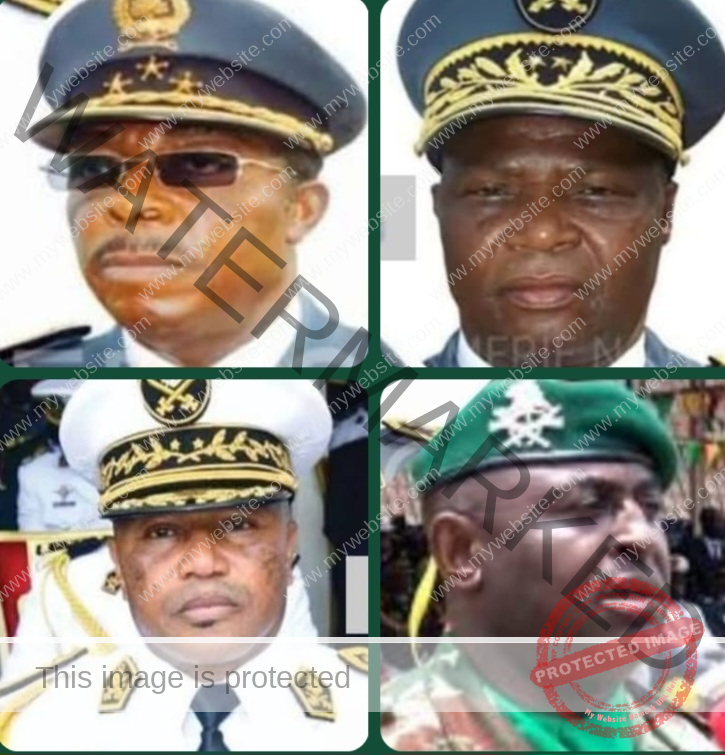
Recently deceased, retired or replaced officers should be recorded separately. Photographs should also be individually identified and sourced. An uncaptioned collage cannot prove the identity, rank or current appointment of every person shown. The completed dossier should include a clear disclaimer:
Inclusion in this document indicates a reported or verified institutional position. It does not, without further evidence, establish individual responsibility for any alleged crime or human-rights violation.
The dossier must never be used to encourage violence, identify private locations or facilitate attacks against individuals. Its legitimate purposes are institutional analysis, public-interest reporting, diplomacy and lawful accountability.
From a Roll Call to a Strategy
Cameroon’s senior military leadership is relevant to Ambazonia, but not because a long list of generals will itself change the conflict. Its value lies in what the command structure reveals: the centralisation of authority, the longevity of senior officials, the relationship between territorial commands and elite forces, and the institutions through which military decisions are transmitted.
For Ambazonians seeking recognition, accountability and a durable political settlement, accuracy is not a minor editorial concern. It is a strategic asset. An unsourced roll call can be dismissed as propaganda. A dated and documented command map can become an advocacy instrument, an accountability resource and a serious contribution to understanding how Cameroon prosecutes the conflict. The essential question is therefore not simply: Who are Cameroon’s generals? It is this: Who commanded which forces, during what period, under whose authority—and what did that command do when civilians were placed at risk?
Until those questions are answered with reliable evidence, the circulating list remains a useful investigative lead. It is not yet a finished Ambazonian intelligence or accountability document.
Ali Dan Ismael, Editor-in-chief The Independentist News
Share This Post:
Brenda Biya’s Explosive Claims: What the First Daughter Revealed—and What Remains Unproven
The Bedrock of Africa’s Divisions: How colonial borders, imported institutions and post-independence failures continue to separate the continent
Related Post
The Government of the Federal Republic of Ambazonia (in
À PARAÎTRE EN DÉCEMBRE 2026: UN AUDIT DE L’ÉCONOMIE
WHO BORROWS? WHO OWNS? WHO EXITS? Cameroon’s FCFA 250
COMING DECEMBER 2026: AN AUDIT OF PAUL BIYA’S ECONOMY
ADF KIDNAPPING AND ATTACK IN WOWO VILLAGE, Thirteen Residents
DONGA MANTUNG POPULATION RAISE ALARM ON ALLEGED KIDNAPPING, ASSAULT,