










Commentary

We are home to news on Cameroon and the CEMAC region. We are dedicated to honest and reliable reporting. We are the voice of the Cameroonian people and their fight for freedom and democracy at a time when the Yaoundé government is silencing dissent and suppressing democratic voices.

Africa is learning that sovereignty is not simply declared. It is negotiated, legislated, industrialized, and defended through economic policy. Cameroon’s concessions are therefore not destiny. They are a choice. The country can continue along the familiar path of extraction without transformation, or it can join the growing continental movement toward value addition, industrial development, and economic self-determination.
By M.C. Folo The Independentist News Contributdor
In the quiet green forests of Cameroon and across the red earth of its mineral-rich regions, a new cartography of power is being drawn. It is not being shaped by farmers cultivating ancestral lands or by local entrepreneurs building national industries. Instead, it is increasingly being defined by foreign corporations whose influence extends across vast agricultural concessions, mining licenses, forestry permits, and strategic natural resources.
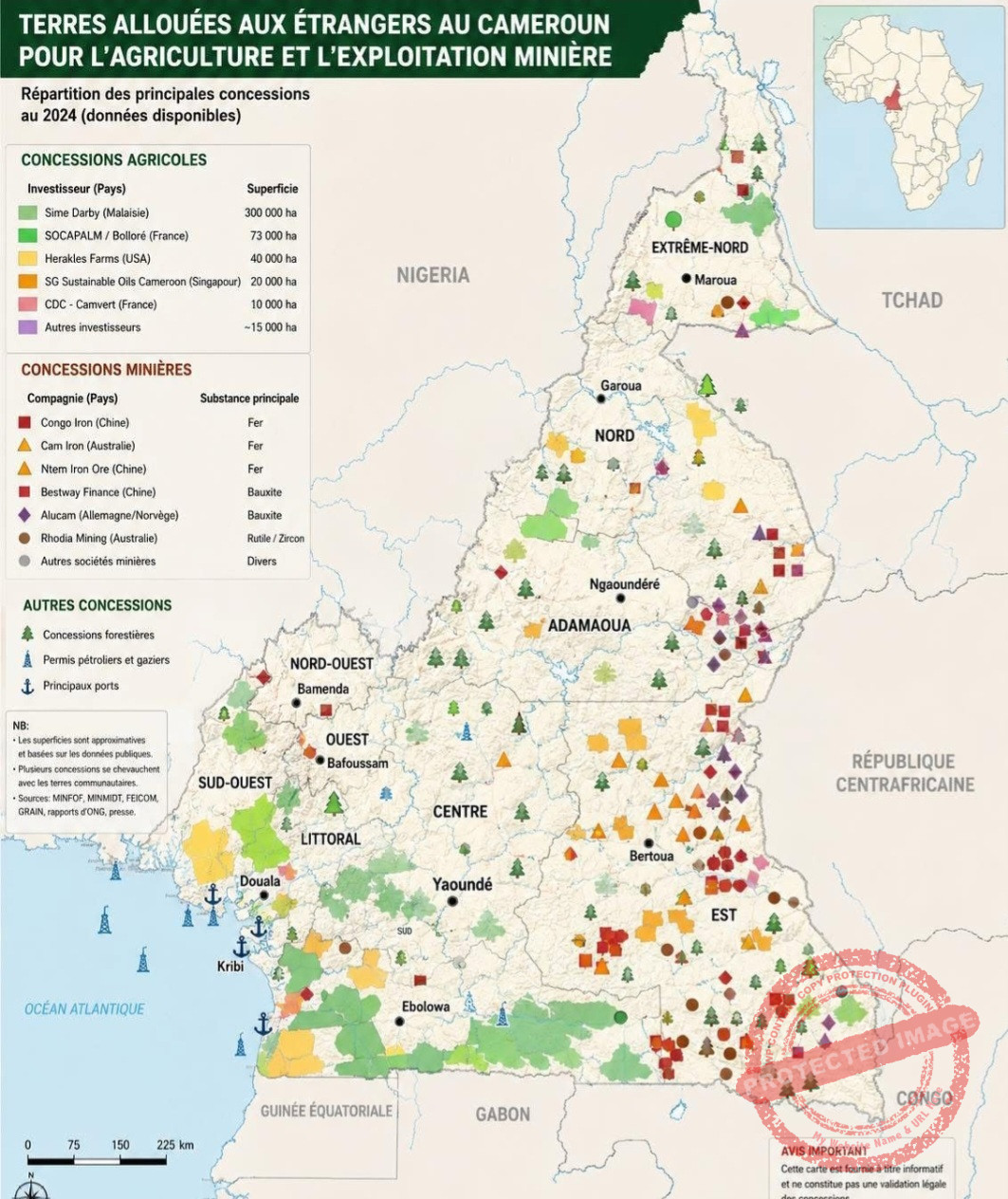
The map of lands allocated to foreign interests for agriculture and mining is more than a record of economic activity. It is a mirror reflecting Africa’s unfinished struggle for sovereignty in the twenty-first century.
The names are familiar to students of global commerce: Sime Darby, Bolloré, Herakles Farms, Bestway Finance, and numerous others. They arrive not with soldiers, colonial governors, or imperial flags, but with contracts, investment agreements, and promises of development. Yet beneath the language of modernization lies a pattern that many Africans find hauntingly familiar. Resources are extracted, wealth is exported, and local communities often remain trapped in the same cycle of dependency that has characterized much of Africa’s post-colonial economic experience.
Cameroon today stands at a crossroads between development and dispossession. Foreign investment undoubtedly brings capital, technology, expertise, and employment opportunities. Yet it also raises profound questions about ownership, control, and the long-term future of national development. When hundreds of thousands of hectares are allocated to foreign agricultural interests or when strategic mineral deposits are placed under external control, the issue extends far beyond economics. It becomes a question of sovereignty.
Land in Africa is not merely a commodity. It is history, identity, inheritance, and survival. It carries the memory of ancestors and the promise of future generations. To transfer control of such assets without ensuring meaningful local participation is to risk exchanging long-term sovereignty for short-term financial gain.
The scale of foreign involvement in Cameroon’s agricultural sector is difficult to ignore. Malaysian giant Sime Darby has been associated with approximately 300,000 hectares of agricultural land. French-linked interests through SOCAPALM and Bolloré control roughly 73,000 hectares. Herakles Farms, an American venture, has been linked to approximately 60,000 hectares. SG Sustainable Oils Cameroon of Singapore controls approximately 20,000 hectares, while additional concessions have been allocated to other foreign-backed agricultural ventures.
The mining sector presents a similar picture. Strategic deposits of iron ore, bauxite, rutile, zircon, and other valuable minerals are increasingly being developed through partnerships involving foreign companies from Australia, China, Europe, and elsewhere. Iron ore projects involve companies such as Congo Iron, Cam Iron, and Ntem Iron. Bauxite development has attracted Chinese and European interests through entities such as Bestway Finance and Alucam. Rutile and zircon projects have drawn Australian participation through firms such as Rudd Mining.
Beyond agriculture and mining, foreign participation extends into forestry concessions, oil and gas permits, logistics infrastructure, and strategic port operations. Taken individually, these agreements may appear commercially justified. Viewed collectively, however, they raise a larger question: who ultimately controls the productive assets upon which future prosperity will depend?
The issue is not whether foreign companies should invest in Africa. Capital, expertise, and technology are essential components of economic development. The issue is whether Africans remain owners, partners, and beneficiaries within these arrangements or whether they become spectators watching their resources generate wealth elsewhere.
This dilemma lies at the heart of the Pan-African project. For generations, African leaders have spoken of a continent capable of feeding itself, processing its own resources, and determining its own destiny. Yet these aspirations become difficult to realize when vast portions of the continent’s most valuable assets remain controlled by external interests whose primary obligation is to shareholders abroad rather than communities at home.
The challenge is particularly evident in the mining sector. Cameroon possesses significant deposits of iron ore, bauxite, rutile, cobalt, gold, and other strategic minerals. These resources hold the potential to transform the country’s economic future. Yet the familiar pattern persists. Raw materials leave African soil, are processed elsewhere, and return to African markets as finished products carrying significantly higher value.
The irony is profound. Africa supplies the raw materials that power global industries while often remaining excluded from the higher-value stages of production. The wealth beneath African soil fuels prosperity elsewhere while many resource-rich communities continue to struggle with underdevelopment.
This is not a uniquely Cameroonian phenomenon. It is a continental reality. From the copper belts of Zambia to the gold fields of Ghana, from the cobalt mines of the Democratic Republic of Congo to the bauxite reserves of Guinea, Africa continues to confront the same fundamental question: how can resource wealth be transformed into national prosperity rather than external enrichment?
The encouraging news is that a growing number of African states are beginning to challenge the old model. The Democratic Republic of Congo, long known as the world’s cobalt quarry, has begun insisting on greater domestic processing of cobalt and copper. Rather than remaining a supplier of raw materials for battery manufacturers abroad, the country is seeking to capture a larger share of the value chain through local refining and industrial development.
Zimbabwe shocked international markets when it restricted the export of raw lithium. The message was simple: if investors want Zimbabwe’s lithium, they must also invest in Zimbabwe’s industrial capacity. The policy has encouraged discussions around battery manufacturing and domestic value addition rather than simple extraction.
Namibia has adopted a similar approach with strategic minerals such as lithium, graphite, and rare earth elements. Rather than accepting the role of a passive supplier, the country has emphasized domestic beneficiation and industrial processing as prerequisites for long-term development.
Tanzania has gone even further by renegotiating mining agreements, demanding greater state participation, fairer revenue-sharing mechanisms, and stronger local processing requirements. The result has been the recovery of billions of dollars in value and a renewed debate about resource sovereignty across Africa.
Guinea, which possesses the world’s largest bauxite reserves, increasingly requires foreign investors to support local refining and industrialization. The country has recognized that exporting raw bauxite while importing finished aluminum products is a formula for perpetual dependency.
These examples represent more than policy adjustments. They signal a broader continental awakening. African governments are increasingly recognizing that political independence without economic sovereignty leaves nations vulnerable to new forms of external control.
The lesson for Cameroon is clear. The issue is not whether foreign investment should be welcomed. Modern economies require investment, partnerships, and integration into global markets. The real question is on whose terms those relationships are structured.
A nation that merely exports raw palm oil remains vulnerable. A nation that refines palm oil into food products, cosmetics, pharmaceuticals, and biofuels captures far greater value. A nation that exports iron ore remains dependent on external industrial systems. A nation that transforms iron ore into steel creates the foundation for manufacturing, infrastructure, and industrial growth. A nation that exports bauxite exports opportunity. A nation that produces aluminum creates industries. The future therefore lies not in rejecting foreign investment but in redefining it.
Imagine a Cameroon where palm oil is refined into cosmetics, pharmaceuticals, and biofuels in Bamenda, Victoria, Kribi, and Douala rather than being shipped abroad for processing. Imagine iron ore becoming steel that feeds local manufacturing and construction industries. Imagine bauxite being transformed into aluminum that powers African industries. Imagine communities becoming shareholders in development rather than passive observers. This vision is neither radical nor unrealistic. It reflects the direction in which much of Africa is already moving.
The struggle of the twenty-first century is no longer primarily about political flags or territorial borders. It is increasingly about economic sovereignty and control over the value chain. The question confronting African nations is not whether they possess resources. The question is whether they possess the institutions, leadership, and strategic vision necessary to transform those resources into broad-based prosperity.
Africa’s minerals helped build global industries. Africa’s agricultural lands have supplied international markets. Africa’s forests and natural wealth have enriched distant capitals. Yet a new generation of African states is beginning to insist that the continent must no longer remain merely a supplier of raw materials.
Africa is learning that sovereignty is not simply declared. It is negotiated, legislated, industrialized, and defended through economic policy. Cameroon’s concessions are therefore not destiny. They are a choice. The country can continue along the familiar path of extraction without transformation, or it can join the growing continental movement toward value addition, industrial development, and economic self-determination.
The next map of Cameroon should not be defined by a mosaic of foreign concessions and external logos. It should be defined by African factories, African ownership, African innovation, African value addition, and African prosperity. Only then will the soil beneath our feet truly nourish the future our ancestors envisioned and the future our children deserve.
M.C. Folo The Independentist News Contributor
Share This Post:
THE UNALTERABLE MAPS OF 1960: Why the Historical Borders of Southern Cameroons Continue to Challenge Yaoundé’s Narrativeo
WHY NIGERIA’S DEMOCRATIC FUTURE MATTERS TO AMBAZONIA
Related Post
WHEN INDEPENDENCE BECOMES STATECRAFT: What Scotland, Wales and Ireland’s
Dr. Martin Mungwa publishes Southern Cameroons 2050 : why
Adelle Nazarian of the Western Journal calls on the
NKAMOUNA, WASHINGTON, AND THE NEW POLITICS OF AFRICA’S STRATEGIC
When Conflict Becomes an Economy The Political Economy of
THE POLITICAL ECONOMY OF THE SOUTHERN CAMEROONS CONFLICT: Who