

The message is unmistakable. When identity becomes a marker for scrutiny, the idea of equal citizenship begins to fracture. And when that fracture deepens, the question is no longer whether unity can be preserved—but whether it ever truly existed.
By Carl Sanders Guest Writer
The Independentistnews
Soho, London
3 April 2026
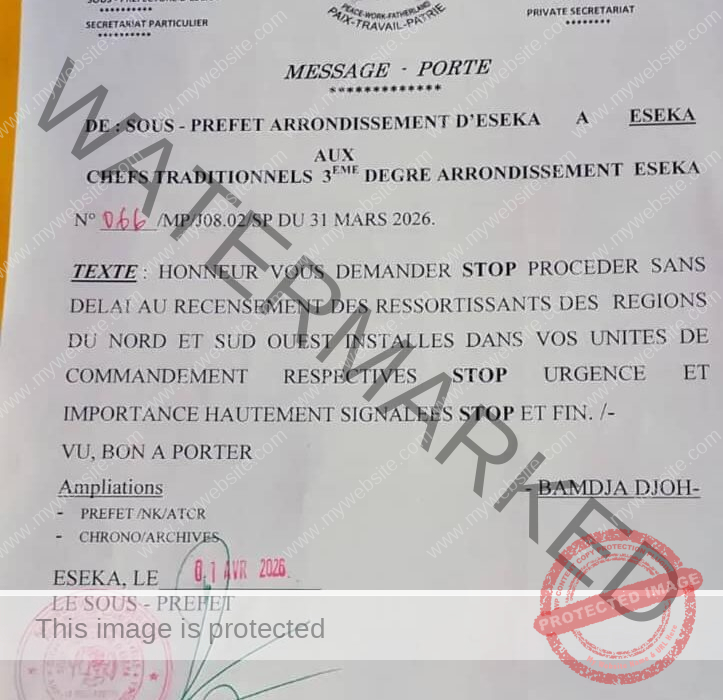
The directive issued on 31 March 2026 by the Divisional Officer of Eseka, Bamdja Djoh Aurélien, is not a routine administrative exercise. It is a line being crossed in plain sight. By ordering traditional authorities to identify and register residents specifically from the North West and South West regions, the administration has moved beyond the rhetoric of “national unity” into the practice of targeted profiling.
Let us call this what it is: a system of classification that isolates a population based on origin. And once a population is identified, it can be monitored, restricted, and—when convenient—blamed. This is not speculation. It is the logic of every system that begins with lists and ends with exclusion.
A register of this nature does not exist in a vacuum. It creates a ready-made catalogue of suspicion. When unrest occurs, the names are already there. When blame is needed, the targets are already defined. It transforms identity into liability. It converts citizenship into conditional presence.
We have seen precursors to this approach before. Security sweeps in urban areas have too often operated without clear standards of accountability, leaving communities feeling exposed rather than protected. Public discourse has, at times, reinforced division rather than cohesion, with language that deepens mistrust instead of addressing it. These patterns, taken together, form a trajectory—and the Eseka directive appears to follow it.
The deeper issue is not administrative overreach alone; it is what such measures signal. They suggest that belonging is no longer assumed, but scrutinized. That certain populations must be documented differently, watched more closely, and treated with a level of suspicion not applied uniformly.
No society can sustain unity on that foundation. Trust cannot coexist with targeted surveillance of identity. A nation cannot claim cohesion while institutionalizing division.
What emerges from Eseka is not reassurance, but a warning. A warning that the relationship between state and citizen is being redefined—not through law openly debated, but through directives quietly enforced.
And history is unambiguous on this point: when a state begins to catalogue its people along lines of origin, it is no longer strengthening unity—it is preparing the ground for separation.
The message is unmistakable. When identity becomes a marker for scrutiny, the idea of equal citizenship begins to fracture. And when that fracture deepens, the question is no longer whether unity can be preserved—but whether it ever truly existed.
Carl Sanders Guest Writer The Independentistnews