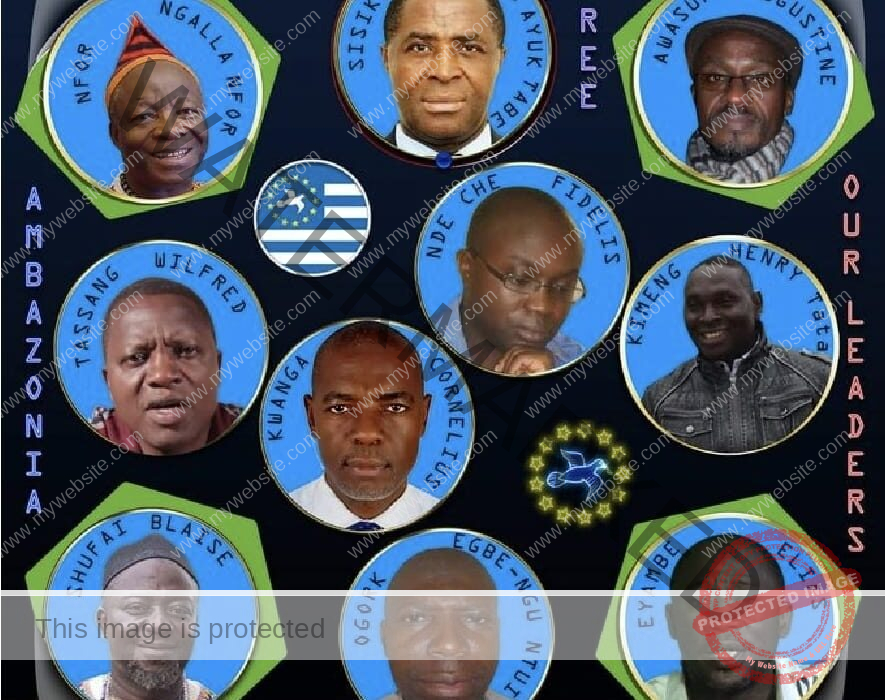


Judicial management may prolong detention. It may reshape media narratives temporarily. It may create the appearance of procedural flexibility. But it cannot by itself dissolve the historical grievances, competing national identities, and political fractures that continue to fuel the conflict. And until those deeper questions are addressed through a process perceived as credible beyond the walls of Yaoundé’s institutions,
By Mankah Rosa Parks
Senior Investigative Correspondent, The Independentist News, Soho, London
YAOUNDÉ – 25 May 2026 – The Cameroonian regime’s ongoing attempt to recycle the prosecution of the Nera 10 through renewed appeals and judicial reconsiderations rests upon a contradiction that continues to haunt the entire legal process. Yaoundé insists on presenting the detained Ambazonian leaders as ordinary internal offenders subject exclusively to domestic criminal jurisdiction. Yet the circumstances under which they arrived on Cameroonian soil remain internationally contested and legally controversial.
At the centre of this controversy stands the January 2018 removal of Sisiku Julius Ayuk Tabe and nine associates from Abuja, Nigeria, under conditions that multiple legal observers and international rights advocates continue to characterize as unlawful.
The most consequential legal development emerged on 1 March 2019, when the Federal High Court of Nigeria sitting in Abuja delivered a landmark judgment concerning the incident. Presiding Judge Justice Anwuri Chikere ruled that the transfer violated constitutional protections under Nigerian law as well as provisions linked to regional and international human rights obligations.
The judgment held that the forcible removal violated Sections 35 and 36 of the Constitution of the Federal Republic of Nigeria, which protect personal liberty and fair hearing rights. The court further found that the transfer contravened Articles 6 and 12 of the African Charter on Human and Peoples’ Rights.
Even more significantly, the ruling acknowledged the protected international status claimed by several of the detainees under refugee and asylum frameworks linked to the United Nations High Commissioner for Refugees. The court therefore concluded that the transfer potentially violated international refugee protections, including the principle of non-refoulement — the prohibition against forcibly returning protected persons to territories where they may face persecution. The Nigerian court subsequently ordered compensation and directed that steps be taken concerning the applicants’ status and return.
For many Ambazonian activists, the implications of this ruling are profound. They argue that the legal issue is no longer merely about whether the Nera 10 received a fair trial inside Cameroon. Rather, they contend that the very foundation of the proceedings is compromised because the detainees were allegedly transferred into Cameroonian custody through actions already condemned by a foreign court and criticized by international legal bodies.
Within this framework, every subsequent retrial, appeal, or sentence adjustment appears less like an independent judicial process and more like an attempt to normalize a politically explosive international incident through procedural repetition. This is why many Ambazonian commentators increasingly describe the ongoing proceedings not as justice, but as a judicial carousel — a cyclical legal mechanism that continually resets itself while avoiding the underlying political and international legal questions at the heart of the case.
The controversy also exposes deeper historical continuities in the political culture of the Cameroonian state. Many historians have drawn comparisons between contemporary state practices and earlier French colonial counter-insurgency methods deployed during the suppression of the Union des Populations du Cameroun (UPC) in the 1950s and 1960s. During that era, French colonial authorities frequently criminalized nationalist actors as terrorists or outlaws while simultaneously constructing legal and administrative frameworks designed to preserve centralized authority.
The UPC leadership was subjected to surveillance, detention, assassination campaigns, judicial repression, and political fragmentation. Figures such as Ruben Um Nyobè and Félix-Roland Moumié became symbols of a broader anti-colonial struggle violently contained through a mixture of military force, legal exceptionalism, intelligence operations, and selective political co-optation.
Critics of the current Cameroonian government argue that elements of this institutional logic remain visible today. They point to the continued tendency to frame political separatism primarily through the language of criminality and counter-terrorism rather than as a constitutional or historical dispute requiring neutral international mediation. They also highlight the state’s preference for internally managed dialogue structures over internationally supervised negotiations.
Within this context, the prosecution of the Nera 10 acquires significance far beyond the fate of the individuals themselves. The case has evolved into a symbolic struggle over legitimacy, sovereignty, and the competing narratives surrounding the Ambazonian conflict. To supporters of the Cameroonian state, the proceedings represent the lawful prosecution of separatist actors accused of threatening national unity. To many Ambazonian supporters, however, the prosecutions symbolize something entirely different: the criminalization of a political self-determination movement through a judicial system they believe cannot act neutrally in a conflict where the state itself is a principal actor.
This divide explains why repeated comparisons to Nelson Mandela continue to generate fierce debate. Regime-aligned commentators frequently argue that imprisoned leaders can and should negotiate pathways toward peace from detention, citing Mandela’s imprisonment during apartheid South Africa. Yet Ambazonian critics reject the analogy, noting that Mandela consistently resisted conditional arrangements that denied political equality or broader structural legitimacy to the anti-apartheid struggle. More importantly, they argue that the Ambazonian conflict has evolved beyond centralized personalities alone.
Years of war, displacement, militarization, village destruction, civilian casualties, and political fragmentation have created decentralized networks of resistance that no longer depend entirely upon any single detained leadership group. Local self-defense structures, diaspora mobilization, and hardened historical consciousness now sustain the conflict independently of courtroom developments in Yaoundé. This is the dilemma confronting the Cameroonian state today.
Judicial management may prolong detention. It may reshape media narratives temporarily. It may create the appearance of procedural flexibility. But it cannot by itself dissolve the historical grievances, competing national identities, and political fractures that continue to fuel the conflict. And until those deeper questions are addressed through a process perceived as credible beyond the walls of Yaoundé’s institutions, the legal carousel will continue to spin without bringing the conflict any closer to resolution.
Mankah Rosa Parks
Senior Investigative Correspondent soho, London.