

China’s Belt and Road Initiative emerged because Beijing no longer trusted a world where nearly every major global artery passed through systems controlled by the United States. So China began building another world alongside the old one. A world of alternative trade routes. Alternative partnerships. Alternative technology. Alternative finance. Alternative logistics. Alternative influence.
By Ali Dan Ismael
Editor-in-Chief, The Independentist News
America Built the System Everyone Used
After the Second World War, the United States emerged as the most powerful country on Earth. But America did not build its dominance the same way old empires did. It did not simply conquer territories and raise flags everywhere. Instead, it built systems that the entire world eventually depended upon.
American military bases spread across Europe, Asia, the Middle East, and the Pacific. U.S. naval fleets protected major shipping lanes. American intelligence agencies built global surveillance capabilities. International banking systems became tied to the U.S. dollar. Oil trade increasingly flowed through financial institutions connected to Washington and its allies.
For decades, this arrangement brought stability. Trade moved safely across oceans. Energy reached industrial economies. Markets expanded. Many countries accepted American leadership because the system worked. But there was another side to this reality. Almost every important global artery passed through infrastructure influenced, monitored, or protected by the United States.
The sea lanes were guarded by the U.S. Navy. Financial transactions passed through Western-controlled systems. Global communications increasingly depended upon American technology companies and intelligence partnerships. In many ways, the modern world was operating inside an American-designed framework.
China Realized It Had a Problem
China watched this system carefully. As the Chinese economy grew, Beijing became richer and more powerful, but Chinese leaders also noticed something deeply uncomfortable. Their economic success depended heavily on systems they did not control. China imported enormous amounts of oil through sea routes vulnerable to American naval power. Chinese exports traveled through maritime chokepoints dominated by U.S. military alliances. International banking still depended largely on Western financial structures.
Then China watched what happened to other countries that challenged Washington. Iraq faced invasion. Russia faced sanctions. Iran faced economic isolation. Libya collapsed after Western intervention. Chinese strategists began asking themselves difficult questions. What would happen if China one day became the main target? Could America cripple China without even launching a direct war? Could shipping routes simply be blocked? Could fuel imports be interrupted? Could financial systems be frozen? Could technology access disappear overnight? To Beijing, these were not theoretical questions. They were strategic warnings.
The Fear of the Strait of Malacca
One vulnerability frightened China more than anything else. A large percentage of China’s oil imports passed through the Strait of Malacca, a narrow maritime passage between Malaysia and Indonesia. If that route were blocked during a major conflict, China’s economy could face enormous disruption. Chinese officials eventually gave this fear a name: the “Malacca Dilemma.” That dilemma changed Chinese thinking forever. China realized that true power was not only about military strength. It was about control over infrastructure, logistics, energy routes, and supply chains. Beijing understood that if another country controlled your critical pathways, then your sovereignty was incomplete. China needed alternatives.
The Birth of the Belt and Road Initiative
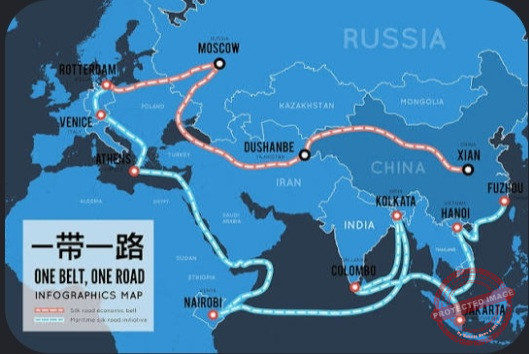
This realization eventually led to one of the largest geopolitical projects in modern history: the Belt and Road Initiative. When China first announced the project, many people assumed it was simply an economic development program. The world saw highways, railways, ports, bridges, and pipelines. But Beijing saw something much bigger. China was building escape routes. Railways connecting China to Europe would reduce dependence on vulnerable sea lanes. Pipelines across Central Asia would create alternative energy corridors. Ports in Pakistan and the Indian Ocean would provide access to strategic trade routes outside traditional American-controlled pathways.
The Belt and Road Initiative became China’s attempt to slowly build a parallel global infrastructure network. China understood a lesson every great empire had learned before: whoever builds the infrastructure shapes the future. A country that finances ports influences trade. A country that builds railways shapes supply chains. A country that controls digital networks influences information. Infrastructure creates dependency. And dependency creates power.
China’s Digital Strategy
But China’s ambitions went beyond roads and ports. Chinese leaders understood that the future world would also be controlled by data, communications, and digital systems. For decades, American technology companies dominated much of the global digital environment. Communication systems, software platforms, cloud services, and internet infrastructure were deeply tied to the United States and its allies. China became increasingly uncomfortable with this dependence. So Beijing began building what became known as the Digital Silk Road. Chinese companies expanded into telecommunications, fiber optic systems, satellite networks, artificial intelligence, surveillance technology, and digital payment systems across multiple continents.
To many Western governments, this looked dangerous. Washington viewed companies like Huawei not simply as businesses, but as strategic extensions of Chinese state influence. But from Beijing’s perspective, these projects were about survival. China believed that a nation could not become a true superpower if its communications systems depended entirely on foreign-controlled infrastructure. The struggle was no longer just about ships and armies. It was about who would control the operating system of the future global economy.
America Begins to Push Back
Eventually, Washington realized what China was doing. American leaders increasingly concluded that China was not merely growing economically. It was attempting to build an alternative global order capable of functioning outside American influence. That realization triggered a major strategic response. The United States tightened technology restrictions on China. Semiconductor exports became a battleground. Military alliances in the Indo-Pacific strengthened. Trade wars escalated. Competition over artificial intelligence, telecommunications, and supply chains intensified.
What had once looked like economic cooperation slowly transformed into geopolitical rivalry. The conflict between Washington and Beijing became much larger than trade. It became a contest between two competing systems of power. The American system remained rooted in military alliances, naval dominance, global finance, intelligence networks, and international institutions. China’s emerging system focused on infrastructure, industrial production, trade corridors, energy access, and long-term connectivity. Both sides understood what was at stake. Neither side openly speaks of empire. But both are fighting for influence over the future world order.
The World Is Changing
Today, many countries in Africa, Asia, Latin America, and the Middle East find themselves caught between these two systems. For some governments, China offers an attractive alternative. Chinese-funded roads, railways, ports, and energy projects often arrive faster and with fewer political conditions than Western-backed programs. To many developing nations, China appears practical and transactional. Critics warn that this comes with serious risks. Countries may accumulate debt, become strategically dependent on Beijing, or lose leverage over key national infrastructure. Those concerns are real. But the deeper truth remains impossible to ignore.
China’s Belt and Road Initiative emerged because Beijing no longer trusted a world where nearly every major global artery passed through systems controlled by the United States. So China began building another world alongside the old one. A world of alternative trade routes. Alternative partnerships. Alternative technology. Alternative finance. Alternative logistics. Alternative influence. And as this new system expands, the world is entering a new era — one where American dominance may no longer go unchallenged. The future may not belong entirely to Washington or Beijing. It may belong to the nations capable of navigating carefully between both worlds.
Ali Dan Ismael
Editor-in-Chief, The Independentist News