

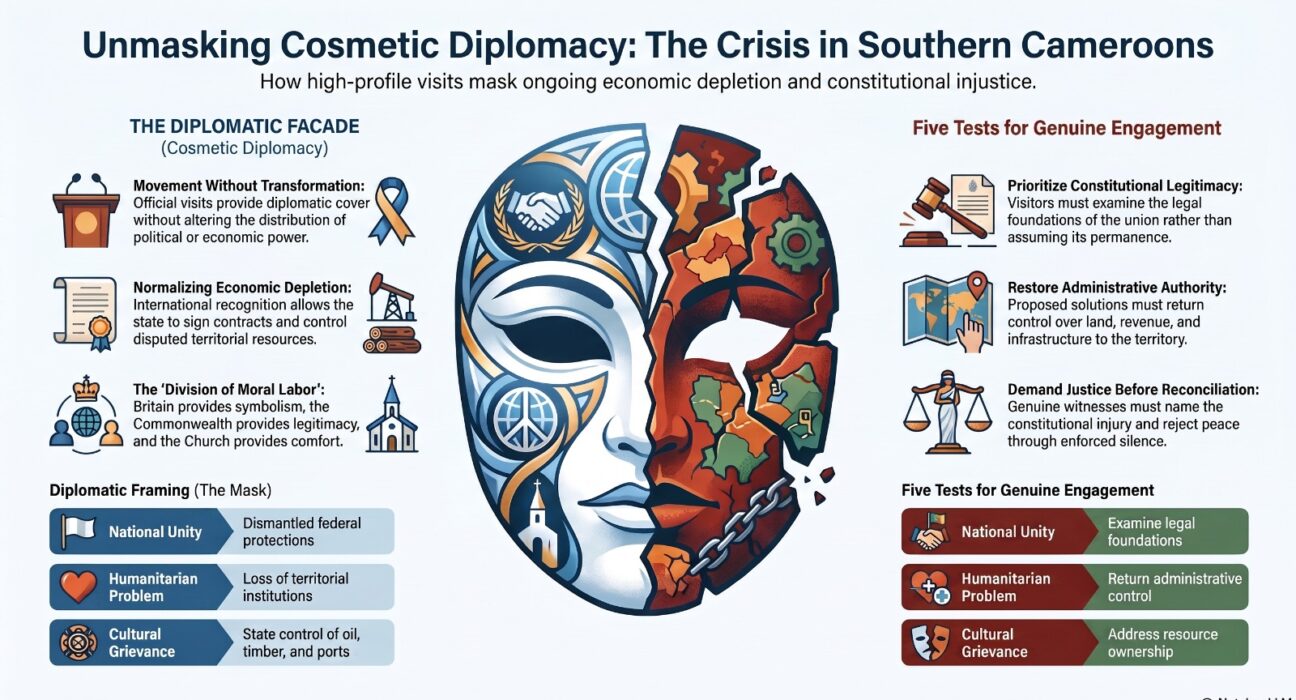


The powerful do not need additional reassurance. The victims do not need more pageantry. Southern Cameroons needs the mask removed, the archives opened, productive assets accounted for and the constitutional question addressed without predetermined limits. Until then, every cosmetic diplomatic or pastoral visit risks becoming part of the machinery it claims to heal.
By Ali Dan Ismael
Editor-in-chief The Independentist News
Modern systems of domination do not always require colonial governors or foreign flags. They also survive through diplomatic recognition, ceremonial visits, carefully drafted communiqués, pastoral appeals and photographs suggesting that responsible international institutions are actively pursuing peace. The visitor arrives. Motorcades move through Yaoundé. Meetings are conducted. Selected representatives are heard. Peace, unity and dialogue are praised. The visitor departs. The governing structure remains untouched.
Southern Cameroons has experienced too much of this cosmetic diplomacy: interventions that acknowledge suffering but refuse to confront the constitutional and economic order producing it. These visits do not necessarily involve malicious individuals or secret commercial instructions. Their effect can nevertheless be to legitimize the centralized state, reduce a dispute over self-determination to a humanitarian-management problem and reassure the international community that the crisis is receiving attention. The system is made to appear humane without being required to change.
Patricia Scotland and diplomacy with a predetermined destination
Commonwealth Secretary-General Patricia Scotland visited Cameroon for five days in December 2017. She met President Paul Biya, political parties, civil-society representatives and stakeholders in Buea. Commonwealth statements emphasized peace, inclusion, unity and dialogue among Cameroon’s cultures and communities. There was nothing wrong with calling for peace. The difficulty lay in the political assumptions surrounding the appeal.
By making national unity the preferred starting point, the Commonwealth effectively treated continued rule from Yaoundé as the presumed destination of dialogue. It did not publicly place the original constitutional bargain at the center of the intervention. It did not ask whether federal protections had been dismantled contrary to the expectations under which Southern Cameroons entered the union. It did not foreground Britain’s trusteeship responsibility or demand an accounting of the political and economic institutions absorbed into the centralized state.
The dispute was therefore narrowed before meaningful dialogue began. A constitutional question became an inclusion problem. A claim to self-determination became a disagreement requiring better communication. The loss of territorial institutions became a cultural grievance. Economic domination became an unfortunate consequence of instability. This framing was not politically neutral. It favored continuity of the established state.
The 2019 tripartite visit and the theater of engagement
In November 2019, Patricia Scotland returned to Yaoundé with African Union Commission Chairperson Moussa Faki Mahamat and Francophonie Secretary-General Louise Mushikiwabo. Their joint mission met national actors and exchanged views on the situation in Cameroon. The diplomatic theater was impressive. Three international organizations appeared together. Senior officials held consultations. Government leaders received recognition. Statements calling for dialogue and stability followed. But what changed in the distribution of political or economic power? Southern Cameroons did not recover its parliament. It did not regain its government. It did not recover authority over CDC.
Victoria did not regain autonomous control of its maritime future. Tiko did not receive the political authority needed to become a major agro-industrial and logistics center. The people did not acquire decisive control over taxation, oil, timber, ports or public investment. Britain did not reopen the history of its trusteeship. The mission generated movement without transformation. That is cosmetic diplomacy.
Why diplomatic recognition has economic value
Extractive orders require legitimacy as much as they require force. A government exercising authority over a disputed territory needs international recognition to sign contracts, award concessions, control public corporations, collect revenue and present itself as the sole lawful representative of the territory. Every prestigious visit reinforces that authority.
The diplomat does not have to manage the plantation. Diplomatic recognition helps normalize the government controlling it. The visitor does not have to sign an oil concession. Recognition strengthens the legal order under which concessions are awarded. The Commonwealth official does not have to silence constitutional claims directly. Repeated appeals for unity can define those claims as politically unacceptable before negotiations begin.
The economic effect follows the political framing.
When international actors presume the permanence of centralized authority, the institutions controlling Southern Cameroons’ resources are protected from fundamental challenge. Dialogue is then permitted only within a political structure whose legitimacy is itself disputed. The public record is the proper test
It is neither necessary nor responsible to claim that Patricia Scotland personally intended to promote economic extraction. Motive cannot be inferred merely from an official visit. The stronger criticism concerns the public record and institutional effect. The available Commonwealth statements emphasized peace, dialogue and unity. They did not publicly make Britain’s trusteeship legacy, the legal basis of the union, the dismantling of the federation or control of productive assets central to the intervention.
What may have been discussed privately is not fully known. Therefore, the responsible conclusion is not that constitutional questions were never mentioned. It is that the publicly documented diplomacy did not place them at the center of the Commonwealth’s response. That omission mattered. Silence at the institutional level can protect power as effectively as endorsement.
When clerical neutrality becomes political cover
Religious leaders who visit Cameroon frequently speak of peace, reconciliation, forgiveness and national healing. These values have moral importance. Communities wounded by conflict require spiritual support. Victims deserve consolation and solidarity.
But religious neutrality becomes politically dangerous when it comforts the wounded without confronting the machinery inflicting the wound. An Anglican bishop or senior church delegation is not automatically an agent of the British government. The Anglican Communion is not simply an arm of the state, and individual clergy should not be accused of economic complicity without evidence.
Nevertheless, Anglican institutions carry a history inseparable from the British Crown and empire. Missionaries often provided education, health care and genuine spiritual service, but the church also operated within an imperial order that encouraged loyalty, obedience and acceptance of colonial authority.
That history imposes a higher responsibility upon modern church leaders. A pastoral visit to Southern Cameroons should not be evaluated only by the number of sermons preached, officials greeted or services attended. It should be judged by whether the visitor speaks truth to power. Does the visitor acknowledge Britain’s historical responsibility? Does the visitor meet victims independently of official programs? Does the visitor challenge political imprisonment, collective punishment and attacks on civilians? Does the visitor distinguish genuine peace from enforced silence? Does the visitor ask who controls the territory’s plantations, oil, forests, ports and revenue? Does the visitor demand justice before prescribing reconciliation?
Where the publicly available record does not demonstrate that these questions were central, the visit risks becoming pastoral cover for political continuity. Do not preach reconciliation while protecting dispossession Christianity does not require victims to bless injustice. Forgiveness is not the abolition of accountability. Peace is not the silence created when a population is militarized. Unity is not sacred merely because the powerful demand it. The biblical prophets did not simply comfort those who suffered. They confronted rulers, condemned exploitation and demanded justice for the dispossessed. A church that calls for peace without confronting the constitutional and economic roots of the conflict risks becoming the chaplain of the status quo. It may pray over the wound while refusing to identify the weapon.
That pastoral approach has economic consequences. Calls for calm can become appeals for plantations to resume production without addressing control. Appeals for stability can become demands that oil continue flowing without territorial accountability. Calls for national unity can become arguments that ports, forests, taxation and public corporations remain permanently under the same centralized authority. Peace then becomes the stabilization of extraction.
Britain’s division of moral labor
Britain’s relationship with Southern Cameroons now operates through a convenient division of institutional roles. The British government speaks cautiously about dialogue and humanitarian need. The Commonwealth provides diplomatic engagement and legitimacy. Church leaders offer prayer and reconciliation. The Crown provides the larger symbolism of duty, dignity and benevolent continuity. Each institution appears separate. Together, they can create a complete system of reassurance. The government avoids direct responsibility. The Commonwealth normalizes the state. The church comforts the victims. The Crown preserves Britain’s moral image.
No secret conspiracy is required. Institutions simply follow familiar habits. Diplomats favor internationally recognized governments. Commonwealth officials prioritize stability. Churches avoid being described as political. Former colonial powers resist reopening borders and settlements they consider closed. The cumulative outcome nevertheless protects the existing order.
France supplies much of the centralized administrative, diplomatic and monetary architecture inherited by La République du Cameroun. Britain supplies Commonwealth respectability, English-speaking diplomatic legitimacy and moral symbolism. France helps preserve the machinery. Britain helps preserve the mask. Humanitarian assistance cannot substitute for constitutional justice International actors increasingly describe Southern Cameroons as a humanitarian emergency. They discuss displaced persons, schools, humanitarian access, local reconciliation and reconstruction.
These concerns are essential, but they cannot replace constitutional diagnosis. Food aid cannot restore a parliament. A church service cannot return authority over plantations. A development grant cannot create political consent. A humanitarian mission cannot determine who rightfully controls oil, customs, ports and taxation. When international engagement relieves suffering without examining the political structure producing it, humanitarianism becomes containment. Its practical objective becomes keeping people alive within the existing order rather than transforming the order.
This separation conceals the economic chain connecting political dispossession to material decline. Plantation disruption is called insecurity. School closures are called humanitarian damage. Business collapse is called conflict loss. Professional migration is treated as displacement. What disappears is the underlying sequence: Southern Cameroons first lost control of its institutions; political grievances were then suppressed; armed conflict followed; productive and human assets were subsequently destroyed.
Five tests for every future visitor
Southern Cameroons should no longer judge an international visit by the visitor’s title, clothing or institutional prestige. Every delegation should be measured against five tests.
First, constitutional legitimacy: Is the visitor willing to examine the legal and political foundations of the existing arrangement rather than presuming them?
Second, administrative authority: Does the proposed solution restore meaningful institutions through which Southern Cameroonians can govern themselves?
Third, civilian protection: Does the visitor demand accountability for abuses by both state forces and armed groups?
Fourth, productive capacity: Does the proposed settlement give the territory authority over land, revenue, infrastructure and economic development?
Fifth, external voice: Can Southern Cameroons represent its own political and developmental interests rather than speaking only through Yaoundé?
A visit that avoids these tests is unlikely to resolve the crisis. It manages appearances. Dialogue must not begin with surrender. A credible political process cannot begin by declaring that unity is non-negotiable. That is not dialogue. It is a demand that one side accept the other side’s conclusion before discussion begins.
Dialogue must permit examination of every relevant historical and constitutional question. It must address federalism, confederation, separation and other possible political arrangements without predetermining the outcome. Peace must not mean restoring quiet around plantations and oil infrastructure. Reconciliation must not mean absolution without restitution. Humanitarian access must not become a substitute for political justice. Religious leaders must not tell the wounded to forgive while failing to tell the powerful to return what was taken.
Southern Cameroons needs witnesses, not stage performers
Southern Cameroons does not need another procession of distinguished visitors arriving with prewritten appeals for peace and unity. It needs witnesses willing to name the constitutional injury. It needs diplomats who understand that stability without justice protects extraction. It needs religious leaders who understand that prayer without truth may become complicity. It needs Britain to accept that its trusteeship decisions created obligations that ceremony cannot erase. It needs the Commonwealth to determine whether its democratic principles apply when doing so inconveniences a member government. It needs Anglican and other Christian leaders to recognize that repentance for empire cannot end with symbolic compassion while the economic and political consequences of empire remain intact.
The powerful do not need additional reassurance. The victims do not need more pageantry. Southern Cameroons needs the mask removed, the archives opened, productive assets accounted for and the constitutional question addressed without predetermined limits. Until then, every cosmetic diplomatic or pastoral visit risks becoming part of the machinery it claims to heal.
Ali Dan Ismael
Editor-in-chief The Independentist News