



Our greatest declaration of independence will be our demonstrated capacity to think, create, innovate, regulate, produce and build. We must not merely aspire to inherit a nation. We must develop the intellectual capacity, institutional discipline and moral character necessary to build one.
By Martin S. Mungwa, Ph.D., MBA, PE, F.ASCE Engineer, Researcher, Author and Founder of SCRIPTEGRITY™ and Contributor to The Independentist New. November 28, 2026
Sovereignty Beyond Political Independence
The aspiration of the people of Southern Cameroons–Ambazonia for sovereign nationhood must extend beyond political independence, territorial integrity and international recognition. It must encompass the intellectual, scientific, technological, institutional and economic capacity to build, govern and sustain a modern nation.
Political independence without intellectual and economic capacity risks replacing one form of dependency with another. True sovereignty requires the ability of a people to determine their developmental priorities, educate their citizens, manage their resources, develop their industries and participate competitively in the global economy.
One of Ambazonia’s greatest resources is neither beneath its soil nor within its territorial waters. It resides in the intellectual capacity of its people, both at home and across the global diaspora.
Over several decades, Ambazonians have acquired considerable knowledge and professional experience in engineering, medicine, mathematics, computer science, agriculture, economics, education, law, architecture, scientific research and emerging technologies. Many have studied, taught, conducted research and served in institutions across Africa, Europe, North America, Asia and other parts of the world.
The fundamental question before us is no longer simply whether we possess intellectual capacity. It is whether we have the vision, organizational discipline and institutional framework to harness that capacity for national development.
Throughout my professional journey as an engineer, researcher, university educator, engineering manager and author, I have come to appreciate that the development of nations is fundamentally linked to the quality of their human capital and the strength of their institutions.
Natural resources alone do not guarantee prosperity. Nations endowed with abundant minerals, petroleum, fertile agricultural land and vast forests can remain economically dependent when they lack the intellectual and technological capacity to transform those resources into productive wealth.
Ambazonia must therefore recognize its intellectual diaspora as a strategic national asset whose accumulated knowledge can be mobilized for the benefit of present and future generations.
STEAMERS Education: The Bedrock of Human Capital Development
Any serious discussion about the future educational architecture of Ambazonia must recognize the intellectual contribution of Judith Elondo, the originator of the STEAMERS educational philosophy.
I consider STEAMERS a particularly valuable starting point for developing a national educational philosophy that recognizes the interconnected relationship between knowledge, character, creativity, economic competence and human purpose.
STEAMERS integrates eight fundamental pillars: Science: Scientific inquiry, discovery and evidence-based reasoning. Technology: Innovation, digital literacy and the application of knowledge. Engineering: Design, problem-solving, infrastructure and productive capacity. Arts: Creativity, imagination, cultural identity and human expression. Mathematics: Logical reasoning, quantitative analysis and analytical competence. Economics: Financial literacy, entrepreneurship, productivity and wealth creation. Religion: Moral reflection, ethical responsibility and understanding of religious traditions. Spirituality: Conscience, integrity, compassion and human purpose.
The significance of Judith Elondo’s educational philosophy lies in its recognition that education must develop the whole human being. An engineer without integrity can compromise public safety. A physician without compassion can undermine the dignity of patients. An economist without ethical responsibility can contribute to exploitation. A political leader without conscience can misuse public institutions. Technical competence alone is therefore insufficient to sustain a just, productive and prosperous society.
Ambazonia must educate citizens who are not only professionally competent but also ethically grounded, economically literate, socially responsible and committed to the public good. The religious and spiritual dimensions of education must respect freedom of conscience, religious diversity and the equal dignity of every citizen.
I propose that STEAMERS serve as the philosophical and pedagogical bedrock of Ambazonia’s human capital development strategy, beginning in early childhood and continuing throughout primary, secondary, vocational, university and postgraduate education. We must develop the human being before expecting the human being to develop the nation.
SCRIPTEGRITY™ and the Development of Intellectual Sovereignty.
While STEAMERS provides a philosophical foundation for human capital development, the emerging capabilities of SCRIPTEGRITY™ present an opportunity to establish technological infrastructure for the production, verification, preservation and dissemination of educational knowledge.
As part of my continuing commitment to intellectual development, academic publishing and technological innovation, I have undertaken the development of SCRIPTEGRITY™, an intelligent editorial and publishing technology designed to support authors, educators, researchers and publishing institutions.
Its broader scientific and educational vision extends beyond conventional manuscript preparation and proofreading. It encompasses structured textbook development, mathematical analysis, scientific illustrations, engineering drawings, computational modelling, academic verification, research organization and human-supervised editorial quality assurance. A preliminary educational framework has identified 225 academic subjects across 12 major scientific, engineering and technological disciplines.
Academic discipline
Subjects: – Mathematics and Computational Sciences 18 – Physical and Chemical Sciences 18 – Biological and Medical Sciences 16 – Civil and Structural Engineering 28 – Mechanical and Industrial Engineering 20 – Electrical and Electronic Engineering 18 – Computer Science and Artificial Intelligence 22 – Agricultural Sciences and Engineering 20 – Environmental, Geological and Earth Sciences 18 – Energy, Petroleum and Chemical Engineering 16 – Architecture and Urban Development 14 – Advanced Engineering and Emerging Technologies 17 – Total = 225
These disciplines could eventually support the development of more than 500 original textbooks, laboratory manuals, exercise books, instructor guides, computational learning materials and specialized academic publications. Additional publications could address economics, financial literacy, entrepreneurship, arts, humanities, ethics and the other dimensions of the STEAMERS educational philosophy.
This is a long-term development vision. Its implementation would require qualified subject-matter experts, rigorous scientific verification, independent academic review and internationally recognized educational standards. The advanced scientific capabilities of SCRIPTEGRITY remain subject to development and validation. Artificial intelligence must serve as an instrument of intellectual advancement, not a substitute for human judgment, scientific accountability or academic integrity.
Establishing an Ambazonian Scientific and Engineering Educational Library
I envisage the eventual establishment of an Ambazonia Scientific and Engineering Educational Library (ASEEL), supported by modern publishing technologies and the collective expertise of Ambazonian professionals worldwide.
Our future generations should have access to educational materials developed by qualified professionals who understand both internationally accepted scientific principles and the particular developmental challenges of their homeland.
– A student studying civil engineering should understand the principles of structural mechanics while also appreciating local construction materials, geological conditions, rainfall patterns, soil characteristics and infrastructure requirements.
– An agricultural student should understand universal scientific principles alongside the practical realities of tropical agriculture, coffee and cocoa production, food processing, irrigation and agricultural mechanization.
– An electrical engineering student should be able to apply theoretical knowledge to electricity generation, transmission, distribution, renewable energy and rural electrification.
– A computer science student should acquire the competence to develop software, artificial intelligence applications, digital platforms and technological solutions capable of addressing national and international challenges.
Our educational publications should incorporate mathematical derivations, scientific illustrations, worked examples, practical applications, laboratory experiments, computational simulations, assessment materials and independent technical verification.
Affordable printed editions, digital libraries and offline educational resources must make this knowledge accessible to students irrespective of their geographical location or economic circumstances. Education must become a national instrument of opportunity rather than a privilege restricted to a minority.
Establishing the International Building Code as the Foundation of National Construction Standards
The development of a sovereign nation requires more than the availability of qualified engineers, architects and construction professionals. It requires a comprehensive regulatory framework governing the design, construction, inspection, operation and maintenance of its physical infrastructure.
Ambazonia must not become a nation where buildings are constructed without adequate engineering supervision, where construction materials are used without scientific verification, or where public safety is compromised by the absence of enforceable construction standards.
Drawing upon my professional experience in structural engineering, construction, research and infrastructure management, I propose that Ambazonia adopt the International Building Code (IBC), published by the International Code Council (ICC), as the foundational model code for its national building regulations, subject to appropriate national administrative provisions and technical amendments.
The IBC provides an established regulatory framework addressing building safety, structural integrity, fire protection, accessibility, occupancy classification and construction requirements. Its adoption by different jurisdictions demonstrates how an internationally developed model code can be adapted to local legislation and conditions. ICC +2
Rather than spending considerable time and financial resources developing an entirely new building code from the ground up, Ambazonia could build upon an established body of engineering knowledge while developing the administrative and technical provisions necessary to address its unique circumstances.
These national amendments would address tropical climatic conditions, volcanic and seismic hazards, coastal flooding, intense rainfall, landslides, locally available construction materials, affordable housing and the geographical characteristics of our territory. Our engineers and architects must be educated not only in engineering theory but also in the practical application of construction codes, professional standards and regulatory compliance.
A Proposed Ambazonia Administrative Clause to the International Building Code
The International Building Code would not automatically acquire legal authority within Ambazonia. It would require formal legislative adoption by the competent national authority.
The IBC already contains a chapter addressing scope and administration. Ambazonia could adapt this framework through a national administrative chapter establishing the institutions, procedures and legal responsibilities necessary for effective enforcement. ICC Digital Codes +1
I therefore propose the following preliminary administrative clause as a basis for future legislative and professional consideration. Proposed Article 1 — Adoption, Administration and Enforcement of the Ambazonia National Building Code
Section 1 — Adoption and legal authority
The designated edition of the International Building Code, as published by the International Code Council, together with approved national amendments and referenced technical standards, shall, upon legislative enactment, constitute the foundational building code of Ambazonia.
Section 2 — National building authority
An Ambazonia National Building and Construction Authority shall be established by law to administer, interpret, coordinate and oversee the implementation of the national building code. The authority shall establish national technical requirements and coordinate enforcement through duly authorized regional, county and municipal building departments.
Section 3 — Professional responsibility
Engineering and architectural services requiring professional judgment shall be undertaken under the supervision of appropriately qualified and licensed professionals.
Structural calculations, engineering designs, architectural documents and other regulated technical submissions shall be prepared, reviewed and authenticated by professionals authorized to undertake such work. Professional responsibility shall be accompanied by enforceable ethical and disciplinary standards.
Section 4 — Construction permits and technical review
Construction, alteration, enlargement, demolition and regulated changes in building occupancy shall be subject to the appropriate permitting and approval procedures established under the national building code. Applications shall undergo technical review proportionate to the complexity, occupancy and risk classification of the proposed development.
Section 5 — Construction inspection and materials verification
Authorized building officials and qualified inspectors shall conduct inspections at prescribed stages of construction. Construction materials, structural components and workmanship shall comply with applicable technical requirements. Independent testing and special inspections shall be required where prescribed by the adopted code.
Section 6 — Certificate of occupancy
Buildings subject to occupancy certification shall not be occupied until the competent building authority has verified compliance with applicable requirements and issued the necessary certificate.
Section 7 — Public safety and enforcement
The competent building authority shall possess legally defined powers to issue notices of violation, suspend unsafe construction activities, require corrective measures and restrict the occupancy of buildings presenting unacceptable risks to public safety. Enforcement shall be conducted transparently, consistently and in accordance with due process.
Section 8 — National technical amendments
National amendments shall address Ambazonia’s geographical, climatic, geological, environmental, technological and socioeconomic conditions. Such amendments shall be supported by scientific evidence, engineering research, hazard assessments and professional consultation.
Section 9 — Appeals and accountability
Property owners, developers and registered professionals shall have access to an independent administrative appeals mechanism. Building officials shall be subject to professional accountability, conflict-of-interest requirements and appropriate public oversight.
Section 10 — Periodic revision
The Ambazonia National Building Code shall undergo periodic review to incorporate scientific advances, improvements in construction technology, lessons from structural failures and appropriate revisions to internationally recognized technical standards.
The proposed administrative clause would establish the institutional relationship between national government, local authorities, engineers, architects, contractors, developers and property owners.
Complementary regulations would also be necessary for residential construction, existing buildings, fire protection, electrical installations, mechanical systems, plumbing, energy efficiency and accessibility. Roads, bridges, dams and other specialized infrastructure would require their own appropriate engineering standards.
The objective is to establish a construction industry in which public safety is a legal obligation rather than an individual preference. A sovereign nation must not merely possess the capacity to construct buildings. It must possess the institutional capacity to guarantee that those buildings are safe.
Establishing National Engineering and Professional Institutions
The adoption of construction standards must be accompanied by the establishment of credible professional institutions. Ambazonia should consider developing independent statutory and professional bodies, including: – Ambazonia Council of Professional Engineers. – Ambazonia Institution of Civil Engineers. – Ambazonia Council of Architects. – Ambazonia National Building and Construction Authority.– Ambazonia Standards and Materials Testing Institute. – Ambazonia Engineering Accreditation Board. – Ambazonia National Scientific Research Council. – Ambazonia Council for Higher Education and Academic Accreditation. – Ambazonia Institute of Industrial and Technological Development. – Ambazonia National Intellectual Property Office.
These proposed institutions would establish frameworks for professional registration, academic accreditation, research funding, technical standardization, public safety, intellectual property protection and continuing professional development. Professional competence must be demonstrated through education, examination, practical experience and adherence to ethical standards.
Our universities must produce graduates whose qualifications are internationally competitive. Our professional institutions must pursue international recognition and cooperation so that Ambazonian engineers, architects, scientists and other professionals can participate confidently in the global marketplace. The credibility of our institutions will contribute significantly to the credibility of our nation.
Education as the Foundation of National Reconstruction
Our educational priorities must be directly connected to our developmental aspirations. Civil and structural engineering must support the construction of roads, bridges, hospitals, schools, housing, transportation systems and resilient communities. Mechanical and industrial engineering must support manufacturing, agricultural mechanization, industrial equipment, transportation technology and domestic production.
Electrical engineering must support reliable electricity generation, transmission and distribution, renewable energy development and rural electrification. Agricultural sciences must support food security, crop improvement, irrigation, mechanization, food processing and agricultural exports.
Medical and biological sciences must strengthen healthcare delivery, biomedical research, pharmaceutical development and public health institutions. Computer science and artificial intelligence must facilitate digital transformation, industrial automation, scientific research, entrepreneurship and technological competitiveness.
Environmental sciences must address climate change, coastal protection, water management, environmental conservation and disaster resilience. Architecture and urban planning must facilitate the development of organized, accessible, sustainable and economically productive cities and communities.
Advanced engineering disciplines, including aerospace engineering, robotics, nanotechnology, semiconductor engineering and computational mechanics, must prepare future generations for the technological realities of tomorrow. Our educational system must not be designed exclusively around the economic conditions of yesterday. It must prepare our children for the opportunities and challenges of the next century.
Mobilizing the Ambazonian Intellectual Diaspora
Imagine bringing together our professors, engineers, physicians, mathematicians, computer scientists, agricultural specialists, architects, economists and researchers under a coordinated national knowledge-development initiative.
An Ambazonian structural engineer working in North America could contribute to textbooks, engineering standards and infrastructure development guidelines. A medical researcher in Europe could contribute to biomedical education and public health policy.
An agricultural scientist working elsewhere in Africa could develop educational materials on tropical agriculture, food security and agro-industrial production. A computer scientist in Asia could contribute to artificial intelligence, robotics and advanced computing.
A retired university professor could dedicate part of his or her time to curriculum development, academic mentorship and independent manuscript review. An educator could contribute to implementing Judith Elondo’s STEAMERS philosophy, ensuring that technical competence is accompanied by character, creativity and conscience. Physical distance would no longer constitute an insurmountable barrier to national service.
Through digital collaboration, Ambazonians worldwide could participate in educating generations of children they may never personally meet.
I propose consideration of an Ambazonian Intellectual and Scientific Development Council, a voluntary network of qualified professionals dedicated to educational development, scientific research, technical standards and institutional preparation. Such an initiative should operate across geographical boundaries and political affiliations, united by the common objective of advancing education, human dignity and sustainable development.
Intellectual service to the nation must transcend individual differences. Connecting Education to Industrialization and Economic Sovereignty
Education must not exist in isolation from the economy. Our universities and technical institutions must become centers of research, innovation, entrepreneurship and practical problem-solving rather than merely institutions that award academic certificates.
Engineering departments should collaborate with construction companies, manufacturing enterprises, agricultural producers, energy developers and technology businesses. Students should be encouraged to develop prototypes, establish businesses, undertake industrial internships and participate in multidisciplinary research.
Universities should progressively develop innovation centers, business incubators, research laboratories and technology-transfer mechanisms. The economics pillar of STEAMERS is particularly significant in this regard. Scientific knowledge and technical competence must be accompanied by an understanding of entrepreneurship, financial management, investment, productivity and wealth creation.
A nation cannot develop a sustainable industrial economy if its engineers understand technology but do not understand the economic mechanisms through which technology becomes a productive enterprise. Coffee, cocoa, palm oil, timber and other natural resources should progressively become foundations for domestic processing industries and value-added exports.
We must educate agricultural entrepreneurs, industrial engineers, manufacturers, inventors and business leaders capable of transforming resources into products and products into sustainable wealth. A productive economy cannot be built solely through the distribution of existing wealth. It must be built through the continuous creation, circulation and regeneration of wealth. Education is the foundation of that productive capacity.
An Integrated Architecture for National Development
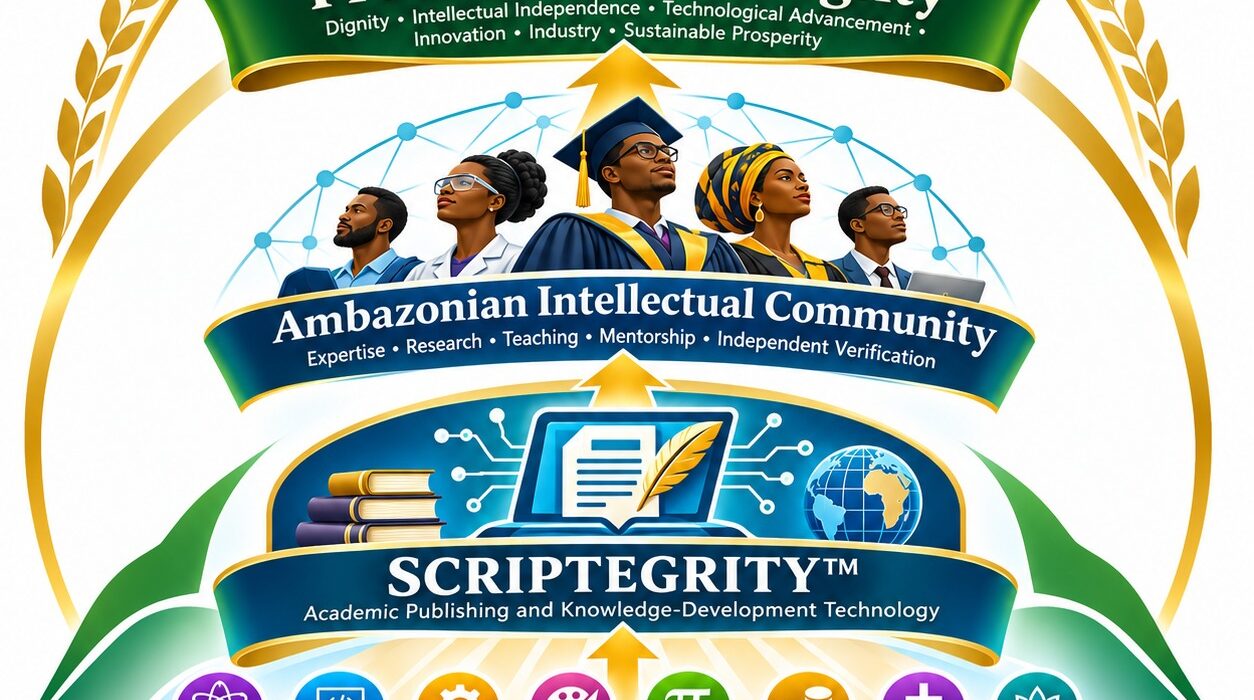
The proposed combination of STEAMERS, SCRIPTEGRITY, internationally recognized technical standards and the intellectual resources of Ambazonians worldwide could establish a coherent framework for national development.
STEAMERS Education
Originator: Judith Elondo, Philosophical bedrock of human capital development – Science – Technology – Engineering – Arts – Mathematics – Economics – Religion – Spirituality
SCRIPTEGRITY™
Knowledge production, academic publishing and editorial verification 225 Subjects. 12 Disciplines,
500+ Target publications, Ambazonian intellectual community, Scientists · Engineers · Educators · Researchers · Entrepreneurs
Academic institutions. Education, accreditation and research. Professional institutions Licensing, ethics and competence, IBC and national standards
Construction regulation and public safety
Industry and innovation – Manufacturing, entrepreneurship and employment – Productive Sovereignty – Human dignity · Institutional integrity · Technological advancement · Sustainable prosperity. STEAMERS would provide the philosophical foundation. SCRIPTEGRITY would support the development and dissemination of knowledge.
Our intellectual community would contribute professional and scientific expertise. Our academic institutions would develop human competence. Our regulatory institutions would establish enforceable standards. Our industries would transform knowledge into productive capacity.
Together, these components could provide the foundation of a modern, productive and accountable society. Preparing for Sovereignty Before International Recognition We must not wait for international recognition before developing the intellectual and institutional architecture of the nation we aspire to build.
The preparation of textbooks, educational curricula, scientific research frameworks, professional training programs, construction regulations and technological platforms can begin today.
While diplomatic and political efforts continue, our intellectual community must equally prepare the developmental foundations necessary for a prosperous, peaceful and sustainable future. We must prepare the institutions before we inherit the responsibilities. We must develop the knowledge before we confront the challenges. We must establish the standards before we embark upon national reconstruction. We must cultivate the human capital before we undertake industrialization.
The establishment of a future educational system, construction industry and regulatory framework should not begin with an empty page. It should draw upon years of careful preparation, intellectual collaboration, scientific research and institutional planning. Our preparedness must become an expression of our commitment to the responsibilities of nationhood.
A National Call to Intellectual Service
I call upon Ambazonian intellectuals, professionals, academics, researchers, entrepreneurs and educational specialists worldwide to reflect upon their individual and collective responsibilities in building the intellectual foundations of our future.
Every professor can contribute knowledge. Every engineer can contribute technical expertise. Every scientist can contribute research. Every physician can contribute medical knowledge. Every architect can contribute to the development of sustainable communities. Every educator can contribute to curriculum development. Every artist can contribute creativity and cultural enrichment. Every entrepreneur can contribute innovation. Every legal professional can contribute to the development of accountable institutions. Every generation can prepare the foundation upon which the next generation will stand.
Our intellectual resources must become a shared national asset, available to advance education, human dignity, economic opportunity and sustainable development. We must cultivate a national culture that celebrates academic excellence, scientific discovery, professional competence, productive enterprise, ethical leadership and intellectual integrity.
Our children must grow up believing that they can become inventors, scientists, engineers, medical researchers, industrialists and technological innovators whose contributions extend beyond the geographical boundaries of their homeland. Equally, they must grow up understanding that knowledge confers responsibility, leadership requires conscience, engineering requires accountability and prosperity must serve humanity.
Conclusion: The Architecture of a Sovereign and Productive Nation
The ultimate measure of our sovereignty will not simply be our ability to raise a national flag, establish diplomatic missions or occupy government institutions. It will also be our ability to educate our children, feed our population, heal our sick, build safe infrastructure, develop our industries, protect our environment and create opportunities for generations yet unborn.
Through Judith Elondo’s STEAMERS educational philosophy, we have a proposed framework for developing the whole human being. Through SCRIPTEGRITY™, we are developing technology that could support the production and dissemination of educational knowledge.
Through the proposed adoption of the International Building Code, supplemented by an Ambazonian administrative chapter and scientifically justified technical amendments, we could establish a credible foundation for construction quality, regulatory compliance and public safety.
Through the intellectual capacity of Ambazonians worldwide, we have an opportunity to mobilize scientific expertise, professional competence, academic experience and entrepreneurial talent.
Political sovereignty must open the door to intellectual sovereignty. Intellectual sovereignty must drive technological advancement. Technological advancement must generate economic prosperity. Institutional integrity must ensure that prosperity serves human dignity and the public good.
The greatness of Ambazonia will ultimately be measured not by the abundance of the resources beneath its soil, but by the quality of the minds it develops above it, the integrity of its institutions and the character of the citizens entrusted with its future.
A nation that possesses natural resources may possess wealth. A nation that develops its intellectual resources possesses the capacity to create wealth across generations.
But a nation that combines intellectual competence, moral character, scientific advancement and institutional accountability possesses the foundation for a civilization capable of enduring across generations.
STEAMERS must nurture the human being. SCRIPTEGRITY must support the development of knowledge. International standards must guide professional practice. Our institutions must safeguard the public interest. Our intellectual community must transform knowledge into sustainable national prosperity.
Our greatest declaration of independence will be our demonstrated capacity to think, create, innovate, regulate, produce and build. We must not merely aspire to inherit a nation. We must develop the intellectual capacity, institutional discipline and moral character necessary to build one.
Dr. Martin S. Mungwa Contributor The Independentist News
Intellectual Acknowledgment
Judith Elondo, originator of STEAMERS Education, is acknowledged for her original intellectual contribution integrating Science, Technology, Engineering, Arts, Mathematics, Economics, Religion and Spirituality into a comprehensive philosophy of human capital development.
About the Author
Dr. Martin S. Mungwa, Ph.D., MBA, PE, F.ASCE, is a structural engineer, researcher, former university department head, former engineering manager, author and technology entrepreneur. He is a Fellow of the American Society of Civil Engineers and founder of SCRIPTEGRITY™.
His professional interests encompass scientific research, engineering education, construction standards, infrastructure resilience, intellectual sovereignty, entrepreneurship and sustainable economic development.
The Independentist News — Advancing National Consciousness, Intellectual Development and Constructive Nation-Building.