



The Independentist news book review desk
INTRODUCTION
When Faith Encounters the Cry for Freedom
“Defend the weak and the fatherless; uphold the cause of the poor and the oppressed. Rescue the weak and the needy; deliver them from the hand of the wicked.”
— Psalm 82:3–4
Throughout human history, the relationship between religion, political authority and the pursuit of freedom has remained one of the most profound questions confronting human civilisation.
The Christian Church, entrusted with proclaiming the Gospel and defending the sacred dignity of the human person, has repeatedly found itself at the crossroads of spiritual responsibility and temporal injustice. From the enslavement of ancient peoples to colonial domination, racial segregation, political persecution and contemporary armed conflicts, religious institutions have faced the difficult question of what fidelity to God demands when human beings are subjected to oppression.
Can the Church proclaim salvation while remaining indifferent to human suffering? Can it preach justice from the pulpit while overlooking injustice beyond the walls of its sanctuaries? Can religious institutions maintain political neutrality without surrendering their moral responsibility?
These questions constitute the foundation of this book.
The Christian understanding of liberation cannot be reduced exclusively to political emancipation. It encompasses spiritual redemption, human dignity, moral responsibility and freedom from the conditions that diminish the human person. Nevertheless, the spiritual mission of the Church cannot be understood in isolation from the realities of poverty, persecution, discrimination and institutional injustice experienced by the communities it serves.
History provides numerous examples of religious leaders who confronted these realities with remarkable courage. Archbishop Desmond Tutu challenged the institutional injustice of apartheid. Martin Luther King Jr. drew upon Christian principles in confronting racial segregation. Archbishop Óscar Romero became a powerful witness against repression and the killing of innocent civilians. Across continents, religious leaders have demonstrated different understandings of the relationship between faith, conscience and political responsibility.
Their experiences, however, were neither identical nor free from controversy. Some embraced nonviolent resistance. Others became directly involved in political movements. Still others sought reconciliation, mediation and institutional transformation. These differences invite serious theological examination rather than unquestioning acceptance.
The emergence of liberation theology, particularly in Latin America, gave renewed intellectual expression to the relationship between Christian faith and the struggle against structural injustice. Papal encyclicals, the documents of the Second Vatican Council and subsequent theological debates have further illuminated both the responsibilities and ethical limitations of religious intervention in political affairs.
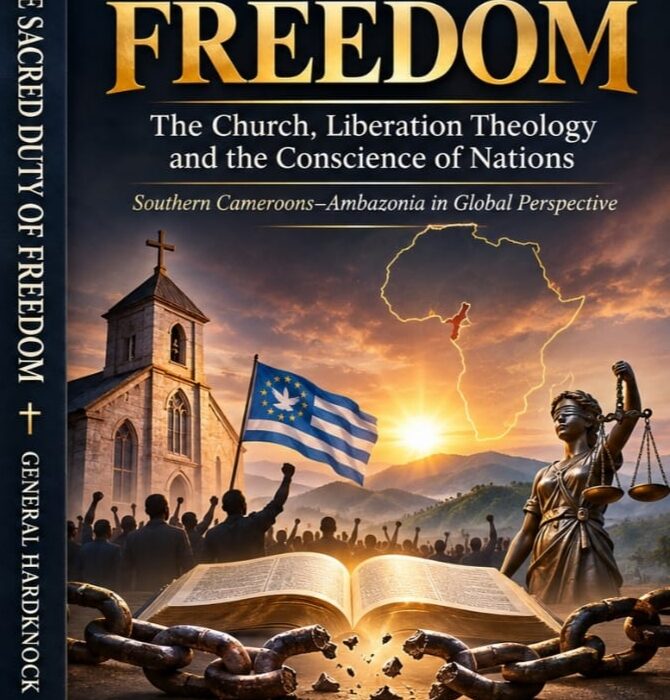
It is within this historical, biblical and theological framework that, General Hardknock examines the Southern Cameroons–Ambazonia experience.
The continuing conflict raises profound questions concerning the responsibilities of religious institutions towards suffering communities, displaced populations, persecuted individuals and those whose fundamental rights have been violated.
The Ambazonian experience is not presented merely as an isolated political question. It provides a contemporary case study through which broader questions of Christian conscience, institutional responsibility, human freedom and the moral boundaries of political resistance may be investigated.
This book seeks neither to transform the Church into a political party nor to reduce Christianity to a revolutionary ideology. Rather, it examines how religious institutions can remain faithful to their spiritual vocation while responding meaningfully to injustice, protecting innocent life and upholding the dignity of every human being.
The moral responsibility of the Church must transcend political affiliations. Injustice does not become acceptable because it is committed by those whose political objectives we share. Neither does human suffering become less significant because its victims belong to an opposing community.
The principles of justice, compassion and human dignity must be applied consistently.
Ultimately, liberation cannot be measured solely by the defeat of an oppressive system, the acquisition of political independence or the establishment of new institutions of government. Its enduring significance must be measured by the quality of the society that emerges: its commitment to justice, its respect for human dignity, its protection of the vulnerable and its capacity to prevent the recurrence of oppression.
The central question of this book is therefore not simply whether the Church should participate in liberation movements.
It is whether the Church can remain faithful to its divine mission without confronting the injustice that diminishes the humanity of those entrusted to its spiritual care—and how it can fulfil that responsibility without abandoning the sanctity of human life.
The Independentist news book review desk