








News commentary

We are home to news on Cameroon and the CEMAC region. We are dedicated to honest and reliable reporting. We are the voice of the Cameroonian people and their fight for freedom and democracy at a time when the Yaoundé government is silencing dissent and suppressing democratic voices.

The Nso throne must be addressed through legitimate Nso custom. The Ambazonian war must be addressed between the Federal Republic of Ambazonia and LRC. And the future of Ambazonia must be determined through the restoration of the people’s right to govern themselves. Anything less risks managing the appearance of peace while leaving the reasons for the war unresolved.
By Uchiba Nelson, with
additional information
from Timothy Enongene,
Associate Editor-in-Chief,
The Independentist News
As Amazon associate this site earns from qualifying purchases
Buy your copies of books on the Ambazonian revolution by Martin Mungwa on Amazon
https://www.amazon.com/s?k=Martin+mungwa&crid=OGWVBDZ2JM72&sprefix=martin+mungwa%2Caps%2C1437&linkCode=ll2&tag=njokings-20&linkId=8bd23f564caa9d248de94924215684fc&language=en_US&ref_=as_li_ss_tl
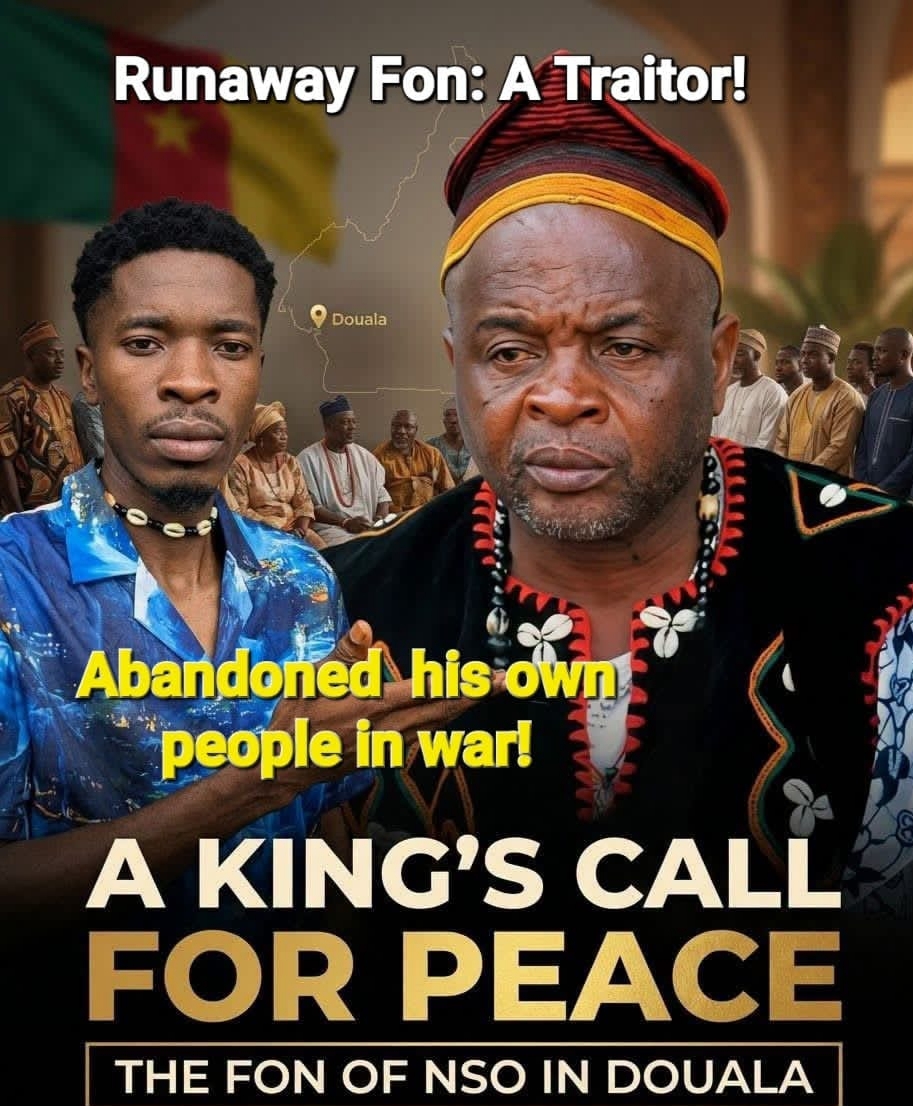
Douala – 25 October 2026 – The image of the Fon of Nso in Douala, away from his ancestral homeland while his people endure the consequences of war, raises questions about traditional responsibility and the political purpose of community dialogue. But the controversy extends beyond the Nso throne: it exposes a wider concern about Yaoundé’s attempts to address the Ambazonian conflict through localised dialogue instead of confronting the political dispute at its heart.
The war is between La République du Cameroun (LRC) and the Federal Republic of Ambazonia. It is not a war between Nso and other Ambazonian communities. Presenting it as a collection of local grievances risks obscuring the fundamental issue: the right of the Ambazonian people to determine their political future.
A THRONE ROOTED IN ANCESTRAL LAND
A Fon is traditionally enthroned to serve his people, preserve their heritage, and uphold the institutions of his ancestral homeland. The palace, ancestral shrines, burial grounds, and traditional council are integral to the cultural foundations of that responsibility.
Critics therefore question whether the Fon of Nso can adequately discharge his customary responsibilities while operating from Douala rather than his ancestral homeland. They argue that if a ruler cannot fulfil those responsibilities, the community should examine the customary provisions for a regency or other appropriate arrangements.
Whether the circumstances justify declaring the throne vacant is a matter for legitimate Nso customary institutions to determine under their established traditions. Nevertheless, the principle remains: traditional authority must be exercised in the interests of the people and with accountability to the institutions that sustain it.
BIYA DECLARED WAR. WHY IS HE NOW PROMOTING COMMUNITY DIALOGUE?
On 30 November 2017, Paul Biya declared war against those he described as terrorists amid the escalating armed conflict. The government’s response did not resolve the underlying political dispute, and the suffering continued.
The 2019 Major National Dialogue subsequently offered proposals including special status for the affected regions. However, key separatist leaders did not participate, and the dialogue failed to produce a settlement acceptable to the independence movement. Researchers have also documented concerns about the process’s inclusivity and the implementation of its recommendations.
Against this background, the promotion of another community dialogue deserves critical scrutiny. The concern is that Yaoundé may be attempting to repackage a political conflict as a collection of local reconciliation problems, using traditional rulers and community representatives to create the appearance of progress while avoiding meaningful negotiations with the Ambazonian independence movement.
Such a strategy could help the government present an image of peacebuilding to international audiences, reduce pressure for independent mediation, and shift attention away from the unresolved political dispute. This is a political interpretation of the initiative, not proof of the organisers’ private intentions. But the history of the 2019 process provides ample reason to demand clarity about the purpose, mandate, and expected outcomes of any new dialogue. Community dialogue cannot substitute for negotiations between the parties to the war.
THIS IS NOT AN NSO WAR AGAINST OTHER AMBAZONIAN COMMUNITIES
The Nso people are part of the wider Ambazonian question, not a separate belligerent whose conflict with other Ambazonian communities can be resolved by a meeting in Douala. The war concerns the relationship between LRC and the Federal Republic of Ambazonia. Local reconciliation may be valuable where genuine community disputes exist, but it must not be used to redefine the war, fragment the people’s political concerns, or portray the conflict as an internal quarrel among communities.
Traditional rulers can contribute to peace and protect their people. Their participation, however, should not be presented as collective consent to a political settlement that the people themselves have neither debated nor authorised.
Ambazonians should therefore examine any proposed dialogue carefully and distinguish genuine community reconciliation from a political process that leaves the central dispute untouched.
BUEA IS THE DESTINATION: RESTORING SELF-GOVERNMENT
When we speak of reaching Buea, we are not talking merely about occupying a geographical location. Buea represents the restoration of Ambazonian self-government—the right of the people to govern themselves as their forebears did before the constitutional and political arrangements that followed the 1961 union.
The historical withdrawal of Southern Cameroons representatives from the Eastern House of Assembly forms part of the struggle over political representation and the constitutional relationship between the two territories. The restoration aspiration seeks to recover self-government, not to negotiate a different administrative arrangement within LRC.
For those committed to Ambazonian independence, therefore, the destination is a self-governing Federal Republic of Ambazonia, with Buea as its historic and political centre—not a succession of community meetings that leaves the fundamental question unresolved.
THE PEOPLE MUST NOT BE USED AS POLITICAL COVER
The Fon of Nso and other traditional rulers should not be placed in a position where their cultural standing is used to legitimise a government-led process without a clear mandate from the people concerned.
The question is not whether dialogue is desirable. It is whether the proposed dialogue addresses the actual conflict, includes the relevant parties, and offers a credible route towards a lasting political settlement.
Yaoundé must not be allowed to replace a political dispute with a public-relations exercise. Nor should the international community mistake the attendance of traditional rulers at community gatherings for evidence that the Ambazonian question has been resolved.
The United Nations and international partners should insist on a credible process that addresses the underlying political dispute and involves the relevant parties. The continued consequences of war cannot be overcome by ceremonies, carefully staged meetings, or declarations of community unity alone.
The Nso throne must be addressed through legitimate Nso custom. The Ambazonian war must be addressed between the Federal Republic of Ambazonia and LRC. And the future of Ambazonia must be determined through the restoration of the people’s right to govern themselves. Anything less risks managing the appearance of peace while leaving the reasons for the war unresolved.
As Amazon associate this site earns from qualifying purchases
Buy your copies of books on the Ambazonian revolution by Martin Mungwa on Amazon
https://www.amazon.com/s?k=Martin+mungwa&crid=OGWVBDZ2JM72&sprefix=martin+mungwa%2Caps%2C1437&linkCode=ll2&tag=njokings-20&linkId=8bd23f564caa9d248de94924215684fc&language=en_US&ref_=as_li_ss_tl
Uchiba Nelson, with
additional information
from Timothy Enongene,
Associate Editor-in-Chief,
The Independentist News
Share This Post:
AMBAZONIAN FONS AND CHIEFS: STAY WITHIN YOUR ANCESTRAL BOUNDARIES AND OUT OF POLITICS!
NKONDA TITUS, TAMBE TIKU AND THE YAOUNDÉ CONNECTION: IS LRC USING ITS OWN COLLABORATORS TO TARNISH THE AMBAZONIA STRUGGLE?
Related Post
AMBAZONIAN FONS AND CHIEFS: STAY WITHIN YOUR ANCESTRAL BOUNDARIES
NKONDA TITUS, TAMBE TIKU AND THE YAOUNDÉ CONNECTION: IS
KONYE HAS EXPOSED THE DIRTY GAME: WHO IS REALLY
AMBAZONIA THE PROPHECY THAT WAS MADE WHOLE: AN EPIC
LIFE INSURANCE EDUCATION HANDBOOK FOR IMMIGRANTS IN AMERICA –
SMEARING THE VULNERABLE WILL NEVER HELP LRC AGAINST AMBAZONIA: