












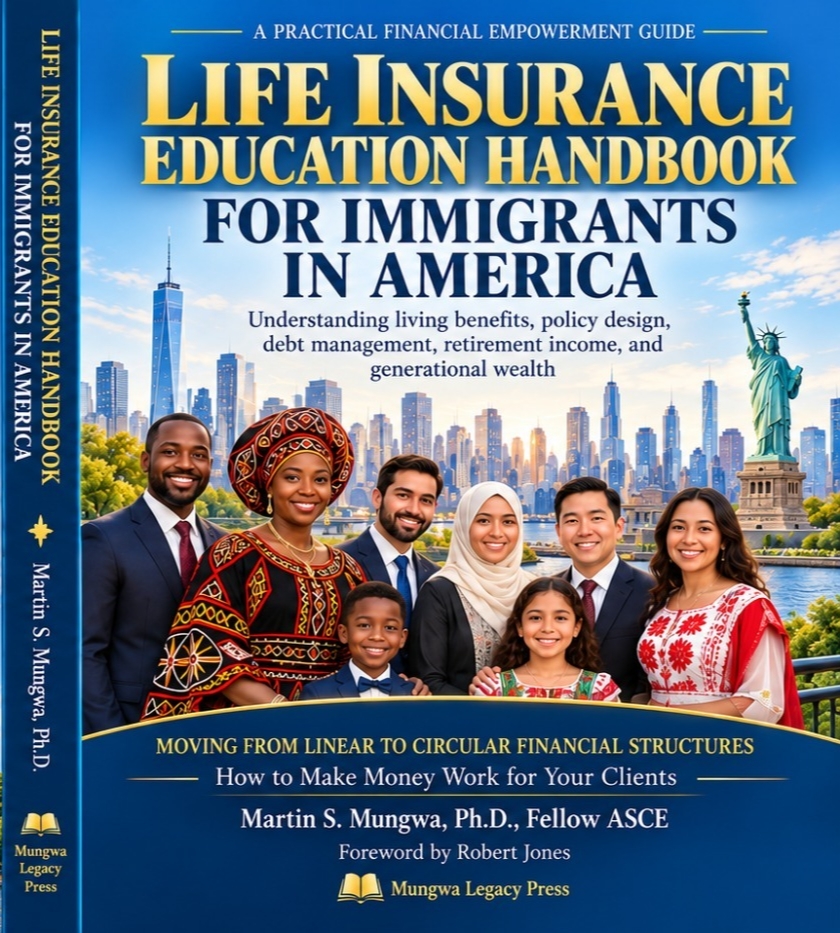
A Comprehensive Review of a New Handbook Designed to Help Immigrant Families Understand Financial Protection and Newly Licensed Insurance Agents Master Their Profession. By The Independentist News — Books & Ideas Desk .October 2026
As Amazon associate this site earns from qualifying purchases
Get your copy Now on Amazon
THE 470 PAGE HANDBOOK, OFFERS 81 ESSENTIAL BUYER QUESTIONS AND 75 FAQs TO STRENGTHEN INSURANCE EDUCATION IN AMERICA
BOOK DETAILS
Title: Life Insurance Education Handbook for Immigrants in America
Subtitle: Understanding Living Benefits, Tax Advantages, Policy Design, Debt Management, and Generational Wealth
Author: Martin S. Mungwa, Ph.D., Fellow ASCE
Foreword: Robert Jones, President and Co-Founder, Faith Life Group, LLC
Publisher: Mungwa Legacy Press, New Jersey, United States
Publication: Coming Soon — 2026
Format: Black-and-white paperback handbook containing figures, charts, tables, instructional frameworks, case studies, and worksheets
Chapters: 18, organized into four parts,Practical Learning Resources: 81 essential buyer questions, 75 frequently asked questions, chapter review exercises, financial planning worksheets, and professional evaluation tools
Planned Retail Price: $44.99
Target Readership: Immigrant families, newly licensed life insurance agents, experienced professionals seeking a reference handbook, insurance educators, and community financial-literacy organizations across the United States.
A Book That Challenges Insurance Agents to Master the Business Before Selling Policies
A new 470-page handbook preparing for publication in the United States raises a fundamental question about the life insurance industry: How can an insurance agent responsibly recommend a financial contract without fully understanding how that contract works, how money flows through it, and how it serves the client’s long-term interests?
That question lies at the center of Life Insurance Education Handbook for Immigrants in America, written by Martin S. Mungwa, Ph.D., Fellow ASCE, and scheduled for release through Mungwa Legacy Press.
The publication addresses two closely related problems. First, many immigrant families are unfamiliar with the language, contractual structure, financial implications, and tax treatment of American life insurance. Second, some newly licensed agents enter the industry equipped with basic licensing knowledge and sales techniques but without the deeper financial understanding required to explain complex products or assess clients’ broader economic circumstances.
Mungwa argues that these two knowledge gaps must be addressed together. The family needs to understand what it is buying. The agent must understand what is being recommended. The handbook attempts to make that educational relationship the foundation of professional insurance practice.
Its guiding principle is direct: “Do not buy what you do not understand. Do not sell what you cannot explain. And do not recommend what you cannot justify in the client’s interest.”
Eighty-One Essential Buyer Questions and Seventy-Five Frequently Asked Questions
One of the publication’s strongest practical features is its extensive question-based learning system. Two chapters are particularly important.
Chapter 16 contains 81 questions every prospective insurance buyer should ask before signing a contract. Chapter 17 addresses 75 frequently asked questions about life insurance. Together, these provide 156 structured questions and answers or inquiry prompts, in addition to the review questions, case studies, exercises, and worksheets elsewhere in the handbook.
For beginning agents, this is a valuable learning resource. The 81 buyer questions encourage systematic investigation of proposed policies. They direct attention to such matters as policy ownership, underwriting classification, premiums, death benefits, living benefits, surrender provisions, loans, guarantees, nonguaranteed illustrations, tax considerations, and the obligations involved in maintaining coverage. The 75 frequently asked questions help agents prepare to answer the concerns and misunderstandings commonly encountered in conversations with prospective clients.
These questions are not simply intended for memorization. Their educational value is that they encourage agents to investigate the actual contracts they recommend, distinguish facts from assumptions, and explain their answers in language an ordinary family can understand.
A newly licensed agent who works systematically through these materials should be better positioned to recognize knowledge gaps, seek reliable guidance, and conduct more informed client discussions. The questions also allow policyholders to assess whether the professional advising them understands the product.
This two-way accountability is one of the handbook’s most distinctive features. From Selling Insurance to Understanding How Money Works The book introduces a broader financial concept: moving from linear to circular financial structures.
In a conventional linear financial pattern, an individual earns income, pays bills, services debt, meets household obligations, and begins the same financial cycle with the next paycheck.
Mungwa encourages readers to examine whether a more deliberate financial arrangement can improve the relationship among earned income, financial protection, liquidity, debt management, savings, productive investments, and long-term family obligations.
In this context, a circular financial structure describes an approach in which financial resources are managed with greater attention to preserving capacity, coordinating obligations, and supporting future productive activity. The author does not claim that money automatically multiplies or that purchasing life insurance guarantees wealth creation.
Instead, the handbook examines how appropriate insurance arrangements may fit within a broader strategy alongside emergency reserves, responsible borrowing, debt reduction, asset development, and estate planning. This distinction is especially important for insurance agents.
A policy’s projected cash value is not the same as cash available for surrender. A policy loan is not free money. A favorable tax treatment is not a universal tax exemption. And an attractive illustration is not proof of guaranteed future performance.
Understanding these relationships is necessary before a professional can meaningfully explain how financial strategies might work for a particular client.
Part I: Understanding Insurance, Family Responsibility, and Financial Protection
The handbook begins with four foundational chapters. Chapter 1 — What Life Insurance Is—and What It Is Not explains the purpose of life insurance, the contractual relationship between insurers and policyholders, the difference between term and permanent coverage, and the importance of informed professional guidance.
Chapter 2 — Immigrant Families in America: Duty, Belief, and the Cost of Being Unprepared examines financial responsibilities that may extend across households, generations, and international borders. It recognizes that immigrant communities are diverse and that family obligations must be assessed individually rather than assumed.
Chapter 3 — Who Depends on You? Assessing the Need for Protection introduces Human Life Value and the author’s Human Life Equity concept. It explains how insurance needs may arise from earned income, caregiving, household services, outstanding obligations, and other economic contributions.
Chapter 4 — Term, Whole Life, Universal Life, Indexed Universal Life, and Annuities compares major financial protection products, including their purposes, guarantees, costs, benefits, and limitations.
The principal lesson of Part I is that insurance planning should begin with identifying a financial risk, not selecting a product to sell. For a beginning agent, this is an essential professional discipline.
Part II: Understanding the American Insurance and Tax Systems
The second part explains the institutional and regulatory environment in which American insurance operates. Chapter 5 distinguishes insurance carriers, licensed producers, insurance marketing organizations, underwriting departments, and state regulators. It also examines professional competence, consumer protection, and the risks of relying on unverified insurance claims circulating on TikTok, YouTube, and other social media platforms.
Chapter 6 examines the significance of 1913 in the development of the modern federal income-tax system and explains its relevance to financial education.
Chapter 7 introduces Internal Revenue Code Sections 101, 7702, and 7702A, including important distinctions in the federal tax treatment of qualifying life insurance contracts.
Chapter 8 explores the Guideline Premium Test, Cash Value Accumulation Test, and Modified Endowment Contract classification, showing why the way a policy is funded can influence its tax consequences.
Chapter 9 explains how to evaluate insurance illustrations, distinguishing contractual guarantees from assumptions about future performance.
This section is particularly important for agents who want to move beyond repeating marketing presentations and develop a working understanding of policy design. It also helps consumers understand why tax-related claims and attractive projected values require careful verification.
Part III: Understanding Insurance Economics, Financial Risks, and Family Legacy
Chapters 10 through 14 address the financial decisions that can determine whether a policy continues to serve its intended purpose.
Chapter 10 — “Zero Is the Hero”: What the Zero-Percent Floor Really Means explains that a zero-percent indexed interest-crediting floor does not eliminate insurance charges or guarantee that cash surrender values cannot decline.
Chapter 11 — Premiums, Costs, Loans, Surrenders, and Lapse Risk examines how money enters an insurance contract, how charges affect policy values, and what happens when a policyowner borrows, withdraws funds, or fails to maintain sufficient coverage.
One instructional example evaluates the use of a policy loan as part of financing a passenger van intended for rental operations. The calculation considers rental revenue, operating expenses, additional vehicle financing, policy-loan interest, repayment, and financial reserves.
The lesson is not that borrowing against life insurance necessarily produces income, but that every proposed use of funds must be evaluated through real cash-flow calculations and risk analysis.
Chapter 12 — Beneficiaries, Probate, Estate Planning, and Cross-Border Families examines ownership, beneficiary designations, inheritance considerations, and the need for legal coordination when family members or assets are located in multiple jurisdictions.
Chapter 13 — From Family Protection to Intergenerational Planning connects knowledge, skills, productive capacity, income, financial protection, asset development, and family succession.
Chapter 14 — Selecting Coverage and Reviewing It Over Time explains why insurance requires continuing evaluation as household income, family circumstances, beneficiaries, and financial obligations change.
For agents, this part reinforces an important point: professional responsibility continues long after a policy has been issued.
Part IV: A Practical Training Toolkit for Agents and Families
The final four chapters are designed to turn financial knowledge into practical understanding. Chapter 15 — Five Multicultural Family Case Studies examines illustrative households facing different financial responsibilities and decisions. The cases encourage readers to compare potential strategies rather than assume that one insurance product is suitable for everyone.
Chapter 16 — The 81 Questions Every Buyer Should Ask Before Signing serves as a practical due-diligence instrument. It helps agents prepare for serious client questions while helping consumers understand the issues they should investigate before entering a long-term contract.
Chapter 17 — Seventy-Five Frequently Asked Questions About Life Insurance provides accessible explanations of insurance concepts, product distinctions, underwriting, policy values, living benefits, claims, and other common concerns.
Chapter 18 — A 30-Day Family Insurance Education Plan supplies a structured approach to reviewing financial responsibilities, coverage needs, existing policies, beneficiary records, and educational priorities.
This final section makes the handbook suitable not only for individual reading but also for structured instruction, agent-development workshops, and financial-literacy programs.
What the 156 Questions Can Teach Beginning Agents
The value of the 81 buyer questions and 75 frequently asked questions extends beyond the number itself. They create an opportunity for agents to test their ability to communicate insurance concepts without relying entirely on carrier sales materials.
For example, can an agent clearly explain the difference between account value and surrender value? Can the agent show why a policy loan affects the net death benefit? – Can the agent explain how a proposed premium schedule differs from a contractual guarantee that coverage will remain in force? – Can the agent describe the circumstances under which policy borrowing may create adverse tax consequences? – Can the agent distinguish insurance protection from asset accumulation? – Can the agent identify when a matter requires the involvement of an attorney, tax professional, or appropriately qualified financial adviser?
And perhaps most importantly, can the agent explain why a policy is suitable—or unsuitable—for a particular client’s financial circumstances? These are the kinds of questions that help distinguish product familiarity from professional competence.
The handbook’s question-based approach encourages continuing learning and self-assessment. It does not replace the licensing process, insurer-approved training, or continuing education requirements. It can, however, provide a substantial supplementary reference for developing practical knowledge.
How Immigrant Families Can Benefit
Immigrant families often encounter American financial institutions while simultaneously meeting significant household, employment, business, educational, and cross-border responsibilities. The handbook recognizes that financial education must account for those circumstances without stereotyping any nationality or community.
Its practical value includes helping families understand the purpose of insurance, identify actual dependents, compare policy types, recognize unreasonable financial commitments, evaluate claims about tax advantages, and maintain accurate beneficiary records. The book also encourages families to examine how debt, emergency reserves, insurance protection, and productive financial goals fit together.
That broader perspective is particularly useful to households whose income must support both present responsibilities and future generations. The message is not that every immigrant family needs permanent life insurance or an elaborate financial strategy. It is that every family benefits from understanding its financial obligations and the contractual consequences of the choices available.
A Necessary Warning About Social Media Insurance Advice
One of the handbook’s timely contributions is its criticism of poorly supported insurance advice distributed through digital platforms. TikTok, YouTube, Instagram, and similar services have created new opportunities for financial education. Experienced and responsible professionals can use these platforms to explain useful concepts.
However, short videos can also oversimplify policy design, exaggerate tax advantages, conceal costs, or suggest that complicated financial outcomes are guaranteed. A newly licensed agent with a persuasive presentation is not automatically an expert in tax law, insurance economics, or financial planning.
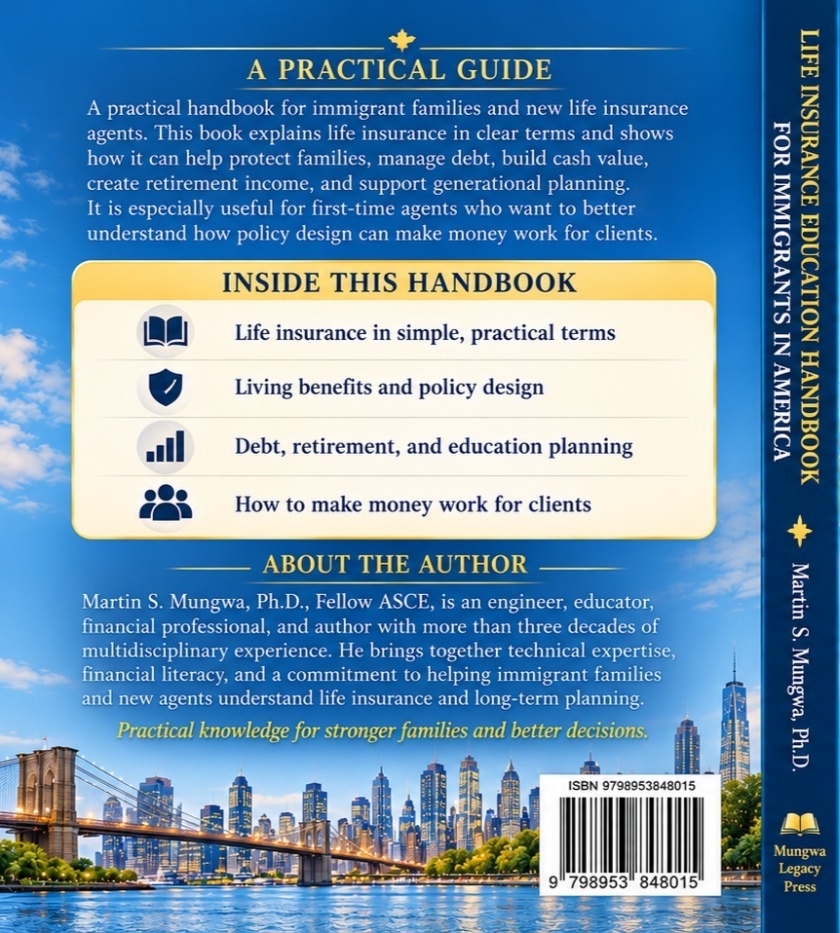
The handbook therefore encourages consumers to examine the actual insurance contract and requires professionals to distinguish between illustrations, contractual guarantees, and hypothetical examples. This is a valuable corrective to a financial marketplace increasingly influenced by promotional content.
The Author and His Professional Perspective
Martin S. Mungwa, Ph.D., Fellow ASCE, brings more than 35 years of multidisciplinary experience in engineering, education, management, financial services, and authorship to the publication. His analytical background is evident in the handbook’s emphasis on understanding systems, evaluating risks, documenting assumptions, and examining long-term financial consequences. He is also the Founder and Managing Partner of Faith Life Group, LLC, an independent insurance marketing organization engaged in insurance education and professional development.
The foreword is contributed by Robert Jones, President and Co-Founder of Faith Life Group, LLC, who emphasizes the responsibility of insurance professionals to educate clients and explain recommendations competently. The combination of technical discussion, consumer protection, financial examples, and practical exercises gives the handbook a distinctly instructional character.
Editorial Assessment:
An Ambitious Working Reference With Substantial Practical Value The strongest feature of Life Insurance Education Handbook for Immigrants in America is that it attempts to bridge the gap between consumer knowledge and professional competence.
Its 18 chapters provide a broad introduction to insurance contracts, regulation, taxation, policy economics, risk management, financial obligations, and family continuity.
Its 156-question learning resource, supported by chapter reviews and practical worksheets, gives readers a structured means of examining and applying that knowledge. The A4 format is also appropriate for a working handbook. It allows additional room for explanatory tables, financial calculations, instructional figures, and worksheets.
The material is substantial, and some of its technical sections—particularly those concerning federal taxation, indexed universal life, Modified Endowment Contracts, and policy loans—will demand careful study.
Readers should not treat the handbook as a replacement for current insurer documents or individualized legal, tax, or financial advice. Its practical value lies in strengthening understanding and encouraging better-informed decisions. For newly licensed agents, the book offers a foundation for more responsible client engagement.
For immigrant families, it offers a framework for asking informed questions before assuming long-term financial obligations.
For training organizations, it provides material that could support workshops, guided reading, classroom discussions, and professional development.
ON AMAZON
Life Insurance Education Handbook for Immigrants in America represents a significant effort to bring comprehensive life insurance education to immigrant communities and insurance professionals across the United States. Its central message is that financial protection should not be separated from financial understanding.
A family must know what it owns, what it owes, what it needs to protect, and what future obligations it intends to meet. An agent must know what a contract provides, what it costs, what its limitations are, and why it reasonably serves a client’s interests. The book’s 81 essential buyer questions and 75 frequently asked questions reinforce that shared responsibility.
Now on Amazon
LIFE INSURANCE EDUCATION HANDBOOK FOR IMMIGRANTS IN AMERICA
By Martin S. Mungwa, Ph.D., Fellow ASCE
Foreword by Robert Jones
470 Pages | A4 Paperback | 18 Chapters | 156 Essential Questions and FAQs | Practical Worksheets and Financial Frameworks
Mungwa Legacy Press — New Jersey, United States
Planned Paperback Price: $44.99
From linear to circular financial thinking. From selling policies to educating clients. From financial uncertainty to informed family protection.
A Review by The Independentist News — Books & Ideas Desk







Leave feedback about this