








News commentary

We are home to news on Cameroon and the CEMAC region. We are dedicated to honest and reliable reporting. We are the voice of the Cameroonian people and their fight for freedom and democracy at a time when the Yaoundé government is silencing dissent and suppressing democratic voices.

Whether Biya makes the reported two-week trip, remains in Yaoundé or returns to Geneva, the central question survives the rumour: Can LRC demonstrate that its institutions are stronger than their dependence on one man?
By Veritas Network for The Independentist News
October 20, 2026
As Amazon associate this site earns from qualifying purchases
Buy your copies of books on Ambazonia’s productive Sovereignty and statecraft By Martin Mungwa from Amazon
https://www.amazon.com/s?k=martin+mungwa&crid=168UPC66G6B3&sprefix=martin+mungwa%2Caps%2C477&linkCode=ll2&tag=njokings-20&linkId=770b7fa4d8d809e4fd8e8888eb24abe3&language=en_US&ref_=as_li_ss_tl
What does it say about a country’s political leadership when its president is reportedly preparing to spend two weeks on a working visit to the very country he governs before returning to Switzerland? This extraordinary question has emerged following an unverified social-media report suggesting that 93-year-old Paul Biya, president of La République du Cameroun (LRC), may travel to Cameroon for a brief working stay before returning to Geneva.
The claim, attributed to @AfricaTodayMG and reportedly amplified by Uganda’s @GalaxyFMUg, has generated considerable attention. The original post is said to have attracted 1.5 million views within a day, although that figure, like the proposed itinerary, has not been independently verified.
But the controversy raises a question more important than the itinerary itself: has LRC become a political system in which the country must continually wait for its president rather than rely on institutions capable of governing in his absence? The distinction is fundamental.
Presidential travel is normal. Extended private stays abroad are not automatically evidence of incapacity. But persistent uncertainty surrounding a president’s whereabouts, availability, appointments and constitutional succession is a legitimate matter of public accountability. And in LRC, these questions are no longer theoretical.
A PRESIDENT RETURNS, BUT THE GOVERNANCE QUESTIONS REMAIN
On August 20, 2026, Paul Biya returned to Yaoundé after spending approximately ten weeks abroad, principally in Geneva, Switzerland. His absence, beginning June 7, attracted international scrutiny and generated speculation about his health, his whereabouts and the continuity of executive authority.
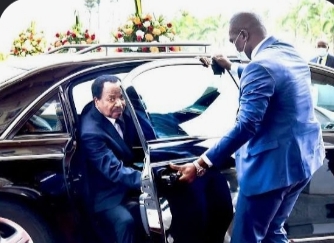
The return was widely publicized. Supporters welcomed him, official accounts celebrated his arrival, and the presidential motorcade proceeded toward Etoudi Palace. Yet an arrival ceremony is not a substitute for institutional accountability.
On October 17, Al Jazeera reported that Cameroon was still awaiting a promised government reshuffle and the appointment of a vice-president. Biya had pledged a new government in his December 31, 2025, national address, but the anticipated appointments had not materialized by the reporting period. The questions therefore extend well beyond the president’s travel schedule.
Why have promised government changes remained outstanding for so long? Why does uncertainty over executive appointments persist? And why must a country’s political expectations revolve so heavily around announcements from one individual? A government should not depend on speculation about when its president will return, whom he might appoint or what decisions he may eventually announce. A functioning state requires institutional continuity, not presidential suspense.
THE VACANT VICE-PRESIDENCY: SUCCESSION WITHOUT CERTAINTY
In April 2026, LRC adopted constitutional changes restoring the office of vice-president. The reform established a mechanism under which a presidentially appointed vice-president could succeed the president following death, resignation or constitutionally established permanent incapacity.
Its proponents presented the measure as an instrument of continuity and stability. Critics questioned whether allowing the president to choose his potential successor further concentrated power within an already dominant presidency. The constitutional amendment did not establish a deadline for the appointment.
As of Al Jazeera’s October 17 reporting, the position remained vacant. The distinction matters. The continued vacancy does not, by itself, establish a constitutional violation. It does, however, invite scrutiny of whether the promised institutional safeguards are operational. A succession mechanism is only as effective as the arrangements established to implement it.
If the office remains vacant, alternative constitutional provisions become critically important. Under the revised constitutional framework, the President of the Senate has a role in the event of a presidential vacancy when no vice-president is in office. But legal provisions alone cannot eliminate political uncertainty. Citizens deserve to understand the procedures, the responsible institutions and the safeguards that would govern a transition.
For a political system dominated by one leader for more than four decades, those safeguards should be unmistakably clear. A constitution cannot provide political reassurance merely by creating an office that remains unoccupied.
WHEN A PRESIDENT’S MOVEMENTS BECOME A NATIONAL QUESTION
The reported Geneva itinerary is particularly revealing because of the language attributed to it. A president is said to be preparing to “visit” his own country. The description is unusual, even if the itinerary ultimately proves inaccurate.
Ordinarily, a presidential visit refers to travel to another country or a particular region within the president’s own state. In this case, the alleged arrangement reverses the familiar relationship between the head of state and the country he governs.
The president’s homecoming becomes an event. His presence becomes a political signal. His departure becomes another subject of speculation. That is an unhealthy foundation for public confidence. The essential issue is not whether Biya resides permanently in Switzerland, a claim that has not been established. Nor is it whether a president may conduct some official business from abroad.
The issue is whether LRC’s executive institutions communicate reliably, conduct public affairs transparently and maintain clear lines of constitutional responsibility. Government business should not become mysterious merely because the president is beyond the country’s borders. Neither should an individual’s age automatically be treated as proof of incapacity.
The proper test is institutional performance, constitutional accountability and the transparent exercise of public authority. On those grounds, LRC’s leadership arrangements deserve serious scrutiny.
THE AMBAZONIA QUESTION CANNOT BE RESOLVED THROUGH ETOUDI’S SUCCESSION
For Ambazonians, the implications extend beyond the internal governance of La République du Cameroun. The unresolved conflict between Ambazonia, the former British Southern Cameroons, and LRC cannot be reduced to questions about Biya’s health, travel schedule or eventual successor.
Ambazonia’s political claim concerns sovereignty, self-determination and the historical and constitutional circumstances surrounding the former British Southern Cameroons. Those issues cannot be settled simply by appointing a vice-president, reshuffling a cabinet or replacing the occupant of Etoudi Palace.
A new administration in Yaoundé might create diplomatic opportunities. A leadership transition might alter the political calculations of the parties. But neither development automatically resolves the fundamental dispute. For advocates of Ambazonian independence, the relevant question remains whether LRC will participate in a credible, third-party-mediated political process that seriously addresses the competing claims over sovereignty and self-determination.
This requires more than administrative dialogue or consultations conducted within the political framework contested by Ambazonian independence advocates. It requires engagement with the substantive political disagreement. Ambazonia’s future must not become a waiting game tied to the departure, survival or succession of Paul Biya.
No people should make their political future dependent on uncertainty surrounding another political leader. Ambazonians must instead remain focused on their own institutional development, political coherence, diplomatic engagement and collective aspirations.
THE DANGER OF CONFUSING POLITICAL UNCERTAINTY WITH POLITICAL OPPORTUNITY
Leadership uncertainty within LRC may have consequences for the broader political environment. A disputed succession could generate instability. A new administration might reconsider existing policies. Changes in leadership could also produce continuity rather than reform. None of these outcomes should be assumed.
For Ambazonians, the strategic danger lies in treating developments in Yaoundé as substitutes for the sustained political work required to advance their own objectives. An independence movement cannot build its strategy around rumours of presidential illness, foreign travel or impending succession.
Its political credibility depends on the clarity of its objectives, the strength of its institutions, the legitimacy of its representation and its capacity to engage the international community. The constitutional uncertainty in LRC should therefore be studied carefully, not celebrated prematurely. Political unpredictability is not the same thing as political progress.
MILLIONS OF VIEWS CANNOT REPLACE VERIFIED INFORMATION
The reported circulation of the Geneva story illustrates another challenge: the growing influence of social media over perceptions of political authority. A claim about a president’s travel arrangements can cross continents in hours, attracting commentary, speculation and political interpretation before reliable confirmation becomes available.
The reported 1.5 million views, if accurate, would demonstrate considerable public interest. They would not establish the truth of the itinerary. The distinction is essential.
The claim attributed to @AfricaTodayMG and amplified by @GalaxyFMUg remains unverified. There is no independently established basis, from the sources examined, to conclude that Biya has scheduled a two-week working visit followed by a return to Geneva. That uncertainty must be clearly acknowledged. But the absence of confirmation does not invalidate the broader governance questions.
The prolonged absence ending August 20 was documented. The constitutional amendment restoring the vice-presidency was enacted. The continuing vacancy of that office was reported on October 17. These established developments provide sufficient grounds for public scrutiny.
The presidency should be able to communicate clearly about presidential travel, executive responsibilities and succession procedures without waiting for viral controversy. Transparency is not a concession granted by political leaders. It is an essential condition of accountable governance.
A COUNTRY MUST BE BIGGER THAN ONE MAN
Paul Biya has governed LRC since November 1982. More than four decades later, questions about his whereabouts, appointments, succession and continued leadership still dominate discussions about the country’s political future. The deeper concern is institutional.
A political system that revolves around one individual inevitably becomes vulnerable to uncertainty about that individual’s availability and decisions. Effective governance requires institutions capable of performing their constitutional functions, irrespective of the president’s physical location.
It requires predictable procedures, transparent communication and an orderly mechanism for transferring executive responsibility when constitutionally necessary. The presidency is an institution. It should never become indistinguishable from the personal circumstances of its occupant.
For Ambazonians, there is an additional lesson. The political future of the former British Southern Cameroons must be pursued through the aspirations, organization and determination of its own people, not through speculation surrounding the leadership of La République du Cameroun.
Whether Biya makes the reported two-week trip, remains in Yaoundé or returns to Geneva, the central question survives the rumour: Can LRC demonstrate that its institutions are stronger than their dependence on one man?
And for Ambazonia, an equally important question follows: Can its people build the political institutions and collective leadership necessary to determine their own future, regardless of who occupies Etoudi Palace? The answer to neither question will be found in an airport arrival, a presidential motorcade or a viral social-media post.
It will be found in constitutional accountability, institutional responsibility and political decisions capable of outlasting any individual leader. A country must be bigger than its president. And the destiny of a people must be bigger than the uncertainties surrounding another country’s leadership.
As Amazon associate this site earns from qualifying purchases
Biy your copies of books on Ambazonia’s productive Sovereignty and statecraft By Martin Mungwa from Amazon
https://www.amazon.com/s?k=martin+mungwa&crid=168UPC66G6B3&sprefix=martin+mungwa%2Caps%2C477&linkCode=ll2&tag=njokings-20&linkId=770b7fa4d8d809e4fd8e8888eb24abe3&language=en_US&ref_=as_li_ss_tl
— Veritas Network
Share This Post:
Spiritual Choke Point: Reclaiming Direct Access, Ethical Consciousness, and Human Responsibility
30 AMBA FIGHTERS SURRENDER IN BAMENDA: TEN QUESTIONS DION NGUTE CANNOT KEEP DODGING
Related Post
Spiritual Choke Point: Reclaiming Direct Access, Ethical Consciousness, and
30 AMBA FIGHTERS SURRENDER IN BAMENDA: TEN QUESTIONS DION
THE WAR THAT PAYS: EX-LRC SOLDIER ALLEGES MILITARY BOSSES
“YOU CANNOT HIDE THE DEATH OF A HEAD OF
BOOK LAUNCH! BOOK LAUNCH! BOOK LAUNCH! The Sako Leadership
THE SECOND RETURN By Dr. Martin S. Mungwa is