








News commentary

We are home to news on Cameroon and the CEMAC region. We are dedicated to honest and reliable reporting. We are the voice of the Cameroonian people and their fight for freedom and democracy at a time when the Yaoundé government is silencing dissent and suppressing democratic voices.

A new president in Yaoundé could introduce new political calculations. Whether those calculations produce a meaningful change would depend on concrete actions. The death of a head of state cannot be established by a viral post. And the political future of an entire people cannot be reduced to the fate of one man.
By Timothy Enongene
Associate Editor-in-Chief, The Independentist News
October 18, 2026
As Amazon associate this site earns from qualifying purchases
Buy your copies of books on Ambazonia’s productive Sovereignty and statecraft By Martin Mungwa from Amazon
0https://www.amazon.com/s?k=martin+mungwa&crid=3IFQGGBERHDG0&sprefix=martin+mungwa%2Caps%2C474&linkCode=ll2&tag=njokings-20&linkId=b8a6cbb209b2432a10a516d464385812&language=en_US&ref_=as_li_ss_tl
A DENIAL THAT RAISES A LARGER QUESTION
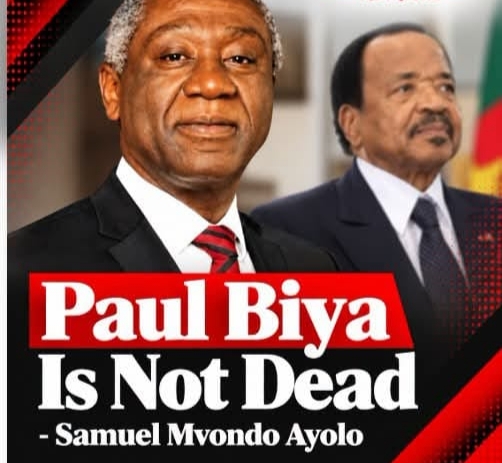
“You cannot hide the death of a Head of State.” That was the substance of Samuel Mvondo Ayolo’s response to renewed rumours that Paul Biya, President of La République du Cameroun (LRC), had died.
Speaking on Friday, October 16, 2026, over RFI, the Director of the Civil Cabinet at the Presidency rejected the allegations circulating on social media. He maintained that Biya was alive, in good health, and continuing his official duties.
The denial was unequivocal. Yet the controversy exposed a question considerably larger than the fate of one individual: What happens to a political system built around one man when the continuity of his leadership becomes a matter of recurring public uncertainty?
For the people of the former British Southern Cameroons—Ambazonia—that question carries implications beyond the corridors of Unity Palace. The government in Yaoundé directs the military, diplomatic, and security policies that affect the Ambazonian people. Changes in its leadership could therefore influence the direction of a conflict that has remained unresolved for years. But uncertainty is not evidence. And political expectation must never be confused with established fact.
THE RUMOUR IS NOT THE STORY
The latest allegations emerged from social media posts claiming that Biya had died and that discussions concerning his replacement were underway. No independently verified evidence has established his death. The Presidency has rejected the allegation. That distinction is fundamental.
A responsible publication cannot declare a head of state dead because an online post has attracted attention. Neither can it treat an official denial as sufficient to settle every legitimate question about how presidential authority is exercised.
Three separate issues require examination: Is there reliable evidence concerning the president’s reported death? How is presidential authority exercised during prolonged absences? What constitutional procedure governs succession if the presidency becomes vacant? Confusing these questions weakens serious political analysis.
The first concerns evidence. The second concerns governance. The third concerns constitutional continuity. All three matter, but they are not interchangeable.
TEN WEEKS AWAY FROM POWER
On June 7, 2026, Paul Biya departed Cameroon for what his office described as a brief private stay in Europe. He returned to Yaoundé on August 20, after more than ten weeks abroad.
The length of that absence revived public debate over the functioning of the presidency and the institutional arrangements for exercising executive authority. It did not establish that Biya had died or become incapacitated. Nevertheless, the episode demonstrated how prolonged presidential absences can generate uncertainty in a political system where executive authority is highly centralized.
A decree bearing the president’s authority demonstrates that an official act has been issued. It does not necessarily provide the public with a complete picture of the internal processes through which presidential decisions are made.This distinction is particularly important when the president’s public appearances are limited.
The question is not whether government can continue to operate in a president’s physical absence. Many constitutional systems provide for such circumstances. The question is whether the mechanisms of governance are transparent, accountable, and sufficiently institutionalized to withstand uncertainty at the top.
THE 2026 CONSTITUTIONAL AMENDMENT CHANGES THE SUCCESSION EQUATION
Paul Biya has governed Cameroon since November 1982. At 93, he remains central to a constitutional and political system shaped by more than four decades of his presidency.
On April 14, 2026, a constitutional amendment reintroduced the office of vice-president and fundamentally changed the arrangements for presidential succession.
Under the revised framework, the vice-president is appointed by the president. In the event of a constitutionally established vacancy arising from death, resignation, or permanent incapacity, the vice-president assumes the presidency and completes the remaining term.
The reform replaced the earlier framework under which the President of the Senate would serve in an interim capacity pending a presidential election. Supporters of the amendment have presented it as a means of ensuring continuity and stability. Critics have questioned whether concentrating succession authority in a presidential appointee sufficiently protects democratic accountability.
For Ambazonians observing events in Yaoundé, the amendment raises an important institutional consideration. A presidential succession is not necessarily a political transformation. The transfer of the presidency from one officeholder to another can preserve existing governing institutions, security arrangements, and territorial policies.
Indeed, constitutional continuity is often designed precisely to avoid institutional disruption. Those expecting a change in Yaoundé to produce an immediate change in policy toward Ambazonia must therefore distinguish the replacement of a president from the transformation of a state’s political position.
WHY THE SUCCESSION QUESTION MATTERS TO AMBAZONIA
The Ambazonian independence movement regards the political status of the former British Southern Cameroons as unresolved and seeks the restoration of its independence. The government of Cameroon rejects that position and maintains that the territory forms part of the Republic. This disagreement lies at the center of the conflict.
From the Ambazonian perspective, the importance of succession in Yaoundé is therefore not primarily who inherits the presidential office, but whether a successor would pursue a different approach to the conflict. Would a new administration reconsider the existing military strategy? Would it initiate a different political dialogue?
Would it reconsider policies affecting displaced communities, detained persons, civilian protection, and the broader humanitarian situation? Would it offer proposals capable of addressing the underlying constitutional and political disagreement? None of these outcomes can be presumed merely because leadership changes.
A successor may revise policies, maintain them, or pursue a combination of continuity and change. The evidence would lie in actual decisions, not speculation about personalities. For Ambazonia, the strategic question is not simply who governs in Yaoundé, but what policies that government adopts toward the conflict.
THE DANGER OF MISTAKING SUCCESSION FOR RESOLUTION
Political history provides many examples of governments changing leaders while preserving their fundamental institutions and national policies. The departure of a long-serving president does not automatically dismantle an existing security establishment, reverse constitutional arrangements, or resolve long-standing political disputes. Those institutions often outlive their architects.
That reality is especially relevant to the Ambazonian conflict, which involves competing interpretations of history, constitutional legitimacy, territorial sovereignty, and national identity.
The uncertainty surrounding Biya’s succession may alter political calculations among government officials, opposition parties, security institutions, and international partners. But uncertainty alone cannot establish what those changes will be.
The Ambazonian independence movement must therefore be understood as having political objectives that extend beyond the tenure of any single Cameroonian president. Its demands cannot be reduced to waiting for a vacancy at Unity Palace. Nor should rumours about the president’s death be mistaken for evidence that the underlying political dispute is approaching resolution.
INSTITUTIONS OUTLIVE INDIVIDUALS
Ayolo’s statement addresses a specific allegation: that Paul Biya had died and that his death was being concealed. The larger issue concerns the institutional arrangements of the state.
The April 2026 amendment provides a new constitutional framework for succession, but questions about its implementation, transparency, and democratic accountability remain legitimate subjects of public examination. For the government in Yaoundé, the challenge is to demonstrate that authority is exercised according to the constitution and that the transfer of presidential power, whenever it becomes necessary, can take place through established procedures.
For observers of the Ambazonian conflict, the task is to examine how any future leadership transition may affect the state’s actions, rather than assume that succession itself will resolve the dispute. A constitutional change in Yaoundé may determine who occupies the presidency. It does not, by itself, determine the political future of the former British Southern Cameroons.
BEYOND THE FATE OF PAUL BIYA
The recurring rumours surrounding Paul Biya reveal the consequences of limited public information in a highly centralized political system. They also expose the ease with which speculation can overtake verifiable evidence.
Samuel Mvondo Ayolo is entitled to reject an unsubstantiated death report. Journalists are equally entitled to ask how the presidency functions and how succession arrangements would operate. Both principles can coexist. For Ambazonia, the decisive considerations remain the policies and institutions responsible for the conflict, the possibilities for political change, and the unresolved questions that have sustained the dispute.
A new president in Yaoundé could introduce new political calculations. Whether those calculations produce a meaningful change would depend on concrete actions. The death of a head of state cannot be established by a viral post. And the political future of an entire people cannot be reduced to the fate of one man.
As Amazon associate this site earns from qualifying purchases
Buy your copies of books on Ambazonia’s productive Sovereignty and statecraft By Martin Mungwa from Amazon
https://www.amazon.com/s?k=martin+mungwa&crid=3IFQGGBERHDG0&sprefix=martin+mungwa%2Caps%2C474&linkCode=ll2&tag=njokings-20&linkId=b8a6cbb209b2432a10a516d464385812&language=en_US&ref_=as_li_ss_tl
Timothy Enongene is Associate Editor-in-Chief of The Independentist News.
The Independentist News | Political Analysis | October 18, 2026
Share This Post:
BOOK LAUNCH! BOOK LAUNCH! BOOK LAUNCH! The Sako Leadership archives invites you and others.
Related Post
BOOK LAUNCH! BOOK LAUNCH! BOOK LAUNCH! The Sako Leadership
THE SECOND RETURN By Dr. Martin S. Mungwa is
UNFINISHED BUSINESS IN AFRICA: WHEN A REVOLUTION MUST ANSWER
POLITICAL SUICIDE OR STRATEGIC MISCALCULATION? THE BIYA–NGUTE ALLIANCE AND
THE EXIT SIGN IS FLASHING, DION NGUTE AND THE
WHEN DIALOGUE FAILS, STATECRAFT TAKES THE STAGE: Another Consultative