








Commentary

We are home to news on Cameroon and the CEMAC region. We are dedicated to honest and reliable reporting. We are the voice of the Cameroonian people and their fight for freedom and democracy at a time when the Yaoundé government is silencing dissent and suppressing democratic voices.

The test of Dion Ngute’s latest mission is not how many people appeared before government cameras. It is whether civilians become safer, hostilities diminish, displaced families can return, and a credible process emerges to address the political dispute. The question remains: Is Yaoundé pursuing a settlement of the Ambazonian conflict—or simply managing its continuation?
By Lester Maddox | Guest Contributor
The Independentist News | Oakland, California
October 20, 2026
As Amazon associate this site earns from qualifying purchases
Buy your copies of books on Ambazonia’s productive Sovereignty and statecraft By Martin Mungwa from Amazon
https://www.amazon.com/s?k=martin+mungwa&crid=168UPC66G6B3&sprefix=martin+mungwa%2Caps%2C477&linkCode=ll2&tag=njokings-20&linkId=71c6c1d81555b67d5535d1918709100d&language=en_US&ref_=as_li_ss_tl
THIRTY FIGHTERS, TEN QUESTIONS, AND ONE UNRESOLVED CONFLICT
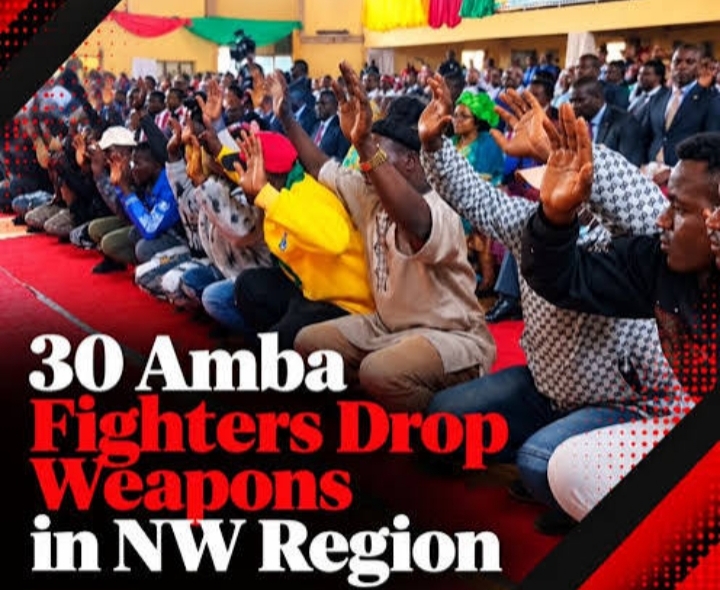
Thirty Ambazonian fighters reportedly surrendered during La République du Cameroun (LRC) Prime Minister Chief Dr. Joseph Dion Ngute’s visit to Bamenda on October 15, 2026.
The surrender coincided with the launch of another government-sponsored community dialogue initiative, presented by Yaoundé as part of its efforts to restore peace to the former British Southern Cameroons. But behind the ceremony, the speeches, and the official expressions of optimism lies a question that cannot be answered by counting surrendered weapons:
Is the government resolving the Ambazonian conflict, or merely administering its consequences while avoiding the political dispute at its center? For nearly a decade, successive government initiatives have promised peace, reconciliation, development, and reintegration. Yet the conflict remains unresolved, civilians continue to suffer, and disagreement over the political status of the former British Southern Cameroons persists.
Dion Ngute is not the first Prime Minister to undertake such missions. His predecessor, Philemon Yang, also visited the territory during a period of escalating political tensions. Different initiatives have followed, including the 2019 Major National Dialogue and subsequent disarmament and reintegration programs.
The government maintains that such initiatives provide pathways toward stability, national cohesion, and the reintegration of former combatants. Critics within the Ambazonian independence movement argue that these measures do not adequately address the underlying demand for self-determination. The disagreement is fundamental.
Disarmament may remove weapons from individual hands. Community dialogue may address local grievances. Development projects may improve livelihoods. But none of these measures automatically resolves a dispute over political status. Against that background, Dion Ngute’s Bamenda mission raises ten questions.
QUESTION 1: WHY DO HIGH-PROFILE SURRENDERS SO OFTEN ACCOMPANY GOVERNMENT VISITS?
Cameroon’s Disarmament, Demobilization and Reintegration structures are intended to facilitate the departure of combatants from armed groups and their return to civilian life. Such programs should function continuously, not merely during visits by senior political officials.
The reported surrender of 30 individuals during Dion Ngute’s visit may reflect genuine progress. But it also raises questions about how the process operates between public ceremonies. How many combatants have surrendered through routine reintegration channels? How many have completed rehabilitation programs? What proportion have successfully returned to civilian communities without taking up arms again?
And what independent evidence is available to demonstrate the long-term effectiveness of the program? The problem is not that surrender ceremonies occur. It is that highly visible events can receive more attention than the difficult work of sustainable reintegration. A surrender ceremony lasts a day. Successful reintegration must endure for years.
QUESTION 2: WHY THIRTY, AND WHO INDEPENDENTLY VERIFIED THE FIGURE?
The government and media reports have referred to approximately 30 fighters laying down their weapons in Bamenda. There is no basis for concluding that the figure is fabricated simply because it is a round number. Nevertheless, accountability requires more than an announcement.
Who verified the identities of the individuals presented? Were their affiliations with armed groups established? Were the surrendered weapons independently documented? Were neutral observers involved? What arrangements guarantee the safety, dignity, and lawful treatment of those entering the reintegration process? These questions matter both to public accountability and to the protection of former combatants.
A credible disarmament program should produce reliable information while protecting participants from retaliation, arbitrary detention, and other abuses. An announced number is a claim about an event. Its significance depends on what can be verified afterward.
QUESTION 3: DID ANY RECOGNIZED FIELD COMMANDERS SURRENDER?
The reported surrender of 30 individuals does not necessarily establish that armed organizations operating across Ambazonia have suffered a significant reduction in operational capacity. Were any recognized commanders among those presented? Did entire units demobilize? Have the individuals surrendered weapons and permanently disengaged from armed activity? Do the relevant armed groups acknowledge their departure?
These matters are important because the number of individuals entering a disarmament program does not, by itself, measure the changing strength of the broader insurgency. At the same time, every voluntary departure from armed confrontation may have value for the person concerned and the civilians who could otherwise be exposed to further violence.
The government should therefore distinguish between individual reintegration outcomes and claims about wider strategic progress. Thirty individuals may leave a conflict without ending the conflict itself.
QUESTION 4: ARE THE BUSHES AROUND BAMENDA NOW EMPTY?
If 30 fighters have surrendered, what does the government believe has changed in the wider security environment? Are civilians safer on the roads around Bamenda? Have kidnappings and attacks declined? Can displaced families return home voluntarily and safely?
Are schools, markets, hospitals, and farms functioning without fear of renewed violence? And what conditions prevail in other areas affected by the conflict? No single surrender event can answer these questions. Security improvements must be measured across communities and over time.
The government may regard each successful reintegration as a contribution toward stability. That is a legitimate objective. But measurable progress requires evidence of sustained reductions in violence and improvements in civilian life. The measure of peace is not the number of weapons displayed at a ceremony. It is the number of communities able to live without fear.
QUESTION 5: CAN AMBAZONIANS EXPECT PEACE, OR ANOTHER ROUND OF PROMISES?
For years, civilians have heard promises of reconciliation and development while continuing to experience the consequences of armed conflict. Families have been displaced. Economic activity has suffered. Educational opportunities have been interrupted. Communities have struggled with insecurity and declining confidence in public institutions.
The government has presented its community dialogue initiative as a way to encourage local participation in peacebuilding. Community involvement is necessary. Traditional rulers, religious leaders, women, young people, and civil society organizations all have important perspectives on the humanitarian and economic consequences of the conflict.
But what follows the consultations? Will the government publish measurable objectives? Will there be timelines for implementation? How will communities assess whether their concerns have been addressed? Who will monitor progress?
And what mechanism will allow participants to challenge commitments that remain unfulfilled? Consultation without implementation risks deepening public disappointment. A serious peace initiative must be assessed through outcomes, not promises.
QUESTION 6: WHAT CAN COMMUNITY DIALOGUE ACHIEVE WHEN THE POLITICAL DISPUTE REMAINS UNRESOLVED?
Community dialogue can help rebuild trust, promote reconciliation, and address local concerns. But there are limits to what local consultation can accomplish when the disagreement concerns constitutional authority, territorial status, and self-determination. The Ambazonian independence movement demands restoration of the independence of the former British Southern Cameroons.
The LRC government maintains that the territory is an integral part of Cameroon. Other political actors have proposed federalism or alternative arrangements. These positions are distinct and cannot be resolved simply through administrative consultations.
Who represents the political parties to the dispute? What issues are open for negotiation? Would the government consider proposals beyond its existing constitutional position? How would the consent and views of affected populations be established?
A community meeting may create opportunities for dialogue, but it does not automatically constitute negotiations between parties holding fundamentally different political objectives. A political conflict cannot be resolved merely by discussing its consequences while leaving its central disagreement untouched.
QUESTION 7: HOW PERSUASIVE IS A PEACE INITIATIVE WHILE THE NERA TEN REMAIN INCARCERATED?
The continued imprisonment of the Nera Ten remains a significant issue for supporters of the Ambazonian independence movement. The detainees, including prominent separatist leaders, have become central to wider disputes about political representation, legal process, and reconciliation.
The government maintains its legal and constitutional positions concerning prosecutions arising from the conflict. Supporters of the detainees dispute aspects of the proceedings and advocate their release. A credible peace process must confront these disagreements through lawful, transparent procedures.
What steps have been taken to address concerns about due process and detention conditions? Could confidence-building measures be considered within a structured political dialogue? How would the government ensure that legitimate peaceful political participation is protected?
What role might detainee-related questions play in a negotiated settlement? The detention issue cannot be treated as the only obstacle to peace, but neither can its political significance be ignored. A reconciliation process requires attention to the conditions that have produced mistrust among the parties.
QUESTION 8: WHEN WILL YAOUNDÉ ADDRESS THE FUNDAMENTAL QUESTION OF POLITICAL STATUS?
This is the central issue. The Ambazonian independence movement advances a claim to self-determination rooted in its interpretation of the former British Southern Cameroons’ historical and constitutional experience. The LRC government rejects separation and defends the territorial integrity of Cameroon. Those positions are incompatible as presently stated.
The challenge is to establish whether a credible political process can address that disagreement without requiring participants to abandon their stated positions before negotiations begin. Is the government prepared to discuss the independence demand? If it rejects independence, what alternative constitutional arrangement does it offer?
What guarantees would accompany such an arrangement? How would affected populations participate in determining its legitimacy? And what safeguards would ensure that commitments made during negotiations are actually implemented?
Development investment and local administrative reforms can address important practical concerns. They do not automatically settle the question of sovereignty. Disarmament addresses armed activity. A political settlement must address the underlying political dispute.
QUESTION 9: WHY HAS IMPARTIAL INTERNATIONAL MEDIATION NOT BECOME THE CENTERPIECE OF THE PEACE PROCESS?
International mediation has been proposed as a possible mechanism for addressing the conflict. An impartial third party acceptable to the relevant participants could help establish rules for negotiations, identify representative interlocutors, support confidence-building measures, and develop mechanisms for monitoring agreements.
Mediation would not require the government to endorse independence at the outset. Nor would it require independence advocates to accept the government’s preferred constitutional outcome before entering talks.
Instead, its immediate purpose would be to establish a credible process for discussing competing positions. What conditions would Yaoundé require for international mediation? Who would represent the different Ambazonian constituencies?
How would the concerns of civilians, women, displaced persons, and other affected groups be included? What role could regional African institutions and other international partners play? And what safeguards would ensure that negotiations did not become another exercise without implementation?
The question is not whether external mediation guarantees success. It does not. The question is whether a mutually acceptable process could help address obstacles that government-led consultations have not resolved.
QUESTION 10: IF DISARMAMENT IS THE OBJECTIVE, WHY NOT PURSUE A VERIFIABLE CEASEFIRE?
Disarmament and a ceasefire are different instruments. Disarmament involves individuals or groups surrendering weapons and withdrawing from armed activity.
A ceasefire involves agreed restrictions on hostilities, often as part of a broader political or humanitarian process. A credible ceasefire could create opportunities to protect civilians, facilitate humanitarian assistance, and establish conditions for substantive negotiations.But it would require agreement among relevant armed parties, credible monitoring, clear rules, and mechanisms for addressing violations.
What steps has the government taken to explore such arrangements? How would the safety of civilians be guaranteed? How would the parties prevent a cessation of hostilities from being exploited for renewed attacks? Could impartial monitors help verify compliance? And how would a ceasefire connect to negotiations addressing the political dispute?
A ceasefire is not necessarily a final settlement. But where it can be agreed and effectively monitored, it may reduce suffering while difficult political questions are addressed. Disarmament may form part of peacebuilding. It cannot replace the political process required to sustain peace.
AMBAZONIA IS NOT SIMPLY A DISARMAMENT PROJECT
The reported surrender of 30 fighters deserves examination on its own terms. Those who voluntarily leave armed groups should be treated lawfully, protected from abuse, and given meaningful opportunities to rebuild civilian lives. That outcome would benefit the individuals concerned and potentially the communities to which they return.
But the wider conflict cannot be evaluated solely through ceremonies, official speeches, and surrender totals. The government’s community dialogue initiative has stated objectives involving local participation, reconciliation, and security.
The central question is how those objectives connect to the unresolved political dispute over the future of the former British Southern Cameroons. If the government considers its existing constitutional framework sufficient, it should explain how that framework addresses the grievances underlying the conflict.
If independence advocates reject that framework, they must be able to articulate their position within a credible political process. All parties have responsibilities regarding civilian protection and respect for humanitarian and human rights obligations. The public deserves more than competing declarations of legitimacy. It deserves a process whose achievements can be independently assessed.
TEN QUESTIONS, ONE FUNDAMENTAL CHALLENGE
Dion Ngute’s latest visit to Bamenda may have produced an important moment for the 30 individuals reportedly entering the reintegration process. But the success of a national peace initiative cannot be established by a single event. The government must explain how its programs reduce violence, protect civilians, rebuild confidence, and address the underlying political disagreement.
Independence advocates and other political stakeholders must also confront the practical demands of representation, negotiation, civilian protection, and a sustainable settlement. The questions raised in this article are not answered by slogans, ceremonies, or expressions of optimism.
They require evidence, institutional accountability, and a credible political process. Thirty surrendered fighters do not settle Ambazonia’s political status. Thirty surrendered weapons do not resolve the demand for self-determination. And thirty more government ceremonies would not, by themselves, amount to a political settlement.
The test of Dion Ngute’s latest mission is not how many people appeared before government cameras. It is whether civilians become safer, hostilities diminish, displaced families can return, and a credible process emerges to address the political dispute. The question remains: Is Yaoundé pursuing a settlement of the Ambazonian conflict—or simply managing its continuation?
As Amazon associate this site earns from qualifying purchases
Buy your copies of books on Ambazonia’s productive Sovereignty and statecraft By Martin Mungwa from Amazon
https://www.amazon.com/s?k=martin+mungwa&crid=168UPC66G6B3&sprefix=martin+mungwa%2Caps%2C477&linkCode=ll2&tag=njokings-20&linkId=71c6c1d81555b67d5535d1918709100d&language=en_US&ref_=as_li_ss_tl
Lester Maddox is a Guest Contributor to The Independentist News, writing from Oakland, California.
Independentist News | Political Commentary | October 20, 2026
Share This Post:
A PRESIDENT WHO “VISITS” HIS OWN COUNTRY: BIYA’S REPORTED GENEVA ITINERARY EXPOSES LRC’S CRISIS OF GOVERNANCE
THE WAR THAT PAYS: EX-LRC SOLDIER ALLEGES MILITARY BOSSES ARE MAKING FORTUNES FROM THE AMBAZONIA CONFLICT
Related Post
Spiritual Choke Point: Reclaiming Direct Access, Ethical Consciousness, and
A PRESIDENT WHO “VISITS” HIS OWN COUNTRY: BIYA’S REPORTED
THE WAR THAT PAYS: EX-LRC SOLDIER ALLEGES MILITARY BOSSES
“YOU CANNOT HIDE THE DEATH OF A HEAD OF
BOOK LAUNCH! BOOK LAUNCH! BOOK LAUNCH! The Sako Leadership
THE SECOND RETURN By Dr. Martin S. Mungwa is