









Commentary

We are home to news on Cameroon and the CEMAC region. We are dedicated to honest and reliable reporting. We are the voice of the Cameroonian people and their fight for freedom and democracy at a time when the Yaoundé government is silencing dissent and suppressing democratic voices.

A republic must know more than what it believes. It must know how it knows. That is the real relevance of Newton to Southern Cameroons. Not the year 2060. Not the apple. Not the prestige of an English genius. The enduring lesson is that knowledge requires a traceable path from claim to evidence, from evidence to judgment, and from judgment to accountability. If the path cannot be traced, the nation should not build upon it.
By Martin S. Mungwa, Ph.D., Fellow ASCE Contributor The Independentist News
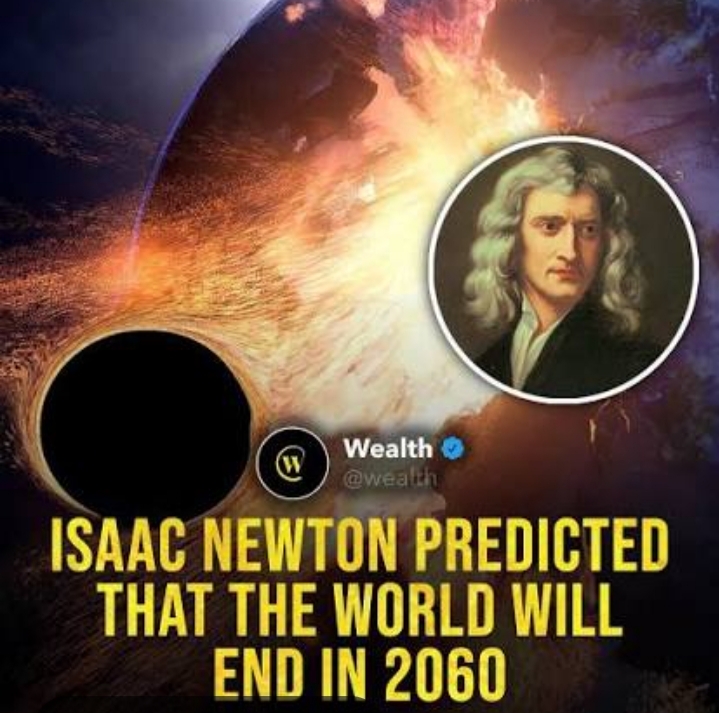
A sensational story has returned to public circulation: Sir Isaac Newton, the English mathematician whose laws of motion and gravitation transformed the study of nature, supposedly predicted that the world would end in 2060. It is an irresistible headline. It joins genius, religion, secrecy, apocalypse and a precise date. It is also an instructive distortion.
Newton did study biblical prophecy for decades. A surviving manuscript fragment records a calculation pointing to 2060. Yet the leading scholarship on that document is clear: Newton was not forecasting the literal destruction of the planet. He was interpreting a prophetic chronology and envisaging the end of an old age and the beginning of a messianic era. He even warned against reckless date-setting. The National Library of Israel preserves extensive papers showing the seriousness with which he studied Revelation, church history and prophecy.1
Why should this matter to Southern Cameroons? Not because Newton was English. His nationality creates no automatic connection to our history. It matters because the distortion reveals a problem every aspiring nation must solve: how will its citizens decide what is known, what is believed, what is interpreted, and what is merely repeated because a famous name makes it sound authoritative?
The Wrong Lesson and the Necessary Lesson
The wrong lesson would be to present Newton as proof that scientific greatness validates every theological interpretation. Competence does not transfer automatically from one field to another. A structural engineer may be highly competent in load paths and still lack authority to diagnose a neurological disease. A theologian may interpret scripture with care and still not possess laboratory evidence for a medical claim. Newton’s laws of motion can be tested against observation. His prophetic chronology belongs to a different category of reasoning.
The equally wrong response would be to ridicule faith because a scientist studied prophecy. Newton did not inhabit the modern institutional separation between science and religion. He was a natural philosopher who believed that the study of nature and scripture disclosed a unified divine order. To erase that part of him is not enlightenment; it is bad history.2
The necessary lesson is therefore more disciplined. Faith and scientific inquiry may occupy the same human mind, but they do not answer every question by the same method. A mature society can respect spiritual conviction without labelling it experimental proof. It can investigate indigenous knowledge without assuming that age alone proves efficacy. It can honour inherited wisdom while asking what was observed, how consistently it worked, under what conditions it failed, and how it might be verified and improved.
A Republic Needs an Intellectual Load Path
In engineering, a structure is not made safe by appearance or reputation. The designer must identify the load, trace how it travels, inspect the connections, test the materials and determine what happens when an assumption fails. Public knowledge requires the same discipline.
When a claim enters a classroom, pulpit, radio program, government office or social-media feed, we should be able to trace its load path. Where did it originate? What kind of claim is it: empirical, historical, theological, cultural or political? What method supports it? Who independently checked it? Who bears the consequence if it is false?
This is not an attack on religion. It is protection against the misuse of authority. It is not an attack on African tradition. It is protection against both colonial contempt for African knowledge and the uncritical commercialization of that knowledge. It is not an attack on prophecy. It is a demand that no person use a private revelation to seize another person’s money, health, marriage, vote, land or freedom.
The Productive Asset Is the Mind of the Citizen
Southern Cameroons cannot build a knowledge republic by producing children who memorize conclusions but cannot inspect the reasoning that carries them. A laboratory without trained teachers is equipment without capacity. A school that teaches formulas without curiosity produces examination success without invention. A church that discourages questions may gather followers while weakening moral responsibility. A political movement that demands belief without evidence reproduces the same centralization of authority it condemns in the state.
The productive asset is not the imported textbook, donated computer or foreign curriculum. It is the disciplined mind that can ask a question, test an explanation, revise an assumption and defend a conclusion. Who owns that productive source? If our schools train citizens merely to consume answers generated elsewhere, intellectual capital leaves as surely as an unprocessed commodity leaves a port.
The African Union and UNESCO have already called for African STEM curricula grounded in real-world applications, critical thinking, problem-solving, creativity and culturally relevant resources.3 That principle should become concrete in Southern Cameroons. Students should examine local agriculture, water systems, medicinal plants, soils, climate practices and construction traditions. They should interview elders and document inherited knowledge. Then they should learn how to compare observations, measure results, identify risk, preserve what works and reject what fails. Respect should initiate inquiry, not terminate it.
A Practical Standard for Public Claims
A future Southern Cameroons should teach a simple knowledge-accountability standard from primary school through university and public service. First, identify exactly what is being claimed. Second, match the claim to the appropriate method of inquiry. Third, disclose the evidence and its limitations. Fourth, permit independent verification and correction. Fifth, assign responsibility for the consequences of acting upon it.
Apply that standard to Newton. The documented fact is that he performed a prophetic calculation. The interpretation is that 2060 represented a possible boundary in his reading of biblical chronology. The sensational claim that he scientifically proved the world would end in 2060 fails because it changes the category of the evidence. It takes theological interpretation, places the prestige of physics behind it, and sells the mixture as science.
Apply the same standard at home. If a public official announces a project, who signed the feasibility study? If a healer claims a cure, what outcomes have been recorded and what harms are monitored? If a prophet identifies an enemy in a family, what evidence permits that accusation and who repairs the damage if it is false? If a liberation leader announces a policy, who approved it, who pays for it and who can audit the result?
Neither Colonial Contempt nor Uncritical Belief
Southern Cameroons inherited an educational tradition that prizes argument, records, procedure and institutional responsibility. That inheritance should be strengthened, not romanticized. Colonial education also subordinated African knowledge, rewarded imitation and often treated Europe as the owner of legitimate intelligence. Our answer cannot be to replace one monopoly of truth with another.
We must refuse both colonial contempt and uncritical belief. Indigenous knowledge deserves documentation, protection, testing and ownership by the communities that developed it. Spirituality deserves ethical seriousness and freedom from fraud. Science deserves investment, laboratories, trained teachers and the right to reach inconvenient conclusions. Journalism deserves primary sources rather than recycled headlines.
Newton’s papers offer a surprisingly useful civic lesson. A great mind can pursue more than one kind of truth. A famous name can be used to carry a claim farther than its evidence allows. A fragment can become a headline, and a headline can become public memory. The remedy is neither cynicism nor blind faith. It is disciplined interpretation.
The Nation We Must Build
Southern Cameroons needs citizens who can pray without surrendering judgment, investigate without despising culture, disagree without criminalizing one another, and revise a conclusion without losing dignity. It needs teachers who explain the difference between evidence and authority. It needs religious leaders confident enough to welcome honest questions. It needs journalists who open the manuscript before publishing the prophecy. It needs public institutions that show their calculations.
A republic must know more than what it believes. It must know how it knows. A republic must know more than what it believes. It must know how it knows. That is the real relevance of Newton to Southern Cameroons. Not the year 2060. Not the apple. Not the prestige of an English genius. The enduring lesson is that knowledge requires a traceable path from claim to evidence, from evidence to judgment, and from judgment to accountability. If the path cannot be traced, the nation should not build upon it.
Endnotes
Chicago Manual of Style, 17th Edition, notes-and-bibliography format
Martin S. Mungwa, Ph.D., Fellow ASCE Contributor The Independentist News
Share This Post:
WHEN THE CAGED BIRD FINDS HER VOICE: Maya Angelou, the Ambazonian Woman, and the Politics of Silence
WHO CONTROLS CAMEROON’S CRUDE? Nathalie Moudiki’s Growing Influence at SNH and the Unanswered Question of Productive Sovereignty
Related Post
WHEN YAOUNDÉ’S ALLIES SUDDENLY ENDORSE AYUK TABE: SOLIDARITY OR
THE SECOND RETURN: FROM THE PAIN OF SEPARATION TO
WHEN THE REGULATOR BENDS: WHAT THE VISION 4 AFFAIR
PROPHECY, POLITICS, AND THE AMBAZONIAN QUESTION (PART II) :
IF SOMALILAND MATTERS TO WASHINGTON, WHY NOT SOUTHERN CAMEROONS?
A CALL FOR GENERATIONAL RENEWAL: From Individual Leadership to