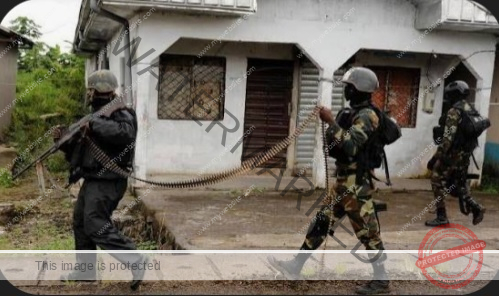


The era of so-called “military solutions” in Cameroon is not only failing; it is over. What remains is the question of whether the political courage exists—domestically and internationally—to replace it with something real. A table exists. The question is who is willing to sit at it—and speak the truth.
By Lester Maddox
Guest Contributor, The Independentistnews
Oakland County, California
13 April 2026
At a recent prayer vigil, Pope Leo XIV urged political leaders to gather at the “table of dialogue and mediation” rather than at tables where rearmament is planned. It was a familiar moral appeal. But in the context of Cameroon’s protracted Anglophone crisis, it carries an urgency that transcends symbolism. It is, in fact, a test of whether moral authority can still influence political reality.
For nearly a decade, the conflict in the country’s English-speaking regions has been defined not by dialogue, but by its systematic absence. The Cameroonian government’s so-called “Major National Dialogue” in 2019 was presented as a turning point. In practice, it excluded key stakeholders, avoided core constitutional questions, and ultimately reinforced the very grievances it purported to address. The result has been predictable: continued violence, deepening mistrust, and a humanitarian crisis that remains underreported and under-prioritized on the global stage.
The persistence of a military-first approach reflects a broader miscalculation—one that has characterized similar conflicts across the post-colonial world. Force may suppress symptoms temporarily, but it cannot resolve fundamentally political disputes rooted in identity, governance, and historical legitimacy. In Cameroon, the continued reliance on military operations in regions such as Manyu and Lebialem has not restored stability; it has entrenched division.
This is where the Vatican’s potential role becomes significant. Unlike traditional geopolitical actors, the Holy See operates from a position of moral rather than material power. Its influence lies not in coercion, but in its ability to legitimize dialogue and elevate the ethical dimensions of conflict. A papal intervention—if it moves beyond ceremony—could help reframe the crisis from a security issue to a political and humanitarian imperative requiring genuine negotiation.
Such an intervention, however, must be unambiguous. A visit framed as a “peace mission” cannot coexist with ongoing hostilities. An immediate and unconditional ceasefire is not merely a moral demand; it is a strategic prerequisite for any credible negotiation process. Without it, calls for dialogue risk becoming performative, further eroding trust among affected populations.
The broader international community also bears responsibility. The relative silence of major powers and multilateral institutions has contributed to the conflict’s endurance. Cameroon’s strategic positioning and longstanding diplomatic relationships have insulated it from the level of scrutiny applied in other crises. This inconsistency undermines the credibility of global norms around conflict resolution and human rights.
There is precedent for a different approach. From Northern Ireland to Colombia, durable peace processes have required the recognition that insurgencies cannot be defeated solely through military means, and that state legitimacy depends on the inclusion—not exclusion—of dissenting voices. These processes were neither quick nor easy, but they were grounded in the understanding that negotiation is not a concession of weakness; it is an acknowledgment of reality.
Cameroon now stands at a similar crossroads. The continuation of military operations offers only the illusion of control, while perpetuating cycles of violence and displacement. A transition toward a genuine dialogue framework—what might be called a Table of Truth—would require the participation of all relevant actors, credible mediation, and a willingness to confront foundational issues, including governance structures and historical grievances.
This is the moment for moral clarity. If Pope Leo XIV is to play a meaningful role, it must be as a catalyst for this transition—not as a symbolic visitor, but as a firm advocate for ceasefire, inclusion, and accountability.
The era of so-called “military solutions” in Cameroon is not only failing; it is over. What remains is the question of whether the political courage exists—domestically and internationally—to replace it with something real. A table exists. The question is who is willing to sit at it—and speak the truth.
Lester Maddox
Guest Contributor, The Independentistnews