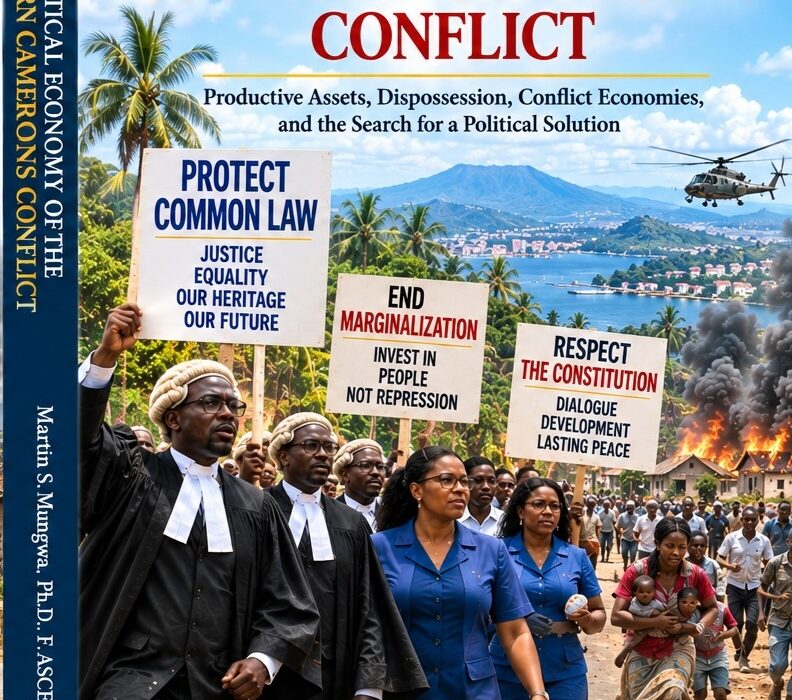


By Martin S. Mungwa, Ph.D., F. ASCE 158 pages | 10 chapters | Coming in Mid-October 2026
Book Review/Preview By The Independentist News education desk
As Amazon associate this site earns from qualifying purchases
Get other books by Dr. Martin Mungwa on Amazon
Much of the literature on Southern Cameroons has examined constitutional history, the 1961 plebiscite, federalism, identity, marginalization, self-determination, repression, and the legal and political origins of the conflict.
Martin S. Mungwa’s forthcoming book enters the discussion from a different direction. It asks not only what happened politically, but what happened to productive control. Across ten chapters, Mungwa follows land, plantations, institutions, Common Law, education, oil, infrastructure, public authority, revenue, conflict financing, displacement, and human capital. His central argument is that the Southern Cameroons conflict cannot be fully understood without examining who controls the productive assets and institutions upon which a society depends.
From Productive Dispossession to Productive Destruction
At the center of the book is the concept of productive dispossession: the loss, transfer, or perceived erosion of effective control over productive assets, institutions, revenues, decision-making authority, and future capability. This is an important distinction. An asset can remain physically located in a territory while decisions over its management, processing, technology, revenue, procurement, leadership, or reinvestment are made elsewhere.
Mungwa therefore repeatedly asks: Who signs? Who pays? Who owns? Who produces? Who processes and adds value? Who controls technology? Who captures recurring value? Who bears the cost? And what remains? Those questions provide the book’s distinctive systems framework.
The opening chapters establish the productive and institutional inheritance of Southern Cameroons before 1961 and examine the subsequent reordering of political and economic authority. The analysis then follows land, plantations, agriculture, petroleum, infrastructure, law, education, and professional institutions.
One of the book’s notable arguments is that institutions themselves are productive assets. Courts, Common Law, schools, professional standards, language systems, and administrative capability are placed alongside plantations, roads, ports, and energy infrastructure. This perspective provides a different lens through which to understand the lawyers’ and teachers’ protests that helped ignite the present crisis.
When Conflict Develops Its Own Economy
The book then moves from the origins of grievance to a more difficult question: why does conflict persist? Dr. Mungwa examines security expenditure, diaspora flows, armed financing, levies, checkpoints, ransom, logistics, territorial control, and organizational survival.
Importantly, he distinguishes benefit from causation. An actor may derive political, organizational, or economic benefit from prolonged conflict without necessarily having caused it. From this emerges the book’s second major concept: productive destruction.
Here lies a troubling paradox. A conflict may begin partly because people fear losing institutions, land, economic opportunity, or productive assets. Yet prolonged conflict can itself destroy farms, schools, businesses, infrastructure, investment, and human capital—the very productive inheritance the struggle seeks to protect.

What This Book Adds
The book does not seek to replace the established literature on Southern Cameroons. Earlier scholarship has illuminated constitutional history, identity, federalism, marginalization, legality, and political mobilization.
Dr. Mungwa adds an underexamined political-economy dimension by connecting those questions to ownership, productive control, value capture, conflict financing, civilian economic destruction, continuation incentives, and the economic viability of a future settlement. That is the book’s principal distinction.
Its analytical journey can be summarized as: Productive inheritance → changing control → productive dispossession → grievance → political mobilization → armed conflict → conflict economy → productive destruction → political settlement → regenerative peace.
Beyond Ending the War
The final chapter asks what a credible political settlement must actually accomplish. For Dr. Mungwa, peace cannot be measured only by the absence of gunfire or by which constitutional formula ultimately prevails. A durable settlement must also rebuild legitimate institutions, restore human security, revive productive capacity, reconstruct human capital, attract investment, and create economic opportunity. He calls this regenerative peace.
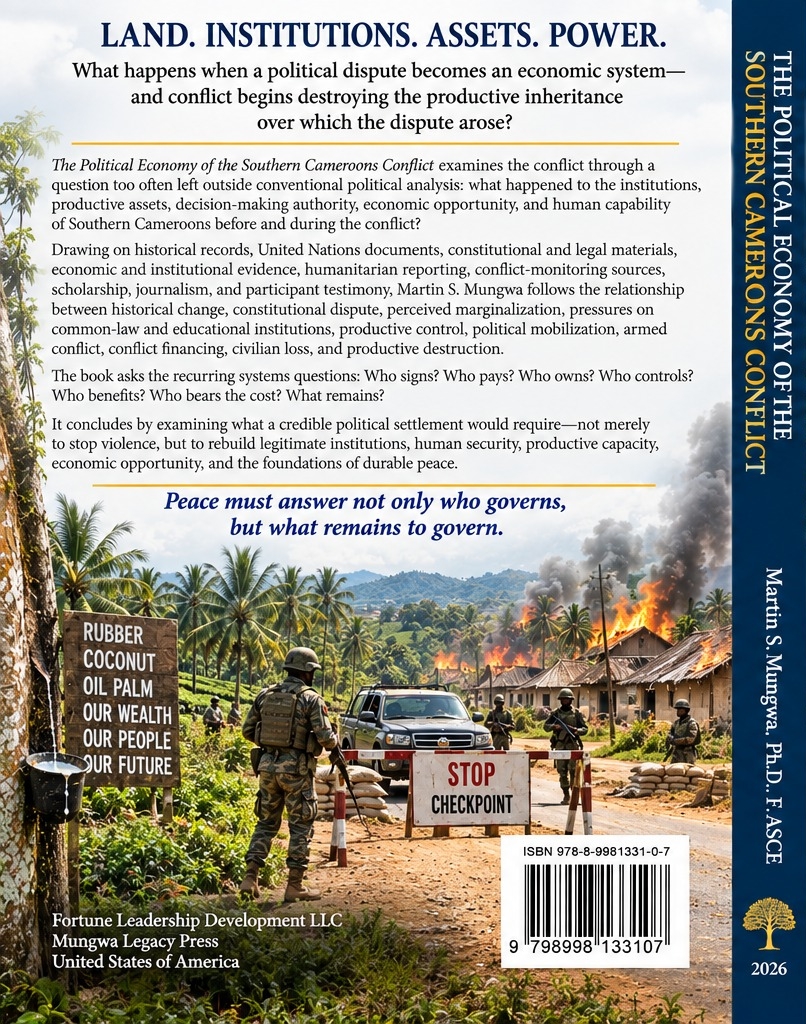
At 158 pages and ten chapters, The Political Economy of the Southern Cameroons Conflict is compact but ambitious. Its contribution is not another retelling of the conflict. It attempts to explain the relationship between political authority, productive assets, institutional control, conflict economics, and the material foundations of peace.
Ultimately, the book leaves the reader with a question larger than who wins the political argument: Peace must answer not only who governs, but what remains to govern.
COMING IN MID-OCTOBER 2026
The Political Economy of the Southern Cameroons Conflict
Martin S. Mungwa, Ph.D., F. ASCE
As Amazon associate this site earns from qualifying purchases
Get other books by Dr. Martin Mungwa on Amazon
https://www.amazon.com/s?k=Book+by+Dr.martin+mungwa&i=specialty-aps&srs=121082092011&crid=U3XDQYOYVDMF&sprefix=book+by+dr.martin+mungwa%2Cspecialty-aps%2C410&linkCode=ll2&tag=njokings-20&linkId=fad4ab2ac94f8ac7c329b5bbc65349b3&language=en_US&ref_=as_li_ss_tl
The Independentist News education desk