

A live president should be capable, within reasonable medical limitations, of appearing live. A functioning government should be capable of explaining who is governing. A constitutional republic should not require citizens to determine the condition of its head of state by comparing old airport photographs.
By The Ambazonia Intelligence Service
Open-Source Intelligence Analysis for The Independentist News
As Amazon associate this site earns from qualifying purchases
Get your back to school supplies from Amazon
YAOUNDÉ – August 21, 2026 – Analytical note: This assessment is based exclusively on publicly available photographs, official statements, media broadcasts and reporting by identifiable news organizations. It does not claim access to Paul Biya’s private medical information or classified intelligence.
An Arrival Intended to End the Speculation
The Cameroonian presidency wanted August 20, 2026, to end the speculation. President Paul Biya, it announced, had returned to Yaoundé after more than ten weeks abroad. Official photographs appeared. Cameroon Radio Television reported that the aircraft carrying Biya and First Lady Chantal Biya landed at Yaoundé–Nsimalen International Airport at approximately 4:45 p.m. Supporters were mobilized along the presidential route, and the Presidency subsequently celebrated the return as a moment of national rejoicing.
Yet the government’s presentation has not eliminated public concern. It has intensified a more fundamental question: Why did an event organized principally to demonstrate the President’s return fail to provide the clearest possible continuous visual confirmation of Paul Biya himself?
That question should not be dismissed as rumor. Nor should it be converted prematurely into a declaration that Biya is dead. The responsible position lies between those extremes. International news organizations, including Reuters and the Associated Press, reported that the 93-year-old president returned from Geneva on August 20. That constitutes substantial evidence and cannot simply be ignored. But the government’s own communications strategy remains unusually opaque for an event whose apparent purpose was to establish beyond reasonable doubt that the President had returned and remained capable of exercising the responsibilities of his office. Reuters, Associated Press.
Live Coverage Is Not Necessarily Live Proof
CRTV described its airport coverage as live. It showed or described aircraft movement, security preparations, waiting officials, political supporters and the presidential motorcade. Critics nevertheless observed that the publicly circulating material did not provide a consistently clear and uninterrupted view of Biya’s arrival.
A broadcast originating live from an airport does not necessarily provide live visual confirmation of every person said to be arriving there. The evidentiary question is more precise: Did the public see a clear, uninterrupted and contemporaneous sequence showing the aircraft door opening, Paul Biya emerging, descending or leaving the aircraft, greeting the waiting officials, entering the presidential vehicle and departing?
If complete, uninterrupted footage exists, the Presidency should release it in full with its original timestamp and source information.
A collection of airport scenes is not equivalent to continuous visual confirmation. A motorcade is not the President. A crowd is not the President. An aircraft is not the President. A written caption is not the President. A photograph displayed during a broadcast is not necessarily proof that the photograph was taken at that moment.
The absence of an unmistakable continuous sequence becomes more consequential because the government knew in advance that the President’s health, whereabouts and capacity had become matters of national concern. This was not an ordinary return from a private journey. It followed the longest recorded foreign absence of Biya’s presidency. Under those circumstances, clarity should have been the easiest part of the operation.
What the Photographs Establish—and What They Do Not
A properly sourced photograph may establish that Paul Biya was alive and physically present at the moment the camera recorded him. But it can do so only when the photograph’s origin, date and context are independently established.The images circulating online do not all meet that standard.
One photograph shows Biya wearing a blue suit and open-neck light-blue shirt while greeting Prime Minister Joseph Dion Ngute. Chantal Biya stands behind him wearing a pale-blue dress, a red wrap and carrying a red handbag. Another image shows a similar airport reception, but Chantal Biya is dressed in bright pink and Paul Biya is wearing different clothing.
The second photograph is traceable to an Actu Cameroun report published on July 24, 2023. It documented an earlier return from Europe following Biya’s attendance at the Summit for a New Global Financial Pact in Paris. It therefore cannot constitute evidence of the August 20, 2026 arrival. Actu Cameroun’s July 24, 2023 report.
The existence of the 2023 image does not automatically prove that the blue-outfit photograph was digitally fabricated. The two photographs may record separate airport receptions conducted under nearly identical protocol. However, if both were circulated together as proof of the August 20 return, the presentation mixed separate events and became misleading.
This distinction matters. A photograph can be genuine while its caption is false. An authentic archival image can be used to create a misleading impression about a current event. That form of misinformation is more common—and often more difficult for the public to detect—than a completely AI-generated image.
The correct question is therefore not merely whether the photograph looks real. The appropriate questions are: Who took it? When was it taken? Where was the original published? Is the original image file available? Does the scene appear in continuous video from the same event? Can independent photographers or journalists confirm its provenance? Without reliable answers, a photograph may document an appearance, but it does not necessarily prove the date, circumstances or significance being claimed for it.
The Communications Strategy Failed Its Own Test
If Paul Biya returned in person on August 20, the Presidency had every opportunity to eliminate reasonable doubt. It could have provided a fixed live camera at the aircraft stairs. It could have allowed several independent news organizations to record the arrival. It could have shown Biya greeting officials in one continuous sequence. It could have permitted him to speak briefly on camera, even for thirty seconds.
Biya did not need to give a lengthy explanation of his health. He could simply have stated: “I have returned to Yaoundé. I thank the people for their concern. I will resume my constitutional duties. Such a statement would not establish complete medical fitness. It would, however, demonstrate identity, presence, voice, orientation and a minimum capacity for direct communication.
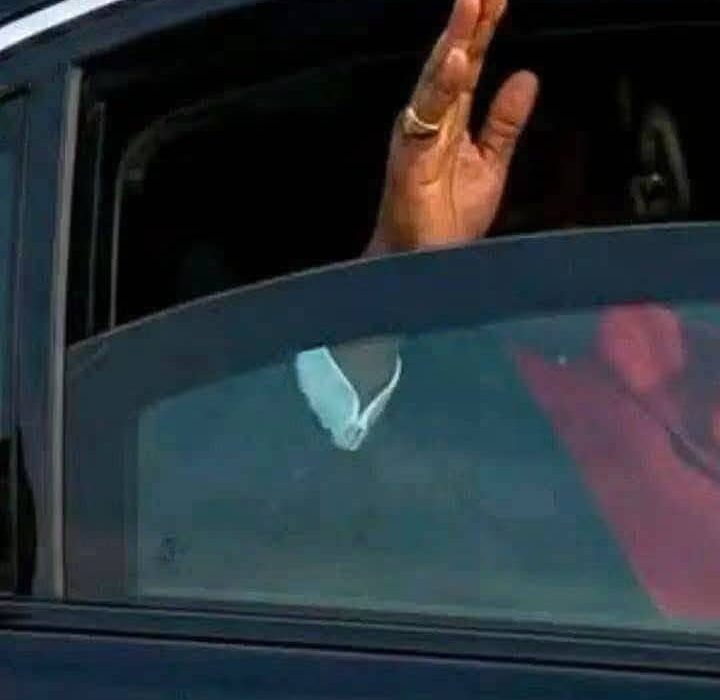
Instead, the public received a highly managed spectacle consisting of an aircraft, official announcements, selected images, organized supporters, a presidential motorcade and reports that Biya waved from a passing vehicle. That presentation may support a claim of ceremonial presence. It does not establish governing capacity.
The failure is therefore not only evidentiary. It is institutional. In a functioning constitutional state, the physical and mental capacity of the individual holding concentrated executive power cannot indefinitely be treated as a private family matter.
Being Alive Is Not the Constitutional Test
The public debate has too often been reduced to the crudest possible question: Is Paul Biya alive? That is not the only question a republic must ask. A president may be alive but incapable of performing the responsibilities of office. A president may be physically present while decisions are made by an unelected circle. A president may sign documents without demonstrating publicly that he understands, directs or supervises the policies issued in his name.
The constitutional questions are more demanding. Is the President conscious and properly oriented? Can he communicate independently? Can he receive and question ministers? Can he evaluate national-security information? Can he make decisions without unauthorized intermediaries? Can he discharge the constitutional responsibilities of the presidency?
There are equally important questions about the prolonged absence itself. Who exercised effective executive authority while Biya was abroad? Which decisions were made during that period? Who initiated them? Under what constitutional delegation were they approved? Who accepted responsibility for their consequences?
Selected photographs answer almost none of these questions. The Government Created the Suspicion It Now Condemns Public suspicion did not arise in a vacuum. Biya left Cameroon on June 7 for what his office described as a brief private stay in Europe. The absence extended beyond ten weeks. Official explanations remained limited, while government representatives offered reassurances without providing regular, independently verifiable appearances by the President.
The government had already restricted public discussion of Biya’s health in 2024 by treating it as a national-security matter. Such secrecy does not eliminate speculation. It rewards it.
When official institutions suppress ordinary questions, citizens begin examining shadows, clothing, aircraft doors and motorcade windows. Every cropped photograph becomes evidence. Every missing video frame becomes a conspiracy. Every archival image reused without a clear explanation further damages public confidence.
The government cannot create an information vacuum and then blame the population for noticing that the vacuum exists. Nor can it reasonably expect selected photographs to carry the evidentiary burden created by weeks of official silence. The longer the absence and the more concentrated the presidential power, the greater the government’s responsibility to provide credible information.
Independent Reporting Must Still Be Acknowledged An honest analysis must not omit evidence that complicates its argument. Reuters and the Associated Press independently reported that Paul Biya arrived in Yaoundé on August 20 aboard a flight from Geneva. Reuters stated that Biya was accompanied by Chantal Biya and later departed for the Unity Palace in a motorcade.
Those reports materially strengthen the conclusion that Biya returned to Cameroon. They should prevent responsible commentators from declaring, without additional evidence, that the entire arrival was fabricated or that Biya is dead. But independent reporting of his arrival does not settle the separate question of his capacity to govern. Nor does it authenticate every photograph circulated by official or unofficial social-media accounts.
The correct conclusion is therefore limited but important: available evidence supports the report that Paul Biya returned to Cameroon, but the official communications surrounding the event have not provided sufficient transparency to resolve reasonable questions about his health, independence and present capacity to exercise presidential authority.
What Would Resolve the Matter?
The standard should be reasonable, humane and constitutional. Paul Biya is 93 years old. As a human being, he is entitled to medical dignity and an appropriate measure of privacy. But as the holder of an office around which extraordinary executive power has been centralized, he is not entitled to complete secrecy concerning his capacity to govern.
The Presidency should release the complete and unedited airport footage with its original timestamps and source information. It should identify the photographers responsible for the official images and publish those photographs with accurate dates, captions and provenance. More importantly, Biya should make a brief, clearly live appearance before independent journalists, the diplomatic corps or another credible audience. He should answer several unscripted questions concerning his return and the immediate business of government.
If health limitations prevent such an appearance, the government should say so honestly and apply the appropriate constitutional mechanism for temporary incapacity, delegation or succession. That approach would protect Biya’s dignity while protecting the country from government by secrecy and rumor.
The Silence Is Becoming the Story
The official photographs may show Paul Biya. They do not, by themselves, establish when every circulating image was taken, whether all the photographs came from the same event or whether the President remains capable of exercising constitutional authority. Independent reporting provides credible support for the conclusion that Biya returned on August 20. It would therefore be irresponsible to claim, without evidence, that he is dead or that the entire arrival was fabricated.
But it is equally irresponsible for the government to present selected photographs, organized crowds and ceremonial motorcade scenes as a complete response to a constitutional question. The longer Biya remains unavailable for a direct and unmistakably live appearance, the less persuasive the official spectacle becomes.
A live president should be capable, within reasonable medical limitations, of appearing live. A functioning government should be capable of explaining who is governing. A constitutional republic should not require citizens to determine the condition of its head of state by comparing old airport photographs.
The demand is not for intrusion, mockery or humiliation. It is for evidence proportionate to the power being exercised in Biya’s name. Until that evidence is provided, every carefully selected photograph may confirm an image—but the absence of a clear live appearance will continue to deepen concern about the man, the office and the system surrounding both.
As Amazon associate this site earns from qualifying purchases
Get your back to school supplies from Amazon
Ambazonia intelligence service