

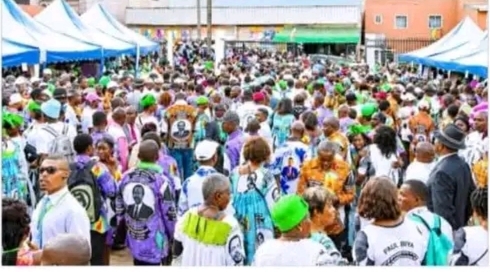


The removal of an established parliamentarian is not equivalent to the transformation of the Cameroonian state. The defeat of a mayor does not resolve a constitutional dispute. The nomination of a younger political figure does not settle the question of self-determination.
By Carl Sanders
Associate Editor-in-Chief
The Independentist News
Soho, London
THE POLITICS OF CELEBRATION WITHOUT TRANSFORMATION
YAOUNDÉ – 23 November 2026 – The recent primaries of the Cameroon People’s Democratic Movement (CPDM) have generated considerable excitement among political commentators, bloggers and social media audiences. The reported defeats of several established parliamentarians and political figures are being portrayed in some quarters as significant political victories.
But victories for whom, and against what? The names of Simon Kumase, Njume Peter and Essomba Bengono have featured prominently in discussions about the changing fortunes of established CPDM personalities. Their reported setbacks may be significant within the ruling party’s internal electoral calculations. Yet they raise a far more important question.
Does replacing a politician amount to replacing the political system that produced him? The answer is no. The defeat of an incumbent candidate does not, by itself, dismantle the institutions, relationships and political practices through which power is exercised. Nor does the emergence of a younger candidate necessarily signify democratic renewal.
A political establishment can replace its representatives while preserving its underlying structures. It can introduce new personalities without embracing new principles. It can change its public appearance without transforming its governing character. The spectacle of internal political competition should therefore not be mistaken for fundamental institutional reform.
When power merely moves from one hand of the same political establishment to another, the establishment itself remains intact. That distinction matters to everyone concerned with meaningful political change. It matters particularly to those who understand the Southern Cameroons question as a dispute extending beyond the electoral politics of Yaoundé.
THE BIYA SYSTEM IS LARGER THAN PAUL BIYA
The political order associated with President Paul Biya cannot be understood solely through his personal leadership. Biya inherited a highly centralised governing system from Ahmadou Ahidjo. Over succeeding decades, that system developed its own networks of political patronage, administrative influence, security institutions and economic interests.
The historical relationship between France and post-independence Cameroon is also relevant to understanding the country’s institutional development. The agreements commonly described as the accords de coopération formed part of the wider political, military, economic and diplomatic relationships that shaped France’s postcolonial influence.
However, the contemporary political system cannot be explained exclusively through French influence. Domestic political decisions, institutional arrangements and successive governing elites have also played decisive roles. The essential point remains unchanged.
Replacing a parliamentarian does not automatically decentralise power. Replacing a mayor does not necessarily strengthen institutional accountability. Introducing younger politicians does not guarantee a departure from established governing practices.
Political transformation must be measured through institutions, laws, accountability, constitutional arrangements and the practical experience of citizens. It cannot be measured simply by counting the number of established politicians who lose party nominations. A new occupant of an old political structure does not necessarily represent a new political future.
THE SOUTHERN CAMEROONS QUESTION CANNOT BE REDUCED TO CPDM ELECTORAL POLITICS
The Southern Cameroons conflict has historical, constitutional and political dimensions that extend well beyond the careers of individual CPDM politicians. Its origins involve the territory’s colonial history, the 1961 plebiscite, the subsequent federal constitutional arrangements, the abolition of the federal structure in 1972 and longstanding disputes over political representation, autonomy and identity.
For supporters of Ambazonian independence, the proclamation of 1 October 2017 represented a reaffirmation of their demand for a separate political future. That proclamation remains central to the independence movement’s political position, although it has not resulted in internationally recognised independent statehood. The distinction is important.
The political objectives of independence advocates cannot be fulfilled merely by determining which CPDM candidate becomes a parliamentarian or mayor. Nor can internal party elections resolve the deeper disagreements surrounding sovereignty, constitutional legitimacy, self-determination and the future political status of the former British Southern Cameroons.
These issues require a political process capable of addressing their substance. The CPDM primaries may determine political careers. They do not determine the legitimacy, aspirations or ultimate resolution of the Southern Cameroons question.
THE REAL QUESTION IS NOT WHO GOVERNS FROM YAOUNDÉ, BUT HOW THE CONFLICT WILL BE RESOLVED
Political debate frequently becomes distracted by personalities. Who has fallen out of favour? Who has secured a nomination? Which faction has gained influence? Which established figure has suffered an unexpected defeat?
Such developments may be important to CPDM members and voters participating in Cameroon’s national political institutions. But they should not displace the more consequential question facing communities affected by the Anglophone conflict. How will the conflict be brought to a just, sustainable and verifiable conclusion?
A durable settlement cannot be produced simply through the replacement of elected representatives. It requires engagement with the grievances, competing political aspirations, security concerns and constitutional disagreements that have sustained the crisis.
For advocates of Ambazonian independence, this necessarily includes the demand that a negotiated separation be seriously considered. Others favour federalism, substantial autonomy or other constitutional arrangements within Cameroon.
These positions differ fundamentally, but a credible peace process must be capable of addressing competing proposals without assuming that an internal party election constitutes a political settlement.
The central question is not whether Yaoundé changes its political personnel. It is whether the underlying conflict can be resolved through a credible, inclusive and internationally supported political process.
A NEGOTIATED POLITICAL FUTURE REQUIRES SERIOUS DIPLOMACY
The continued suffering associated with the Southern Cameroons conflict makes a durable political settlement an urgent humanitarian and diplomatic priority. A credible process would require meaningful participation by legitimate representatives of affected communities, the Government of Cameroon and other relevant stakeholders.
Independent mediation, enforceable safeguards, humanitarian access, civilian protection and mechanisms for accountability would be essential. Such a process must also recognise that political aspirations cannot simply be extinguished through military pressure or administrative restructuring.
Equally, the pursuit of any political outcome must respect the fundamental rights and security of civilians. No political objective justifies attacks on civilians, abductions, torture, arbitrary detention or the denial of essential humanitarian protection.
A sustainable peace must provide room for substantive negotiation, the protection of competing political opinions and lawful mechanisms for determining the future. From the independence movement’s perspective, negotiated separation should remain a legitimate subject for diplomatic discussion. A serious peace process must address the political disagreement itself, rather than merely rearranging the officials responsible for administering the existing system.
SEPARATION NEED NOT MEAN PERMANENT HOSTILITY
History demonstrates that formerly united political territories can develop separate national identities and establish peaceful relations. Norway and Sweden dissolved their union in 1905 and subsequently maintained relations as sovereign neighbours.
Belgium and the Netherlands provide another historical example of neighbouring states whose separate political development ultimately became compatible with extensive diplomatic and economic cooperation.
These precedents cannot be applied mechanically to Southern Cameroons. Their historical, legal and political circumstances differ. Nevertheless, they illustrate an important possibility: political separation need not result in perpetual hostility.
Countries with separate governments can cooperate in trade, transportation, border management, infrastructure, education, public health and regional security. The essential conditions are mutual respect, clear legal arrangements and a shared commitment to peaceful relations.
For independence advocates, the objective of a sovereign Ambazonia need not imply permanent antagonism toward the people of the Republic of Cameroon. Indeed, a future relationship based on peaceful coexistence and economic cooperation deserves serious consideration. Political disagreement does not require permanent enmity.
The challenge is to establish an arrangement that is lawful, peaceful, democratically legitimate and capable of protecting the rights of all affected populations.
AMBAZONIA’S POLITICAL FUTURE WILL NOT BE DECIDED BY THE CPDM PRIMARIES
There is nothing inherently improper about people following or discussing CPDM primary elections. These contests may influence political representation, internal party relationships and future administrative decisions. Their outcomes may even provide useful insights into the workings of the ruling establishment. But their significance must not be exaggerated.
The removal of an established parliamentarian is not equivalent to the transformation of the Cameroonian state. The defeat of a mayor does not resolve a constitutional dispute. The nomination of a younger political figure does not settle the question of self-determination.
And an internal party competition cannot substitute for a comprehensive political solution to a conflict that has caused extensive suffering and displacement. The distinction between political personnel and political structures must remain central to responsible analysis.
CONCLUSION: DO NOT CONFUSE POLITICAL MOVEMENT WITH POLITICAL PROGRESS
The CPDM primaries have produced winners and losers. They have reshaped certain political ambitions and generated considerable public debate. But they have not, by themselves, resolved the longstanding political and institutional problems confronting Cameroon. Nor have they settled the Southern Cameroons question.
For those committed to Ambazonian independence, the political mission remains fundamentally different from competition for office within the CPDM. It concerns the future political status of the territory, the protection of its population and the pursuit of a negotiated arrangement consistent with their understanding of self-determination.
For the wider international community, the priority must be a credible, peaceful and rights-respecting resolution of the conflict. Political developments in Yaoundé should be assessed for what they actually change, not for what observers may wish them to represent. A change of faces is not necessarily a change of government policy. A change of candidates is not necessarily institutional reform. And a change of political occupants is not, by itself, a change in the destiny of a people.
The CPDM may rearrange its candidates. The Southern Cameroons question remains unresolved. That is the distinction history demands we understand, diplomacy must confront and political commentary must never obscure.
Carl Sanders
Associate Editor-in-Chief
The Independentist News
Soho, London
An Independentist News Commentary | 23 November 2026