

The people are no longer at the stage of drafting memoranda; they are at the stage of recognizing the nature of the system itself. And once that recognition is complete, one thing becomes unavoidable: a problem that was created structurally cannot be resolved administratively. No memorandum can change that.
By Ali Dan Ismael
Editor-in-Chief, The Independentistnews
THE MASK FALLS—AGAIN
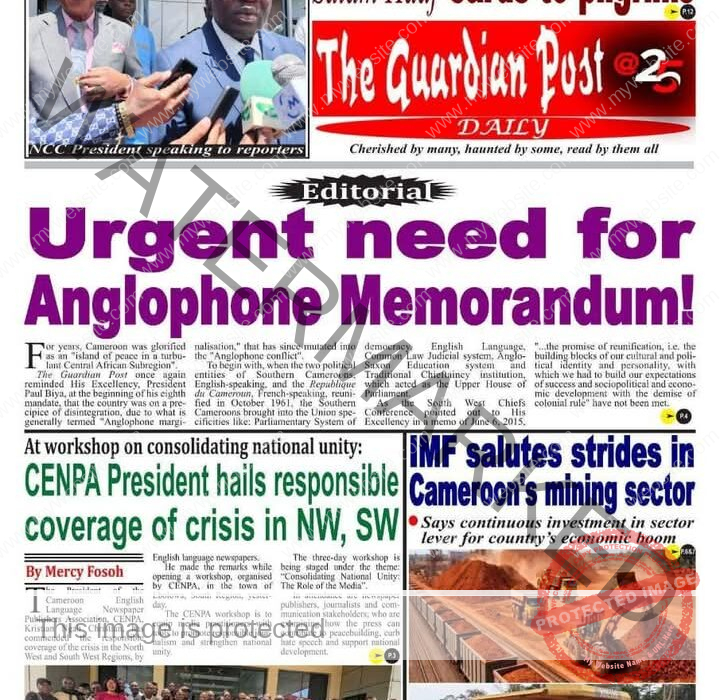
There comes a point in every prolonged crisis where language itself becomes evidence—not of clarity, but of concealment. The latest editorial by The Guardian Post, calling for an “urgent Anglophone Memorandum,” is not an act of insight. It is an act of positioning. It reveals, once again, the role certain media institutions have chosen to play—not as truth-tellers, but as narrative managers within a failing system. This is not journalism. This is crisis management.
A FAMILIAR SCRIPT OF DISTRACTION
The pattern is now unmistakable. At every moment of exposure—when the contradictions of the system become too visible to ignore—the response is never structural. It is procedural. Dialogue. Unity. Decentralization. And now, a memorandum. Different words, same function: delay. Because a memorandum does not confront power; it accommodates it. It does not correct imbalance; it absorbs it. Above all, it gives the illusion of movement while ensuring that nothing fundamentally changes.
THE FALSE PREMISE
A memorandum assumes good faith. It assumes that those receiving it are willing to listen, negotiate, and correct structural wrongs. But history has already issued its verdict. There was no good faith in 1972 when a federation was unilaterally dismantled. There was no consultation when a political identity was reduced to a linguistic label. There was no negotiation when institutions were centralized and parity erased. To call for a memorandum today is to pretend that the conditions that made previous efforts fail have somehow disappeared. They have not.
THE RECYCLING OF A DEAD STRATEGY
What is being proposed is not new. It is the resurrection of a method that has already been exhausted. For decades, documents were written, recommendations submitted, and appeals made. Each time, the outcome followed the same trajectory: absorption, dilution, erasure. A memorandum does not restore what was dismantled. It does not reverse structural imbalance. It does not rebuild trust that was systematically broken. To present it as an “urgent need” is not analysis. It is misdirection.
THE LANGUAGE OF ERASURE
Even more revealing is the continued reliance on the term “Anglophone.” This is not a harmless label; it is the foundation of the distortion. By reducing a political question to a linguistic category, the entire crisis is reframed—from one of structure and history to one of language and administration. This is how reality is managed. A people becomes a language group. A territory becomes a demographic. A political question becomes a communication problem. And once that transformation is complete, the proposed solutions—like memoranda—are designed to address the illusion, not the reality.
THE ROLE OF THE GUARDIAN POST
At this stage, ambiguity is no longer defensible. A publication that repeatedly reframes a structural crisis as a linguistic inconvenience is not neutral. It is aligned—whether by intention or by function—with the preservation of the status quo. This is the uncomfortable truth. When clarity is required, it offers euphemism. When history demands precision, it substitutes terminology. When the moment calls for structural honesty, it proposes administrative remedies. This is not oversight. This is participation.
THE HARD REALITY THEY AVOID
The issue has never been the absence of memoranda. It is the consequence of a political restructuring that altered the foundation of a people’s existence without consent, without parity, and without accountability. That reality cannot be negotiated through documents. It cannot be softened through language. And it cannot be resolved by returning to the very mechanisms that enabled its creation.
FINAL VERDICT: THE ERA OF MANAGED ILLUSIONS IS OVER
Let it be stated clearly—and without qualification: the time for memoranda is over. It ended when the federation was dismantled. It ended when identity was redefined without consent. It ended when every structured appeal was absorbed into a system designed to neutralize it. What The Guardian Post presents as urgency is, in truth, containment. What it frames as engagement is, in reality, control. This is not a path forward. It is a return to a closed loop. But the moment has changed. The illusion that procedural tools can resolve structural questions has collapsed.
The language that once obscured reality no longer holds. The people are no longer at the stage of drafting memoranda; they are at the stage of recognizing the nature of the system itself. And once that recognition is complete, one thing becomes unavoidable: a problem that was created structurally cannot be resolved administratively. No memorandum can change that. No editorial can obscure it. And no amount of recycled language can reverse it.
Ali Dan Ismael
Editor-in-Chief, The Independentistnews