










THE INDEPENDENTIST NEWS BOOK PREVIEW: By The Independentist News editorial desk
As Amazon associate this site earns from qualifying purchases
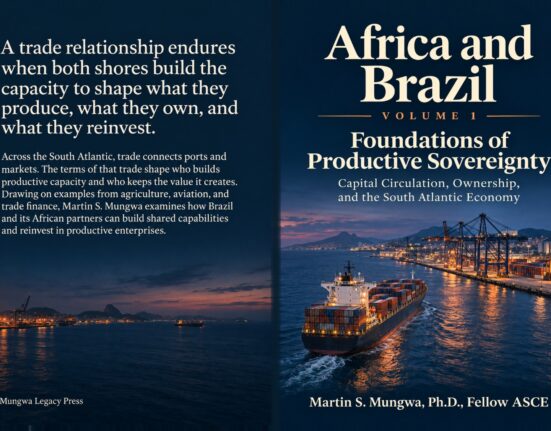
Follow the Amazon link below to get your copies of other publications on the Ambazonian revolution By Martin Mungwa
BOOK REVIEW | SCIENCE, POLITICAL CONFLICT & THE SEARCH FOR PEACE
CAN THE MATHEMATICS OF WAR EXPOSE THE HIDDEN FORCES THAT KEEP NATIONS IN CONFLICT?
FROM THE LAWS OF ENERGY AND ENTROPY TO THE BATTLE FOR PRODUCTIVE SOVEREIGNTY — A STRUCTURAL ENGINEER TAKES ON ONE OF HUMANITY’S GREATEST QUESTIONS
What if the forces that weaken buildings and destabilize complex systems could inspire a new way of understanding why nations fracture, institutions deteriorate, and political conflicts continue for generations?
What if mathematics could help expose the institutional failures, economic interests, and patterns of dispossession that conventional political narratives sometimes overlook?
And what if peace could be measured—not merely by the silence of guns, but by whether the conditions that produced the conflict have actually changed?
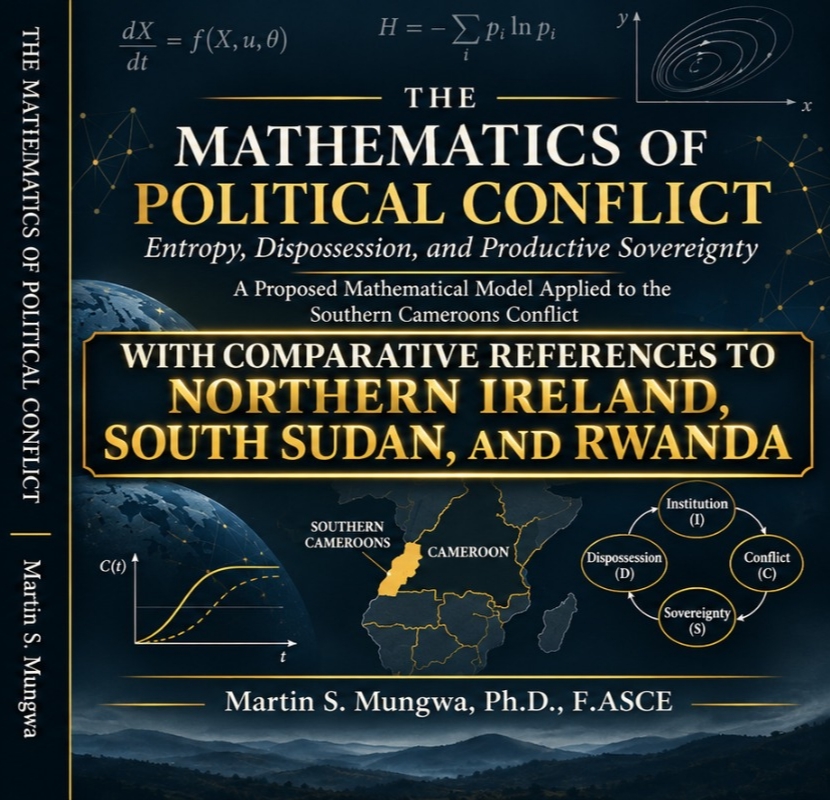
These are the provocative questions at the heart of The Mathematics of Political Conflict: Entropy, Dispossession, and Productive Sovereignty, a forthcoming book by structural engineer, researcher, and author Martin S. Mungwa, Ph.D., F.ASCE.
WHEN ENGINEERING MEETS THE POLITICS OF WAR
Trained in structural engineering at INSA Lyon, the University of Leeds, and the University of Surrey, Mungwa brings an unusual intellectual perspective to political conflict.
His starting point is striking: buildings deteriorate under interacting stresses, materials accumulate damage, and complex systems can fail when warning signs are ignored. Could political institutions experience comparable patterns of accumulated vulnerability?
Drawing methodological inspiration from the conservation of energy, thermodynamic entropy, information theory, and systems dynamics, Mungwa explores this possibility while making an essential scientific distinction: societies do not literally obey the physical laws governing buildings.
Instead, the book employs mathematical reasoning to investigate how inequality, dispossession, institutional exclusion, competing economic interests, and political decisions may interact to produce instability.
FOUR CONFLICTS. DIFFERENT HISTORIES. ONE DISTURBING QUESTION.
The Southern Cameroons conflict occupies the center of the investigation. But the author extends his analysis to three historically significant comparisons:
RWANDA: How did political exclusion, organized incitement, and institutional collapse contribute to the catastrophe of the 1994 genocide against the Tutsi?
THE FORMER YUGOSLAVIA: How did competing national claims, territorial fragmentation, armed mobilization, and external intervention shape a succession of devastating wars?
NORTHERN IRELAND: How did a society divided by constitutional allegiance and decades of violence develop institutions capable of substantially reducing armed confrontation without eliminating political disagreement?
These comparisons confront readers with a challenging proposition: conflicts differ in their histories and mechanisms, yet examining institutional conditions systematically may reveal patterns worth testing.
THE MATHEMATICAL QUESTION THAT COULD CHANGE THE DEBATE
At the center of the book is the proposed Mungwa Productive Sovereignty–Conflict Entropy Model (M-PSCEM).
The framework examines eight institutional dimensions, including productive sovereignty, dispossession, citizen protection, constitutional legality, asset control, and external relations.
Its most intriguing feature is the distinction between three quantities: Structural conflict pressure: Conditions that may contribute to political instability.
Conflict entropy: Mathematical uncertainty concerning possible future political states.
Political disturbance: The observable disruption, displacement, violence, and institutional damage experienced by populations.
The distinction is scientifically important. A conflict may be violently destructive yet highly predictable. Equally, a peaceful political transition may involve considerable uncertainty. Mungwa’s framework seeks to investigate these differences rather than confuse them.
The model remains a proposed research instrument requiring empirical testing and independent validation—not an established universal law of war.
FOLLOW THE MONEY. QUESTION THE POWER. EXAMINE THE EVIDENCE.
Perhaps the book’s most provocative discussion concerns the economic interests that may influence political decisions.
Drawing upon his earlier work, The Cost of Ignorance, and his professional engagement with financial systems, Mungwa asks questions that reach beyond the battlefield:
–Who benefits economically when conflicts persist?– Who controls productive resources? – Who bears the human and financial costs?– And how can the conduct of external powers including former colonial authorities be examined through documented economic and diplomatic relationships?
The book does not treat allegations of secret agreements as proven facts. Instead, it challenges researchers to distinguish legitimate suspicions from demonstrable evidence.
WHEN DOES A WAR REALLY END?
The book’s final challenge may be its most enduring. A ceasefire can silence weapons. A political agreement can produce signatures. But neither necessarily restores stolen livelihoods, protects civilians, repairs institutions, or resolves the grievances that fueled violence.
Mungwa proposes a Conflict Termination Verification Protocol for examining whether peace commitments translate into independently observable improvements. The question is no longer simply whether fighting has stopped. It is whether the foundations of lasting peace have actually been built.
THE INDEPENDENTIST NEWS — ADVANCE REVIEW
The Mathematics of Political Conflict represents an ambitious interdisciplinary contribution to the debate about political instability, dispossession, sovereignty, and peacebuilding.
Its originality lies in attempting to move from political argument toward transparent mathematical definitions, measurable institutional conditions, and propositions that can be independently challenged. Its ultimate scientific significance will depend on the quality of future empirical testing.
For Southern Cameroons–Ambazonia readers, African scholars, international institutions, engineers, economists, and students of conflict resolution, the book raises questions that deserve serious attention.
If societies can identify the conditions under which institutions deteriorate, can they also identify—and deliberately strengthen—the conditions under which peace becomes durable? That is the question Mungwa places before the world.
THE MATHEMATICS OF POLITICAL CONFLICT
Entropy, Dispossession, and Productive Sovereignty
Author: Martin S. Mungwa, Ph.D., F.ASCE
Publisher: Mungwa Legacy Press
Expected Publication: December 2026
As Amazon associate this site earns from qualifying purchases
Follow the Amazon link below and get your copies of other publications on the Ambazonian revolution By Martin Mungwa
An Advance Book Review — The Independentist News editorial desk





Leave feedback about this