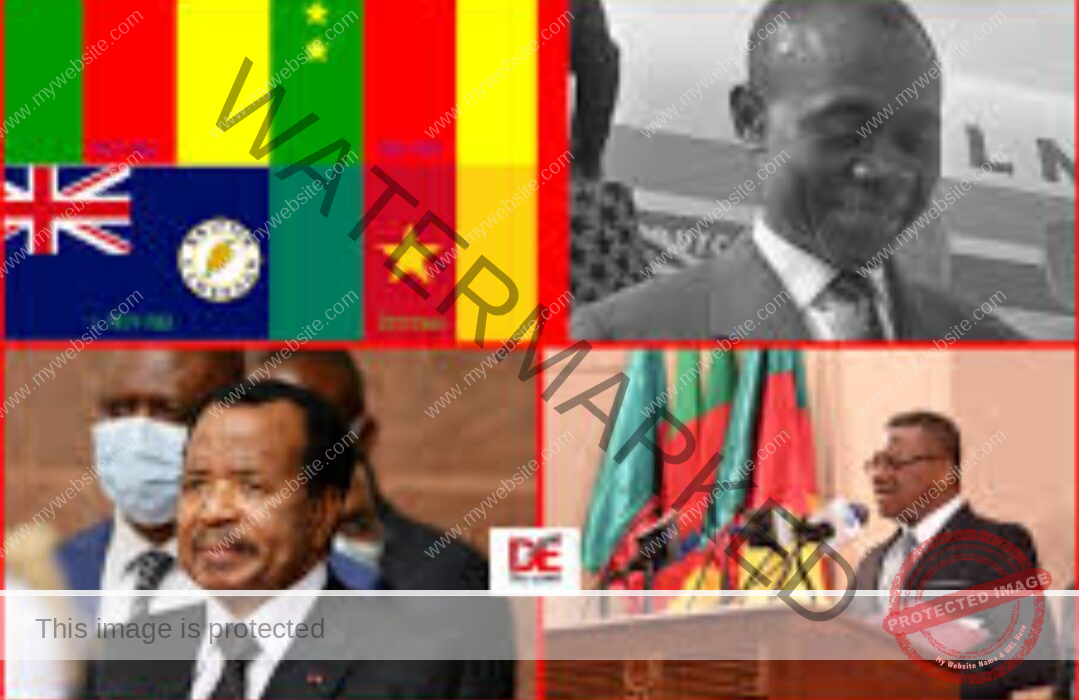


Ambazonian legal thinkers maintain that by reverting the country’s name to “Republic of Cameroon”—the exact title used by the French-speaking state at its independence in 1960—the government in Yaoundé effectively revived the identity of the pre-1961 republic.
By Carl Sanders, Guest Writer
The Independentistnews, Soho, London
LONDON – March 10, 2026 – For decades, the government in Yaoundé has defended the principle of a “one and indivisible” Cameroon, presenting the country’s territorial unity as a settled constitutional fact. Yet supporters of the Ambazonian cause argue that the legal foundations of that claim remain far more contested than official narratives suggest.
At the center of this debate lies Law No. 84-01 of 1984, signed by President Paul Biya, which changed the country’s official name from the United Republic of Cameroon back to the Republic of Cameroon. For many Ambazonian scholars and activists, this seemingly administrative decision carries profound legal implications.
The Historical Context
The political union between the former British Southern Cameroons and the already independent Republic of Cameroon emerged from the 1961 UN-organized plebiscite, after which the territory voted to join Cameroon rather than Nigeria. The arrangement produced a federal state known as the Federal Republic of Cameroon, later transformed into the United Republic of Cameroon in 1972 following a controversial national referendum.
For critics of the central government, the federal system had originally served as the constitutional framework intended to protect the autonomy and distinct legal traditions of the English-speaking territory.
When the name of the state was changed again in 1984, supporters of the Ambazonian argument contend that the symbolism was not merely cosmetic.
The Argument of Legal Discontinuity
Ambazonian legal thinkers maintain that by reverting the country’s name to “Republic of Cameroon”—the exact title used by the French-speaking state at its independence in 1960—the government in Yaoundé effectively revived the identity of the pre-1961 republic.
From this perspective, the change raises a fundamental question: if the state returned to the name and identity of the entity that existed before the union, what became of the legal arrangement that joined Southern Cameroons to it?
Advocates of Ambazonian independence argue that this act symbolically—and in their view legally—undermined the foundations of the original union. They describe the change as evidence that the partnership established in 1961 was effectively dissolved.
A Contested Interpretation
Not all scholars accept this interpretation. Cameroonian constitutional authorities maintain that the 1984 law represented a simple restoration of the country’s historical name rather than a legal dissolution of the state created after reunification.
Under this view, the continuity of Cameroon as a single sovereign state remained intact regardless of the changes in official nomenclature.
The disagreement therefore reflects a broader legal and political dispute: whether the events surrounding the evolution of Cameroon’s constitutional order—1961, 1972, and 1984—represent legitimate internal reforms or the gradual erosion of the original federal agreement.
Law, Politics, and the Future
For supporters of the Ambazonian movement, the significance of the 1984 law lies in its symbolic and legal value as part of a larger argument that the union between Southern Cameroons and Cameroon was fundamentally altered without the consent of the English-speaking population.
In their view, the struggle is therefore not a question of secession from an intact state but a demand to restore a political status they believe was compromised.
For the government in Yaoundé, however, the issue remains firmly within the framework of national unity and territorial integrity.
A Continuing Debate
More than four decades after the passage of Law No. 84-01, the interpretation of its meaning continues to influence political discourse surrounding the conflict in Cameroon’s North West and South West regions.
Whether the future holds constitutional reform, negotiated settlement, or continued confrontation, the legal and historical questions surrounding the nature of the 1961 union—and the subsequent changes to Cameroon’s constitutional structure—will likely remain central to the debate.
For many Ambazonians, the struggle is therefore not simply political or military. It is also an argument about history, law, and the unfinished legacy of decolonization.
Final Reflection
In the end, the debate surrounding the 1984 law reveals something deeper than a dispute over constitutional wording. It reflects two competing interpretations of history: one that views Cameroon’s post-independence evolution as a continuous national project, and another that sees the changes of 1972 and 1984 as the gradual dismantling of a partnership forged in 1961. For Ambazonian advocates, the significance of Law No. 84-01 lies in its symbolic reminder that political unions, like all legal arrangements, depend on consent and legitimacy. When those foundations are contested, history inevitably returns to the negotiating table. Whether through dialogue, reform, or new political realities, the question raised by 1984 continues to echo across the region: not simply what Cameroon was, but what it was meant to become.
Carl Sanders, Guest Writer The Independentistnews