

After Bamenda, the storm did not expose weakness. It revealed capacity. Not fragility—but formation. Not confusion—but clarification. Not division—but definition. This is not a movement reacting to pressure. It is a Government being forged by it.
By Ali Dan Ismael, Editor-in-Chief The Independentist News
The aftermath of the Holy See’s visit to Bamenda was expected to be a moment of diplomatic reflection. Instead, it became something far more revealing: a rapid succession of narratives, each testing the coherence, clarity, and authority of the Ambazonian cause. What followed was not random. It was a concentrated information storm—and with each wave, the Government of the Federal Republic of Ambazonia responded not with reaction, but with intellect, structure, and control.
The modern battlefield is no longer confined to forests, towns, or diplomatic corridors. It extends into diaspora platforms, social media channels, and digital “telegraphs,” where narratives are constructed, contested, and amplified in real time. Influence is immediate. Reach is global. And responsibility, often, is uneven.
The role of diaspora media in this evolving battlefield cannot be ignored. Platforms operating beyond formal institutional structures have, at times, shaped narratives with significant reach and consequence. Figures such as Eric Tano Tataw exemplify both the power and the risk of this dynamic. His online channels commanded attention across the diaspora, but also became focal points of controversy, with critics within the movement arguing that certain narratives amplified division at moments when cohesion was most critical. These developments, now intersecting with ongoing legal proceedings in the United States, underscore a broader reality: influence without institutional discipline can quickly become a strategic vulnerability in an already contested information space.
Almost immediately after the visit, the first signal emerged: the “reform” proposition advanced by Simon Fobi Nchinda. The appeal of such proposals lies precisely in their ambiguity. They are constructed to sound conciliatory while leaving core questions unresolved—allowing multiple interpretations to coexist without committing to a definitive position on sovereignty. This is not accidental. It is the language of political elasticity.
Then came the intellectual layering. Professor Willibroad Dze-Ngwa introduced the doctrine of “shared responsibility,” a formulation that appeared balanced on the surface but carries a deeper effect in practice: the redistribution of accountability in ways that can obscure the structural roots of the conflict. The result is not clarity, but complexity—an environment in which responsibility becomes diffused and resolution deferred.
This pattern was not unfamiliar. It echoed earlier episodes, including the Canadian monologue, where ambiguity and framing replaced clarity, allowing multiple interpretations to coexist while avoiding decisive accountability. Then, almost unexpectedly, another voice entered the arena. Orock Betang, presenting himself in prophetic terms, introduced rhetoric less anchored in law or policy and more in symbolism and declaration—expanding the informational field into yet another direction.
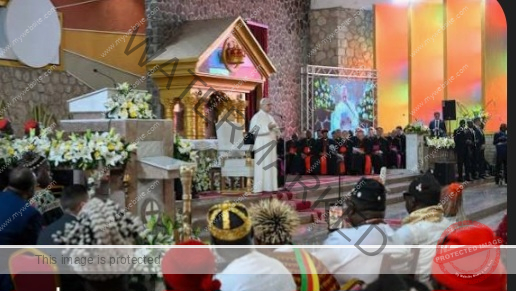
At the same time, the optics of the Holy See’s visit themselves became part of the information battlefield. Ceremonial choices, audience interactions, and the distinct tone of engagements in Bamenda were widely interpreted across different constituencies. While such moments are often governed by protocol rather than politics, their perception carried weight. To some observers, they suggested contrast—between a state seeking to project control and a population seeking recognition. In the information arena, perception is not incidental. It becomes part of the narrative architecture. This was not coincidence. It was sequencing.
First came reform—structured to sound reasonable while avoiding the central question of sovereignty. Then came “shared responsibility”—a framework that diffuses accountability under the cover of intellectual balance. Then came rhetorical disruption—voices unanchored in law or policy, expanding the field of noise. Different tones. Same effect: to dilute clarity and test authority. But this is where the miscalculation becomes evident.
Each wave did not destabilize the Government of the Federal Republic of Ambazonia—it compelled it to define itself more precisely. To speak more clearly. To anchor more firmly in principle. This is the nature of a true stress test: it does not weaken structure—it exposes and strengthens it.
The state in Cameroon has long relied on fragmentation as a strategic advantage. A divided voice is easier to dismiss. A blurred narrative is easier to manipulate. But what is emerging is the opposite dynamic: pressure is producing coherence.
International observers—from the United Nations to diplomatic actors—are not measuring silence. They are measuring discipline. They are watching whether a leadership can hold its line under pressure. And increasingly, that line is not only holding—it is sharpening.
Let us be unequivocal. The Ambazonian struggle is not being defined by competing narratives. It is being defined by the Government’s ability to out-think them, out-structure them, and outlast them.
After Bamenda, the storm did not expose weakness. It revealed capacity. Not fragility—but formation. Not confusion—but clarification. Not division—but definition. This is not a movement reacting to pressure. It is a Government being forged by it.
Ali Dan Ismael, Editor-in-Chief The Independentist News