










Editorial commentary

We are home to news on Cameroon and the CEMAC region. We are dedicated to honest and reliable reporting. We are the voice of the Cameroonian people and their fight for freedom and democracy at a time when the Yaoundé government is silencing dissent and suppressing democratic voices.

A wise nation does not demand that people forget who they are. A wise nation creates conditions where different identities can coexist without domination, humiliation, fear, or forced assimilation.
By Timothy Enongene
Guest Editor-in-Chief, The Independentist News
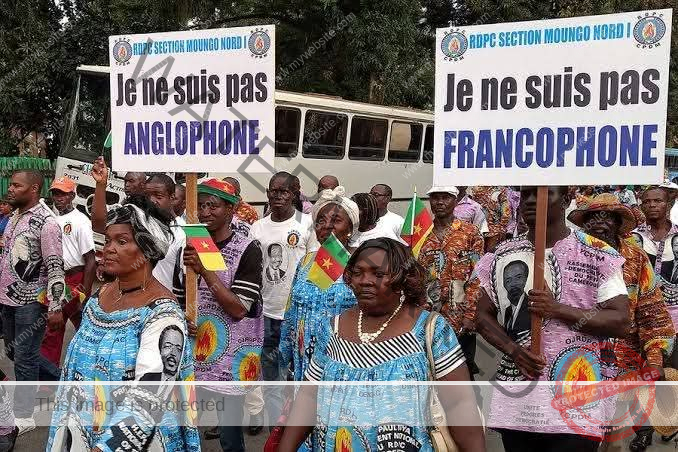
BUEA – May 17, 2026 – There are moments in history when propaganda becomes so desperate, so detached from human suffering, that it unintentionally exposes the moral collapse of the very system it seeks to protect. The images now circulating across Cameroon are one such moment. Men and women marching beneath giant banners declaring:
“Je ne suis pas Anglophone.”
“I am not Anglophone.”
“Je ne suis pas Francophone.”
“I am not Francophone.”
At first glance, the slogans appear harmless. Even noble. A call for unity. A rejection of division. A plea for national cohesion. But history teaches us that authoritarian systems often weaponize the language of unity precisely when they are presiding over division, repression, and bloodshed.
For nearly ten years, the people of the former British Southern Cameroons have lived through one of the darkest chapters in modern African history. Villages have burned. Families have scattered across forests and refugee camps. Children have grown up under the sound of gunfire instead of school bells. Entire communities have been psychologically mutilated by fear, militarization, disappearances, arbitrary arrests, extortion checkpoints, and endless opérations coup de poing.
And now, after a decade of violence, the political establishment suddenly arrives with a new command: Forget who you are. Do not say you are Anglophone. Do not remember your history. Do not mention federalism. Do not question 1961. Do not discuss marginalization. Do not speak of burned villages. Do not mention the dead. Do not mention the disappeared. Do not mention the tortured. Do not mention the displaced. Do not mention the wounded. Just smile for the cameras and chant “unity.” This is not reconciliation. It is the organized psychological liquidation of memory itself — a state-sponsored attempt to train victims to applaud the disappearance of their own identity while the smoke of war still rises from their ancestral homeland.
A nation cannot heal by demanding amnesia from the wounded. The tragedy of Cameroon is not that people identify as Anglophone or Francophone. The tragedy is that the state spent decades transforming those identities into instruments of political inequality while simultaneously pretending the inequalities did not exist.
When Anglophone lawyers protested peacefully in 2016 over the destruction of the Common Law system, they were beaten. When teachers protested over the erosion of the Anglo-Saxon educational structure, they were ignored. When civilians marched peacefully, they were met with bullets, mass arrests, and military terror. And now the same machinery that escalated the conflict lectures the victims about “national unity.” What kind of unity is built on fear? What kind of unity survives on silence? What kind of unity demands that a people abandon the vocabulary of their own history while soldiers patrol their streets and mothers bury their children?
Real unity is voluntary.
Real unity is built through justice, mutual respect, historical honesty, and equal human dignity under the law. Real unity does not fear identity. Only deeply insecure states fear identity, because identity exposes the artificial foundations upon which political domination was constructed.
The irony is staggering. Cameroon itself is a state built upon colonial distinctions created by Britain and France. The administrative systems, educational structures, legal traditions, and linguistic identities that define the country today were inherited directly from colonial partition.
For decades, the political class benefited from those distinctions whenever convenient. Elections were balanced around them. Appointments were calculated around them. Power was negotiated around them. But now, in the middle of war, identity suddenly becomes forbidden. This is not statesmanship. It is political gaslighting of the highest order.
No serious peace process anywhere in the world has ever succeeded by denying the identity of the aggrieved population. Not in Northern Ireland. Not in Bosnia. Not in South Sudan. Not in Eritrea. Not in Rwanda. Peace begins when truth is allowed to breathe. And the truth is painfully simple: The Anglophone problem did not emerge because people called themselves Anglophones.
It emerged because generations of people felt politically unheard, culturally diminished, economically marginalized, administratively absorbed, and progressively stripped of the protections and guarantees that formed the basis of the 1961 union. No banner can erase that reality. No slogan can bury memory. No staged march can reconstruct trust shattered by years of bloodshed.
Cameroon today stands at a dangerous crossroads.
One path continues the politics of denial, forced slogans, choreographed patriotism, and state-managed narratives disconnected from the lived experiences of ordinary citizens. The other path requires courage. The courage to admit historical failures. The courage to acknowledge suffering on all sides. The courage to confront uncomfortable truths about the post-colonial state. The courage to understand that identities do not threaten peace; injustice does. A wise nation does not demand that people forget who they are. A wise nation creates conditions where different identities can coexist without domination, humiliation, fear, or forced assimilation.
Until that lesson is learned, every state-sponsored march for “unity” will resemble not the birth of a reconciled nation, but the slow funeral procession of a political system collapsing beneath the unbearable weight of its own denial.
Timothy Enongene
Guest Editor-in-Chief, The Independentist News
Share This Post:
FOUNDATIONS OF AMBAZONIAN RECONSTRUCTION — PART VI Capital and Control: The Financial Engine of Independence
The Government of the Federal Republic of Ambazonia( in exile) rings the alarm bells over military misdeeds in Ekona
Related Post
THE SECOND RETURN: FROM THE PAIN OF SEPARATION TO
WHEN THE REGULATOR BENDS: WHAT THE VISION 4 AFFAIR
PROPHECY, POLITICS, AND THE AMBAZONIAN QUESTION (PART II) :
IF SOMALILAND MATTERS TO WASHINGTON, WHY NOT SOUTHERN CAMEROONS?
A CALL FOR GENERATIONAL RENEWAL: From Individual Leadership to
The Government of the Federal Republic of Ambazonia (in