

Britain cannot continue praising heroes above ground while burying the victims and consequences of empire beneath their monuments. Southern Cameroons does not need another royal expression of concern. It needs the historical record opened, the constitutional injury examined and productive sovereignty returned to the people whose land and labor created the wealth.
By Ali Dan Ismael
Editor-in-chief The Independentist News
Britain has mastered the art of celebrating national honor while distancing itself from the consequences of empire. It presents the Crown as an enduring symbol of duty, restraint, constitutional government and service. It praises Winston Churchill as a defender of liberty, teaches parliamentary democracy as part of its national character and portrays the Commonwealth as a voluntary family of equal nations. Yet Southern Cameroons stands as evidence of the distance between Britain’s moral self-portrait and its imperial record.
Britain administered Southern Cameroons, shaped the limited choices through which its political future was decided, terminated its trusteeship without securing an enforceable constitutional settlement and subsequently treated the dismantling of the territory’s institutions as somebody else’s internal affair. Britain preserved the appearance of honorable withdrawal while Southern Cameroons progressively lost control over its government, parliament, economy and productive assets.
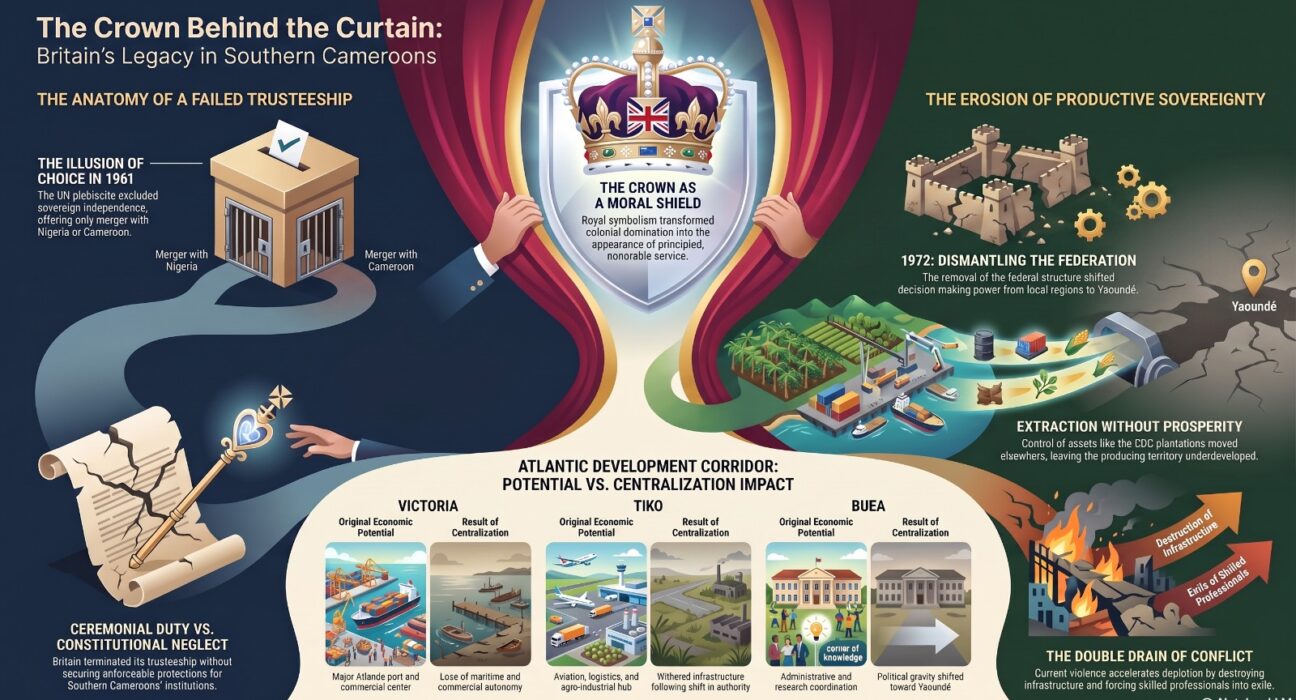
The Crown did not personally seize plantations, collect customs revenue or direct post-1961 policy from Yaoundé. The more serious argument is that royal symbolism helped make imperial authority appear principled. It surrounded control with ceremony, transformed domination into trusteeship and permitted Britain to present an unfinished act of decolonization as a completed constitutional duty.
When power dressed itself as service
British imperialism rarely described itself as exploitation. Colonial officers spoke instead of administration, development, civilization and preparation for self-government. Governors served in the monarch’s name. Royal portraits appeared in public offices. Medals, ceremonies, church services and official proclamations placed dignity around a system in which colonized peoples did not possess equal authority over their political and economic futures. The Crown gave that system an appearance of moral continuity.
This symbolism mattered because extraction is easier to defend when it is presented as service. A plantation economy could be described as development even when the producing population did not control the larger structures of shipping, finance, insurance, processing, trade or capital accumulation. Political dependency could be described as protection. Withdrawal could be declared successful once the colonial flag was lowered, regardless of whether the territory being transferred had obtained secure control of its own inheritance.
Southern Cameroons was not an empty or unproductive territory. Its fertile volcanic soils, Atlantic coastline, plantations, forests, fisheries, commercial settlements and educated population provided the basis for a potentially prosperous state. Victoria could have matured as an Atlantic port and commercial center. Tiko possessed aviation, logistics, plantation and agro-industrial potential. Buea had already developed as the territory’s constitutional and administrative center.
Together, these cities could have anchored a regional economy connecting agriculture, processing, transportation, finance, research and international trade. What Southern Cameroons lacked was not productive capacity. It lacked secure political authority over that capacity.
Britain’s unfinished trusteeship
Under the United Nations Trusteeship System, Britain was expected to advance Southern Cameroons toward self-government or independence. Instead, the 1961 plebiscite offered only two alternatives: joining the Federation of Nigeria or joining La République du Cameroun. Separate sovereign independence was not placed on the ballot.
United Nations General Assembly Resolution 1608, adopted on April 21, 1961, endorsed the termination of trusteeship and contemplated Southern Cameroons joining La République du Cameroun on October 1, 1961. Britain frequently treats those events as the lawful closing of an administrative file. The people voted, the United Nations acted and trusteeship ended.
But trusteeship was not merely a procedure for disposing of territory. Britain had a responsibility toward a territory possessing its own government, legislature, legal system, civil service, educational traditions and political identity. Before leaving, Britain should have ensured that the terms of the proposed union were complete, enforceable and protected against unilateral destruction.
A trustee cannot simply hand the beneficiary’s estate to another authority and declare the duty fulfilled. The trustee must ensure that the beneficiary’s rights are protected. Britain did not do so. It left Southern Cameroons dependent upon assurances that were politically fragile and constitutionally vulnerable. It transferred responsibility before securing the institutions upon which the proposed union depended. The Crown’s moral prestige helped disguise this failure. Britain appeared to have acted honorably. Southern Cameroons was left to bear the cost.
The federation protected more than identity
The federal structure established in 1961 was not merely a cultural accommodation. It was the institutional shell protecting West Cameroon’s political and economic interests.
A regional parliament could influence taxation and public expenditure. A regional government could establish development priorities. Its courts could preserve the common-law system and contractual confidence. Its educational institutions could cultivate the human capital needed for local administration and industry. Its public authorities could decide where roads, ports, airports, processing plants and public institutions should be developed.
When the federation was dismantled in 1972, Southern Cameroons lost far more than a flag or regional title. It lost the political machinery connecting its productive assets to accountable local government.
From then onward, strategic decisions could be made from Yaoundé. Revenues generated within Southern Cameroons could be centralized. Public corporations could be directed by nationally appointed officials. Investment could follow political influence rather than territorial need. Ministries, banks, corporate headquarters and procurement systems could accumulate elsewhere while the producing territory remained an economic hinterland. This is how productive sovereignty is destroyed.
The asset does not have to be physically removed. The plantation may remain, but its strategic direction is controlled elsewhere. Oil may continue flowing, but the producing communities lack authority over revenue. Timber may leave the forests, while surrounding towns remain underdeveloped. The port may exist, yet the territory cannot determine its long-term maritime strategy. The land remains local. The decision-making power disappears.
CDC and the separation of production from prosperity
The Cameroon Development Corporation became one of the clearest expressions of this contradiction. CDC plantations were located overwhelmingly on Southern Cameroons land and sustained by workers and communities from the territory. But the decisive question was never merely whether the corporation employed people.
The real questions were whether the host territory controlled corporate appointments, procurement, processing policy, capital investment, land management, revenue allocation and the long-term industrial use of plantation production.
A plantation economy can employ thousands and still fail to build prosperity if commodities leave without generating local manufacturing, technology, infrastructure, pensions, community ownership and reinvestment.
Once Southern Cameroons lost its government and parliament, its ability to direct the productive purpose of institutions such as CDC was weakened. The corporation remained geographically rooted in the territory, but the political structure through which the people could hold it accountable had been dismantled.
Britain could claim that it had created a development institution. What it failed to provide was the durable constitutional framework necessary to ensure that the institution permanently served the territory whose land and labor sustained it.
The development corridor that was allowed to wither Victoria, Tiko and Buea should have formed the foundation of an integrated Atlantic development corridor. Victoria possessed maritime and commercial significance. Tiko had an airport, plantation economy and logistics potential. Buea offered political administration, higher education, research and strategic coordination. The natural development chain was clear: production, processing, logistics, export, finance and local reinvestment.
Instead, centralized government progressively shifted political and economic gravity away from this corridor. Infrastructure follows authority. Headquarters follow ministries. Banks follow public contracts. Investors follow decision-makers. Skilled workers follow opportunity. Southern Cameroons consequently remained rich in land and resources but increasingly poor in institutional authority. It became a producer without command of the value chain.
The Commonwealth as a new coat over an old wound
Cameroon’s admission into the Commonwealth in 1995 allowed Britain to recast an unresolved colonial legacy as a modern partnership. The centralized state gained English-speaking diplomatic legitimacy, while Britain could point to Commonwealth membership as evidence that Cameroon had voluntarily joined an association founded upon democracy, law and shared values.
Yet membership restored none of Southern Cameroons’ lost institutions. It did not restore its parliament. It did not restore its government. It did not reopen the terms of the 1961 settlement. It did not return authority over plantations, ports, taxation or public investment. It did not require an accounting of the economic consequences of federal dissolution. The Commonwealth became a ceremonial roof over a broken constitutional foundation.
Recent scholarship has observed that, despite Cameroon’s prolonged conflict, the country has not been placed formally on the Commonwealth Ministerial Action Group’s agenda. That omission raises a fundamental question: are Commonwealth principles instruments of accountability, or are they largely ceremonial when confronting a strategically protected member state?
The Crown’s convenient innocence
The monarchy benefits from constitutional distance. Ministers make policy. Administrators execute it. Corporations conduct commerce. Postcolonial governments award concessions. The Crown stands above the machinery as the embodiment of national virtue.
This arrangement allows Britain to claim continuity where continuity produces honor and deny continuity where it produces responsibility. Victory belongs to the nation. Empire belongs to past governments. The Commonwealth belongs to royal tradition. Colonial consequences belong to somebody else. But Britain cannot inherit only the prestige of its history. If the Crown symbolizes the enduring British state, then that continuity must include obligations toward peoples formerly governed in its name. Britain cannot retain imperial ceremony while rejecting imperial accountability.
Conflict as the final destruction of productive capacity
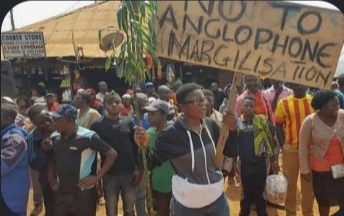
Since 2016, armed conflict has accelerated the destruction of Southern Cameroons’ productive base. Human Rights Watch has documented serious abuses committed by both government forces and armed separatist groups, including killings, destruction of civilian property, kidnappings and attacks affecting education.
Plantation operations have been disrupted. Workers have lost employment. Businesses have closed. Farmers have lost access to markets. Children have missed years of education. Professionals have migrated. Families have been displaced. Every closed school represents lost human capital. Every abandoned farm represents lost production. Every displaced entrepreneur represents lost investment. Every engineer, nurse, teacher or technician forced into exile represents a depleted national asset.
Southern Cameroons is therefore being drained twice: first through the loss of institutional control and then through the physical destruction caused by conflict. Yet Britain continues to emphasize humanitarian relief, dialogue and stability without adequately confronting the constitutional history that made the territory vulnerable. It offers assistance around the wound while refusing to examine how the wound was opened.
The Crown must no longer shield the record
The present monarch did not personally cause Southern Cameroons’ crisis. That is not the point. The Crown matters because it helped make empire appear honorable and continues to lend Britain a language of duty, service and continuity that can conceal the consequences of imperial decisions.
Britain must open its trusteeship, diplomatic, commercial and constitutional archives. It should support an independent investigation into the termination of Southern Cameroons’ trusteeship, the negotiations surrounding the proposed union and the transfer and subsequent control of productive institutions.
Such an inquiry should examine the exclusion of sovereign independence from the plebiscite, Britain’s knowledge of the constitutional negotiations, the economic treatment of CDC and other public assets, the dismantling of federal institutions and the long-term loss of regional investment and human capital.
The Crown should symbolize truth, not concealment.
Britain cannot continue praising heroes above ground while burying the victims and consequences of empire beneath their monuments. Southern Cameroons does not need another royal expression of concern. It needs the historical record opened, the constitutional injury examined and productive sovereignty returned to the people whose land and labor created the wealth.
Ali Dan Ismael
Editor-in-chief The Independentist News