

Once every grievance is treated as a threat, the distance between governing a population and controlling one can become dangerously small.Southern Cameroons has already paid an unbearable price to learn that lesson.
By The Independentist News Commentary Desk
As Amazon associate this site earns from qualifying purchases
Get books on Ambazonia’s productive Sovereignty and statecraft By Martin Mungwa on Amazon
Paris – October 7, 2026 – There is an uncomfortable question France may not want to ask itself: Is Paris beginning to exhibit at home some of the governing reflexes Africans have watched for decades in regimes France has tolerated abroad? No serious observer should claim that Emmanuel Macron’s France and Paul Biya’s Cameroon are identical. They are not.
France retains competitive elections, a vigorous press, opposition parties, trade unions, courts and mechanisms for investigating police misconduct. Cameroon’s record, particularly in the former British Southern Cameroons, is far harsher. But different political systems can still display similar instincts under pressure. And France today presents an uncomfortable mirror.
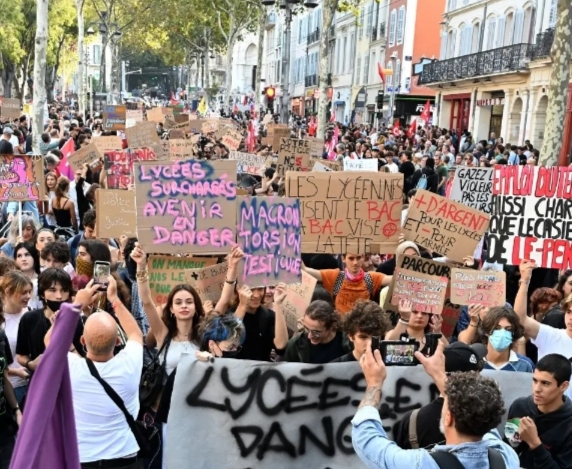
French students began protesting over ordinary grievances: overcrowded classrooms, teacher shortages, deteriorating facilities, unreplaced absences and anxiety over university admissions. These are not terrorist demands. They are not revolutionary demands. They are young people asking whether the institutions preparing them for adulthood are functioning.
Yet as protests intensified, the familiar sequence emerged: Police deployment. Arrests. Violence. Accusations of extremism. Political leaders discussing public order more loudly than the original grievance. Southern Cameroonians know this progression well. From Grievance to Security Crisis The Southern Cameroons crisis did not begin as an armed rebellion. In 2016, English-speaking lawyers and teachers protested what they saw as the erosion of Anglophone legal and educational institutions. Demonstrations were met with arrests and force. Negotiations followed, but prominent leaders were later detained. Positions hardened. Moderate political space narrowed. Separatism intensified. Armed resistance emerged. Government repression escalated. A political grievance became a security war.
France is nowhere near that outcome. But that is precisely why the early pattern matters. Political disasters rarely announce themselves in advance. They begin when governments stop asking: Why are these people protesting? and begin asking only: How do we restore order?
The President Above the Crisis
Another feature of the French moment should feel familiar to observers of Cameroon: presidential distance. As France struggles with unrest, Macron has remained comparatively removed while the prime minister, education officials, interior officials and police absorb much of the pressure. Paul Biya perfected a version of this political architecture. Ministers speak. Governors act. Security forces enforce. Prime ministers negotiate. The presidency remains elevated above the immediate collision between state and citizen, intervening later as arbiter. But leadership cannot consist only of appearing after institutions have failed.
A president should not outsource empathy. That lesson applies in Paris as much as it does in Yaoundé. Police Cannot Solve a Political Question Violence by protesters must not be excused. Governments have a duty to protect students, teachers, businesses, schools and public property. But force has limits. Police officers cannot repair an education system. Tear gas cannot replace teachers. Arrests cannot reduce classroom overcrowding. Riot-control equipment cannot fix broken schools. And security doctrine cannot answer a teenager who believes the state has failed to provide the future it promised.
That is a political problem. Political problems ultimately require political leadership. France’s decision to suspend the use of stun grenades during the protests after a serious student injury demonstrates an important difference between France and Cameroon: French institutions still possess strong mechanisms for investigation and course correction. France should use them before escalation hardens both government and protesters.
When “Extremists” Replace the Grievance
Every major protest movement attracts people willing to exploit disorder. France has experienced vandalism, attacks and destruction. Those responsible should be held accountable. But governments enter dangerous territory when the violent minority becomes the lens through which the entire movement is understood. Southern Cameroonians watched that transformation. Lawyers became agitators. Protesters became separatists. Separatists became terrorists. Some armed separatist groups later committed serious abuses themselves. But once the entire crisis became primarily a security question, the grievances that produced it became easier to ignore.
That creates a dangerous cycle: Grievance Extremism then justifies greater repression. Eventually, every side points to the violence of the other as proof that its own escalation was necessary. France Should Learn From Cameroon The lesson from Southern Cameroons is not that France has become Cameroon. It is that democratic governments are not immune from authoritarian reflexes when challenged from below.
Presidents can distance themselves. Governments can substitute policing for politics.Violent minorities can eclipse peaceful majorities. Dialogue can arrive only after confrontation. And security language can slowly replace political diagnosis. The Southern Cameroons crisis shows where such failures can lead when grievance, repression and radicalization feed one another over time.
France still has institutions capable of choosing another path. That is precisely why this moment matters. For generations, European governments have lectured Africans about dialogue, democratic accountability, human rights and responsive government. Those principles remain valid. But principles acquire their real meaning when the country preaching them must practice them under pressure. France now faces such a test.
The Mirror Facing Paris
Perhaps France should spend less time asking whether its young protesters are becoming ungovernable and more time asking why so many believe their government is no longer hearing them. A teenager demanding a functioning school is not an enemy of the Republic. A teacher demanding adequate resources is not an extremist. A peaceful citizen demanding competent government is not a security threat.
Governments capable of deploying thousands of police officers must also be capable of deploying something more powerful: listening. Southern Cameroons demonstrates what can happen when grievance becomes securitized, dialogue comes too late and moderates disappear from the middle. France has not reached that point. It should make sure it never does. Perhaps the most important question facing Macron is therefore not whether he can restore order. It is whether the French state can hear its citizens before it begins to fear them. Because once every grievance is treated as a threat, the distance between governing a population and controlling one can become dangerously small.Southern Cameroons has already paid an unbearable price to learn that lesson.
As Amazon associate this site earns from qualifying purchases
Get book’s on Ambazonian’s productive Sovereignty and statecraft By Martin Mungwa on Amazon
The Independentist News Commentary Desk