

The more the state insists on a mythical continuity, the more it reveals its own fragility. The more it suppresses historical clarity, the more that clarity re-emerges. This is no longer a matter of interpretation. It is a matter of record. And when the distortions are stripped away, one conclusion remains unavoidable: there was never one cameroon.
By Ali Dan Ismael
Editor-in-Chief, The Independentistnew
A quiet distortion has shaped a nation—and now it is unraveling. For decades, a carefully constructed narrative has defined how Cameroon understands itself—and how it presents its past to the world. It is taught in classrooms, echoed in official speeches, and reinforced by institutions that rarely pause to question its foundations. According to this narrative, Cameroon is a continuous historical entity, stretching from German colonial rule to the present republic. But what if that continuity never existed?
What if the modern Cameroonian state is not the product of historical evolution, but of selective memory—stitched together from colonial fragments and sustained by repetition rather than record? This is not a matter of interpretation. It is a matter of historical fact. First, the lie is simple. that is why it survives.
There is a particular kind of lie that does not shout. It whispers. It repeats. It settles quietly into textbooks, state speeches, and the mouths of compliant intellectuals until it becomes accepted as truth. That lie is this: that today’s Cameroon is a natural continuation of history—stretching seamlessly from German rule to the present republic. It is false. entirely false.
Yet men like Paul Biya, Andrew Nkea, and Victor Julius Ngoh Ngoh continue to recycle it—either out of calculated intent or institutional obedience. Second, Germany did not create cameroon. it created a colony.
Yes, there existed a territory called Kamerun under German rule beginning in 1884. But let us be precise. Kamerun was not a sovereign nation.
It was not a republic. It was not a political community formed by consent. It was a colonial possession—structured for extraction, not representation. No constitution. No citizenship. No self-determination. To present modern Cameroon as a continuation of German Kamerun is not history. It is distortion.
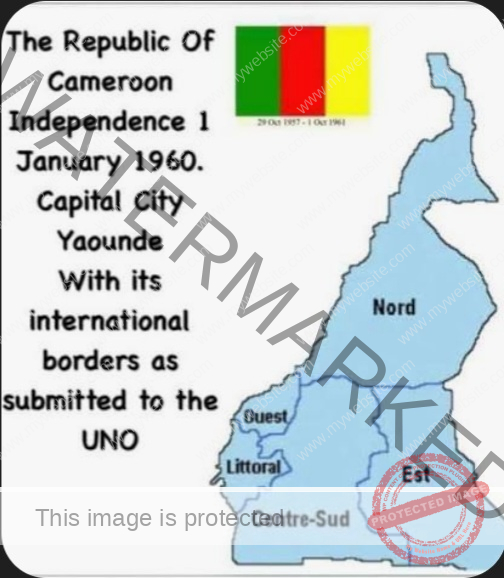
Third, the real birth of cameroon is 1960 — and it was french. Modern Cameroon—La République du Cameroun—was born on January 1, 1960. Not in Berlin. Not in Buea. Not in any imagined pre-colonial unity. But within the geopolitical architecture of France. It was a state designed at independence with inherited administrative, legal, and political structures aligned with French interests. This is the state that Paul Biya governs. This is the state its defenders attempt to universalize. This is the state that claims continuity where none exists.
Fourth, 1961 is the fracture they cannot explain. If Cameroon was complete in 1960, then a single question dismantles the narrative: what happened in 1961? In that year, the Southern Cameroons—a distinct United Nations Trust Territory under British administration—entered into a federal union with La République du Cameroun. Not absorption. Not administrative extension. A union. Two entities. Two legal histories. Two political identities.
This moment exposes the central contradiction. A state that claims historical continuity cannot explain why it required a union with a separate entity in 1961.
Fifth, the strategy of substitution. Unable to defend the historical record, the regime adopted a quieter strategy: substitution. Southern Cameroonians became “anglophones.” A people became a linguistic category. A political question was reduced to a cultural inconvenience. Through this reframing, sovereignty was obscured, and identity diluted. This is not accidental. It is structural.
Sixth, the intellectual collaborators. No enduring distortion survives without institutional reinforcement. Segments of the academic, clerical, and administrative class have participated—actively or passively—in maintaining this narrative. They simplify history. They omit 1961. They present a constructed continuity as fact. This is not scholarship. It is compliance.
Seventh, the truth in full. The historical sequence is not complex: Germany created a colony.
France created a state. 1961 created a union. That union was unequal. That union was contested. That union is now irreparably broken. Finally, the lie is collapsing. Repetition cannot substitute for legitimacy.
The more the state insists on a mythical continuity, the more it reveals its own fragility. The more it suppresses historical clarity, the more that clarity re-emerges. This is no longer a matter of interpretation. It is a matter of record. And when the distortions are stripped away, one conclusion remains unavoidable: there was never one cameroon.
Ali Dan Ismael
Editor-in-Chief, The Independentistnew