








Investigative commentary

We are home to news on Cameroon and the CEMAC region. We are dedicated to honest and reliable reporting. We are the voice of the Cameroonian people and their fight for freedom and democracy at a time when the Yaoundé government is silencing dissent and suppressing democratic voices.

Biafra must make the case for Biafra. Southern Cameroons must make the case for Southern Cameroons. A Movement Must Know What It Is
The greatest danger facing an independence movement is not always military defeat. Sometimes it is strategic transformation.
By The Independentist News Investigative and Political Desk
As Amazon associate this site earns from qualifying purchases
Get books on Ambazonia’s productive Sovereignty and statecraft By Martin Mungwa on Amazon
https://www.amazon.com/s?k=martin+mungwa&crid=3ASZUKJG4IRKV&sprefix=Martin+mungwa%2Caps%2C439&linkCode=ll2&tag=njokings-20&linkId=718d7c970b29d8af669e41918410fbf3&language=en_US&ref_=as_li_ss_tl
For years, one of the most consequential strategic disagreements inside the Southern Cameroons independence movement has received far less scrutiny than it deserves.
It concerns Biafra. More specifically, it concerns the attempt to politically associate the Southern Cameroons independence struggle with the contemporary Biafran separatist movement—and the potentially enormous diplomatic consequences of doing so.
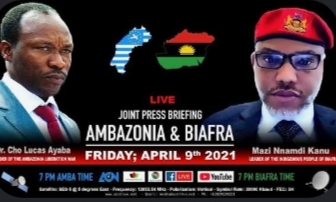
The question today is no longer simply whether Ayaba Cho Lucas and the Ambazonia Governing Council, AGovC, sympathized with the Biafran cause. That association is documented. IPOB itself stated in February 2022 that its representatives had met AGovC leader Ayaba Cho Lucas to strengthen an existing alliance. IPOB’s account said that a foundational memorandum of understanding between AGovC and IPOB had been deliberated upon and adopted in Germany in 2020, with subsequent meetings intended to build structures around that relationship. The more important question is this: What did this association do to the international identity of the Southern Cameroons independence case? And an even more difficult question follows: Was Samuel Ikome Sako’s refusal to merge the Southern Cameroons struggle politically with Biafra one of the most consequential strategic decisions of the independence movement?
Two Historical Questions That Were Never Identical.
Southern Cameroons and Biafra may share geography, historical interaction, commercial relationships and cultural connections. But they do not arise from the same international legal history. The Southern Cameroons question originates in the former British Southern Cameroons, a United Nations Trust Territory whose population participated in the 1961 plebiscite over its political future. The modern Biafran question emerges principally from Nigeria’s post-independence political history, including the attempted Republic of Biafra from 1967 to 1970. Whatever sympathy may exist between their respective populations, these are distinct historical and diplomatic cases. That distinction matters enormously.
A movement seeking international recognition must protect the uniqueness of its legal and historical argument. It cannot afford to allow its case to be absorbed into another separatist conflict carrying different historical, constitutional and geopolitical liabilities. Yet that is precisely the danger the AGovC-IPOB alliance created. AGovC Chose an Alliance With Biafra This relationship was not merely rumored. IPOB’s own public statement described an alliance with AGovC and referred explicitly to a foundational MOU between the two movements. That creates a fundamental question of strategy.
What was Southern Cameroons supposed to gain by institutionally linking itself to a movement engaged in a territorial dispute with Nigeria? Nigeria is not a distant state. It is the largest country bordering Southern Cameroons. Large numbers of Southern Cameroonians displaced by the conflict have sought refuge there. And any serious Southern Cameroons diplomatic strategy must eventually address Abuja. It would therefore be extraordinarily difficult to ask Nigeria to sympathize with Southern Cameroons self-determination while simultaneously appearing aligned with a movement seeking Nigeria’s territorial dismemberment. That contradiction should have triggered extraordinary caution. Instead, an alliance was institutionalized.
Nigeria Was Never an Irrelevant Actor
For any Southern Cameroons government seeking international recognition, Abuja could never reasonably be treated as an incidental player. A durable diplomatic strategy would seek to persuade Nigeria that an independent Southern Cameroons could become a stable neighbor, trading partner and security partner.
Political alignment with Biafran separatism risked producing exactly the opposite impression. It could encourage Nigerian policymakers to view the Southern Cameroons struggle not as a historically distinct decolonization and constitutional question, but as part of a broader regional separatist network capable of threatening Nigeria itself. That would give Yaoundé a powerful diplomatic advantage. Instead of having to defend its record concerning Southern Cameroons, Cameroon could portray the conflict as part of a transnational security problem. The diplomatic terrain would have changed completely.
The Washington Connection Deepened the Problem
The pattern did not end with the original AGovC-IPOB alliance. U.S. Foreign Agents Registration Act records show that Moran Global Strategies represented the Biafra Republic Government in Exile beginning in 2024. A subsequent FARA record lists the Ambazonia Governing Council as another foreign principal represented by the same firm in 2025. This does not prove wrongdoing. Lobbying firms frequently represent unrelated clients. Nor does sharing a Washington representative establish a conspiracy between those clients. But political perception matters.
By the time AGovC entered that Washington advocacy environment, a publicly documented AGovC-Biafra alliance already existed.
The result was an avoidable accumulation of associations: a political alliance; an MOU; continued engagement between the movements;
and later overlapping Washington representation. For a Southern Cameroons movement whose international argument depends upon historical specificity, this was strategically hazardous.
Then Came the IGCARE–AGovC MOU
There is another development that deserves far more attention. Before the death of IGCARE Chief of Staff Eyembe Elango, he reportedly drafted an MOU between IGCARE and AGovC designed to establish cooperation between the two organizations. If authenticated, this document would be highly significant. It would suggest that the political relationship was expanding beyond informal contact and into proposed institutional collaboration. The existence of such an MOU would not by itself prove that IGCARE and AGovC were conspiring to destroy the Southern Cameroons independence movement. That conclusion would require much stronger evidence. But the document would raise legitimate questions about organizational convergence.
What exactly was IGCARE proposing to do with AGovC? What commitments were contemplated? Who authorized the discussions?
Was the existing AGovC relationship with Biafra discussed? What political objective would the proposed collaboration advance? And did the proposed cooperation strengthen the independence case—or further entangle competing structures whose strategies were already pulling the movement in different directions? The MOU itself should therefore be preserved, authenticated and examined.
Samuel Ikome Sako Refused the Merger
This is where Samuel Ikome Sako’s position deserves renewed attention. His opposition to linking the Southern Cameroons independence struggle politically with Biafra was not necessarily opposition to Biafrans. It was a question of strategic separation. Southern Cameroons needed to preserve control over its own international identity. It needed to keep its case anchored in its own history. It needed room to deal diplomatically with Nigeria. And it needed to prevent another liberation movement from acquiring even the appearance of authority to speak in Ambazonia’s name. From that perspective, refusing political merger was not isolation. It was strategic boundary-setting.
Was This a Trap?
The word trap must be used carefully. It does not require the assumption that every organization or personality involved consciously participated in a single hidden conspiracy. Political traps can emerge through cumulative strategy. Consider the sequence. First, associate Southern Cameroons politically with Biafra. Second, formalize that relationship through memoranda and organizational cooperation. Third, normalize the idea internationally that the two struggles belong to the same geopolitical family. Fourth, deepen institutional relationships among organizations inside the Southern Cameroons movement. Fifth, make Nigeria increasingly suspicious of Ambazonian independence. Sixth, reposition the conflict as a regional security problem rather than a historically specific Southern Cameroons question.
If this happened, Yaoundé would not need to defeat the Southern Cameroons argument historically. It would only need to change the category into which the international community placed the conflict. Instead of an unresolved Southern Cameroons political question, the world could be encouraged to see another African separatist insurgency connected to other separatist movements. That distinction is enormous.
Who Benefited?
This is the question that must now be examined without exaggeration. There is not presently sufficient publicly verified evidence to establish as fact that AGovC, IGCARE, Ayaba Cho Lucas or others were acting as agents of La République du Cameroun or French intelligence. Such an accusation requires documentary, testimonial or intelligence evidence substantially stronger than political association. But there is another question that can legitimately be asked: Did these strategies objectively produce outcomes favorable to Yaoundé? That is not the same as accusing every participant of deliberate collaboration.
If Cameroon wanted to weaken the Southern Cameroons case internationally, encouraging foreign governments to view Ambazonia through the lens of Biafra and regional separatism would be strategically useful. It could complicate relations with Nigeria. It could dilute the uniqueness of the Southern Cameroons history.
It could redirect diplomacy toward security containment rather than political status. And it could make foreign governments more cautious about engagement. Whether such consequences were intended remains a matter for evidence.
That they were foreseeable is much easier to argue.
The Ayuk Tabe–NERA 10 Question Returns
Recent developments make the historical sequence even more important. On October 5, 2026, Dr. David Makongo publicly urged the Cameroon government to engage Sisiku Ayuk Tabe and the other members of the Nera 10 in peace talks. There is nothing inherently improper about advocating negotiations with imprisoned political actors. Nor does calling for dialogue automatically compromise the independence struggle. The important question is: Negotiations toward what political destination? That question becomes particularly significant because Makongo has also publicly argued for a federal constitutional settlement within Cameroon rather than separation. That is a fundamentally different objective from restoration of Southern Cameroons independence. One seeks a transformed constitutional relationship inside Cameroon. The other seeks sovereign separation. Those positions should not be conflated.
From Independence to Federalism?
This is where the current debate becomes strategically important. If leading voices increasingly advocate negotiations centered upon Ayuk Tabe and the Nera 10 while simultaneously defining the desired outcome as federalism inside Cameroon, then Southern Cameroonians are entitled to ask whether the political destination of the struggle is being changed. The issue is not whether Ayuk Tabe or the Nera 10 should participate in negotiations.
They remain important political actors. The issue is whether their involvement would be used to validate an independence-centered negotiation or a negotiated return to a reconstituted Cameroon. Those are not the same settlement.
The public should know which one is being proposed.
IGCARE, AGovC, and the Pattern of Convergence
This is why the reported Eyembe Elango MOU deserves scrutiny beyond factional politics.
If IGCARE intended institutional collaboration with AGovC, and AGovC already had a documented political alliance with IPOB, then researchers need to reconstruct precisely how these relationships interacted. One should not leap from association to guilt. But neither should documented relationships be ignored simply because they are politically uncomfortable.
The sequence deserves investigation: AGovC developed an alliance with IPOB. A foundational AGovC-IPOB MOU was publicly acknowledged by IPOB. AGovC later entered a Washington lobbying environment in which the same firm had represented the Biafra Republic Government in Exile. IGCARE, according to the reported Eyembe Elango document, contemplated formal cooperation with AGovC. Samuel Ikome Sako resisted tying the Southern Cameroons struggle politically to Biafra. And today, influential voices are again advocating negotiations involving Ayuk Tabe and the Nera 10, while at least one prominent advocate has openly proposed federalism as the constitutional destination. No single one of these facts proves a coordinated conspiracy. But taken together, they justify serious historical and political investigation.
The Investigation Ambazonians Need
The movement now needs documents rather than accusations. Researchers should establish:
Who conceived the AGovC-IPOB alliance?
Who authorized the original MOU?
What commitments did it contain?
What was its intended diplomatic purpose?
What role did Ayaba Cho Lucas personally play?
What did IGCARE intend to accomplish through its proposed MOU with AGovC?
Who authorized Eyembe Elango to draft that document?
Was the AGovC-IPOB relationship discussed in IGCARE deliberations?
What objections did Samuel Ikome Sako raise at the time?
How were these relationships represented to policymakers in Washington?
Did Nigerian officials interpret Ambazonia through the lens of the Biafran relationship?
Why are current proposals increasingly centered on negotiations involving the Nera 10?
And most importantly, is the intended political destination independence, federation or some other arrangement within Cameroon? These questions can be answered. But only documents, correspondence, meeting records, signed agreements and testimony can answer them responsibly.
The Makongo Development Clarifies the Stakes
David Makongo’s recent intervention is important because it makes the constitutional choice explicit. His public position has not simply called for peace. It has presented federalism as a possible mechanism for resolving the conflict inside Cameroon. His subsequent call for talks involving Ayuk Tabe and the Nera 10 therefore deserves to be examined alongside that stated constitutional preference. That does not prove that Ayuk Tabe shares Makongo’s preferred settlement. It does not prove that the Nera 10 have abandoned independence. And it does not prove that every person advocating negotiations seeks federalism. But it makes one question unavoidable: Who determines the mandate of the negotiators?
If negotiations occur, the people must know in advance whether representatives are negotiating the terms of independence, federation, decentralization, ceasefire or reintegration. Otherwise, negotiations themselves can become the mechanism through which the objective of a struggle is quietly changed.
Friendship Is Not Merger
Nothing in this argument requires hostility toward Biafrans. Southern Cameroonians and Biafrans can remain friends. They can trade. They can cooperate culturally. They can defend one another’s human rights. They can sympathize with each other’s suffering. But sympathy does not require institutional merger. Solidarity does not require common diplomatic identity. And friendship does not require Southern Cameroons to inherit Nigeria’s internal territorial conflict.
Biafra must make the case for Biafra. Southern Cameroons must make the case for Southern Cameroons. A Movement Must Know What It Is
The greatest danger facing an independence movement is not always military defeat. Sometimes it is strategic transformation. A movement may retain its flag, vocabulary and organizations while its political destination gradually changes. Independence can become autonomy. Autonomy can become federation. Federation can become decentralization. And eventually, what began as a claim to sovereign statehood can become a negotiation over improved conditions inside the state from which independence was originally demanded. Whether that transformation is desirable is a political question for the people themselves. But it should never occur by stealth.
That is why the AGovC-Biafra alliance matters.
That is why the reported IGCARE-AGovC MOU drafted by Eyembe Elango matters. That is why Samuel Ikome Sako’s refusal to conflate the Southern Cameroons and Biafran struggles matters. And that is why current calls for negotiations involving Ayuk Tabe and the Nera 10 must be accompanied by a clear declaration of the political mandate under which such negotiations would occur.
The issue is larger than personalities. It concerns the destination of the Southern Cameroons struggle itself. And before anyone speaks in the name of the people, one question must be answered without ambiguity: Are they negotiating the restoration of Southern Cameroons independence—or negotiating the terms under which Southern Cameroons remains inside Cameroon? Everything else follows from that distinction.
As Amazon associate this site earns from qualifying purchases
Get books on Ambazonia’s productive Sovereignty and statecraft By Martin Mungwa on Amazon
https://www.amazon.com/s?k=martin+mungwa&crid=3ASZUKJG4IRKV&sprefix=Martin+mungwa%2Caps%2C439&linkCode=ll2&tag=njokings-20&linkId=718d7c970b29d8af669e41918410fbf3&language=en_US&ref_=as_li_ss_tl
The Independentist News investigative and political desk
Share This Post:
THE TWO NNAMDIS AND THE THIRD BOX: Azikiwe, Kanu, Biafra, Southern Cameroons—and the Strategic Fear Britain May Have Seen Coming
Related Post
THE TWO NNAMDIS AND THE THIRD BOX: Azikiwe, Kanu,
PROPHECY, POLITICS, AND THE AMBAZONIAN QUESTION (PART I) :
COMING SOON!!! SCRIPTEGRITY CERTIFICATION PROGRAM
Clement Atangana Is Gone. What Did He Leave Behind
DAVID MAKONGO’S PRESCRIBED PEACE: His Call to “Engage Sisiku”
Africa Does Not Need More Aid. It Needs an