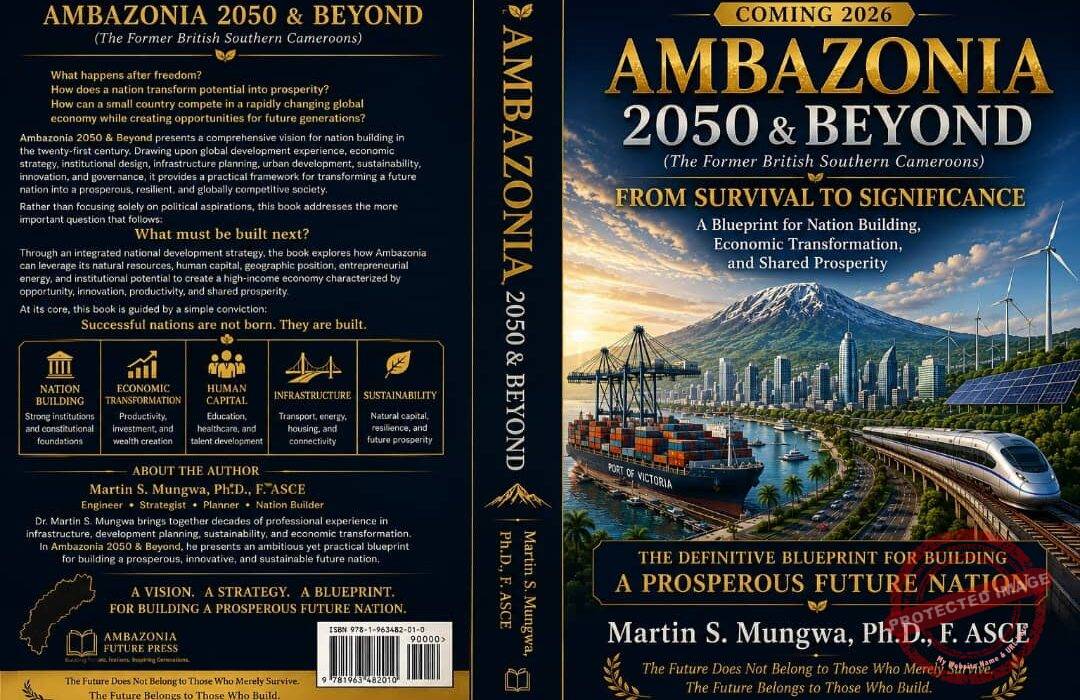


As Dr. Martin S. Mungwa argues in Ambazonia 2050 & Beyond, the objective is not simply to establish another state. It is to build a constitutional, productive and polycentric republic capable of converting sovereignty into human flourishing. That is the Ambazonia we must build. The future will not build itself. We must begin building it now.
By Timothy Enongene
Associate Editor-in-Chief, The Independentist News
As Amazon associate this site earns from qualifying purchases
its back to school shop with Amazon
BUEA – August 15, 2026 – There comes a moment in the life of every people when the central question is no longer simply, “What are we resisting?” but, more importantly, “What are we preparing to build?” For Ambazonia, that moment is now.
The struggle for self-determination cannot be sustained by opposition to Yaoundé alone. A credible national project must offer a positive and practical vision of the constitutional order, institutions, economy and civic culture that will replace the centralized system Ambazonians have rejected.
Political sovereignty, if achieved, will not automatically produce justice, prosperity or responsible government. It may create the opportunity to build them. Whether that opportunity succeeds will depend on the institutions, capabilities and ethical habits prepared before the transition.
This nation-building vision draws substantially from Martin S. Mungwa’s four-volume work, Ambazonia 2050 & Beyond (The Former British Southern Cameroons): From Survival to Significance—A Blueprint for Nation-Building, Economic Transformation, and Shared Prosperity. Mungwa’s framework argues that national readiness should be evaluated through five connected tests: constitutional legitimacy, administrative effectiveness, civilian protection, productive capacity and external relations. It also advances a polycentric republic, productive sovereignty, a circular financial economy and a “Nation of Owners” in which citizens and communities participate meaningfully in the ownership of national assets.
These ideas give Ambazonians a disciplined way to think beyond independence. The objective is not merely to add another flag to the African map. It is to build a constitutional, productive and accountable republic capable of converting political freedom into human flourishing.
- Constitutional Legitimacy Must Come before Political Power
Ambazonia must be governed by a constitution, not by the arbitrary will of presidents, commanders, movements, factions or influential families. The future constitutional order should emerge from public deliberation, representative participation and democratic authorization. It must define the distribution of power, protect fundamental rights, establish civilian control over security institutions, guarantee judicial independence and provide lawful procedures for succession, amendment and the removal of public officials.
No president, minister, county executive, traditional authority, military commander, business leader or liberation organization should stand above the law.
The Constitution must also protect political opposition. Disagreement should not be treated automatically as betrayal. A nation is not strengthened when citizens are frightened into silence; it is strengthened when institutions allow competing ideas to be tested peacefully.
The constitutional system should establish enforceable limits on executive authority, transparent public finance, independent auditing, electoral integrity and meaningful local government. The future state must be designed against the failures Ambazonians already know: centralized authority, politicized justice, executive permanence, arbitrary detention, corruption and the use of public institutions against political opponents.
The first test of Ambazonian readiness is therefore not how many declarations have been issued. It is whether the proposed political order can derive legitimate authority from the people and remain accountable to them.
- We Must Build Institutions, Not Personality Cults
Movements mobilize people, but institutions govern countries. A functioning nation requires courts, legislatures, county governments, municipalities, professional civil services, schools, universities, hospitals, regulators, financial institutions, diplomatic structures, independent media and security institutions under civilian authority.
Ambazonia’s progress cannot be measured only by the number of organizations, leaders, speeches or social-media platforms claiming to represent the struggle. It must be measured by whether credible institutions are being designed and prepared to serve citizens.
Institutions preserve continuity when leaders change. They store knowledge, define procedures, distribute responsibility and prevent national survival from depending on one individual. Ambazonians must therefore reject the belief that unity requires submission to a personality. Genuine unity should be built around constitutional principles, shared institutions and national interests.
Leadership must become a responsibility to serve, not an entitlement to recognition. The governing question should be: What does Ambazonia need from me? It should not be: What position will Ambazonia give me? A nation becomes institutionally mature when competent people can contribute regardless of faction and when public systems remain stronger than the personalities temporarily entrusted with operating them.
- Civilian Protection Must Be the First Duty of the State
The legitimacy of every political movement and government begins with the protection of civilians. Ambazonians have endured killings, displacement, destroyed communities, disrupted education, economic hardship, arbitrary arrests and profound psychological trauma. A future republic cannot treat civilian protection as a secondary matter to be addressed after political victory.
Security institutions must be professional, disciplined and accountable. Their purpose must be to protect citizens rather than intimidate them. Civilian control, enforceable rules of engagement, independent investigations, judicial review and punishment for abuses must be built into the security architecture.
Armed actors claiming to defend Ambazonia must also be held to an ethical standard. No liberation claim can justify violence against civilians, forced recruitment, extortion, collective punishment, attacks on education or the silencing of political disagreement.
The methods used during a struggle can become the habits of the future government. If financial opacity, arbitrary command and intimidation are normalized today, they may be carried into tomorrow’s institutions.
Ambazonia must therefore demonstrate that its proposed political order will protect human life, dignity and lawful disagreement. Civilian protection is not merely a humanitarian obligation. It is a test of whether the national project deserves public trust.
- The Republic Must Be Polycentric
Ambazonia should not replace centralization in Yaoundé with centralization in Buea. Drawing from the framework proposed in Ambazonia 2050 & Beyond, the future country should be organized as a polycentric republic in which political authority, infrastructure, economic opportunity and institutional responsibility are distributed across the national territory.
Buea should function as the coordinating and constitutional center without absorbing every ministry, investment and institution. Victoria should serve as the maritime, port and commercial gateway. Tiko should develop as an airport, agro-industrial and logistics center. Bamenda should become a highland center of education, technology, enterprise and agricultural innovation. Mamfe should function as an inland and cross-border connector.
Kumba, Kumbo, Nkambe, Wum, Muyuka and other urban and rural centers must also be developed according to their productive potential and regional functions. This polycentric model would create multiple centers of competence rather than one extractive capital. It would distribute opportunity, reduce regional resentment and ensure that the collapse or capture of one institution does not paralyze the entire country.
In engineering, redundancy prevents a single point of failure from destroying a complete system. A resilient state requires the same principle.
- Counties and Local Governments Must Carry Real Authority
The proposed 13-county and 61-local-government framework presented in Ambazonia 2050 & Beyond offers a starting point for organizing authority closer to the people. It must, however, remain clearly identified as a proposal subject to constitutional debate and democratic authorization.
The counties are Fako, Meme, Ndian, Manyu, Kupe-Muanenguba, Lebialem, Mezam, Ngoketunjia, Boyo, Bui, Donga-Mantung, Menchum and Momo. These counties should not become ceremonial administrative boundaries controlled from the national capital. They should possess constitutionally protected responsibilities, predictable revenue, democratic leadership and transparent accountability.
Local governments must be capable of managing community roads, markets, sanitation, water systems, primary education, public health, land-use planning and other functions best performed close to citizens.
National institutions should retain responsibility for matters requiring countrywide coordination, including defense, foreign affairs, national infrastructure standards, macroeconomic policy and constitutional protection. Other powers should be distributed according to subsidiarity: decisions should be made at the lowest competent level.
The framework should not be imposed as a final answer. Citizens, counties, traditional institutions, professionals, women, young people and affected communities must participate in determining the constitutional structure. The objective is not administrative complexity for its own sake. It is to construct government that citizens can reach, understand and hold accountable.
- Ambazonia Must Become a Productive Economy
Political sovereignty without productive capacity can become another form of dependency. Ambazonia must be capable of feeding its population, financing public institutions, maintaining infrastructure, supporting enterprise and creating dignified employment. Natural resources alone will not accomplish this.
The future economy must connect land and labor to production; production to wages and business income; income to savings and investment; investment to infrastructure and innovation; and public revenue to transparent reinvestment.
This is the circular financial structure developed in Ambazonia 2050 & Beyond. It differs fundamentally from a linear extractive economy in which raw resources leave, finished goods return, profits disappear, foreign debt grows and citizens migrate toward the places where productive assets have accumulated.
The governing questions must remain visible in every major transaction: Who signs? Who pays? Who owns the productive source? Who independently verifies performance? Who accepts the completed asset? Does capital circulate within Ambazonia, or does it disappear?
A road, port, power plant or railway should not be judged merely by whether it was constructed. It should be judged by the productive system it supports, its lifecycle cost, the local capability it creates and the value it retains within the economy.
Ambazonia must not become another territory that exports timber and imports furniture, exports agricultural products and imports processed food, or exports talent and imports professional services.
- We Must Build a Nation of Owners
The future republic should not be divided between politically connected asset holders and a population surviving on wages and promises.
The “Nation of Owners” principle advanced in Ambazonia 2050 & Beyond requires citizens, communities, counties, cooperatives, pension funds and domestic enterprises to participate meaningfully in the ownership of productive assets.
Strategic enterprises associated with agriculture, energy, ports, transportation, forests, fisheries, minerals and telecommunications should create broad domestic value. Institutions such as the Cameroon Development Corporation and PAMOL must be evaluated according to lawful ownership, community interests, environmental responsibility, worker protection and their ability to support domestic processing.
Foreign investment will be necessary and should be welcomed when it brings capital, technology, market access and professional expertise. But foreign participation must not become permanent foreign control.
Every major agreement should include measurable provisions for local procurement, professional training, technology transfer, domestic processing, environmental protection and progressively greater local responsibility for operations and maintenance.
Ambazonia should learn from countries such as South Korea, which used foreign infrastructure contracts to acquire domestic manufacturing and technical capacity. The important question is not simply what the foreign contractor builds. It is what Ambazonians will be capable of building after that contractor has been paid.
- Education Must Produce National Capability
The most valuable resource of the future republic will not be oil, timber, fertile land or minerals. It will be the disciplined and creative Ambazonian mind. Education must therefore become an operating system for national development—not merely a pathway to certificates and migration.
Schools, universities, technical institutes, research centers, apprenticeships and professional networks must be connected to the country’s productive needs. Ambazonia will require doctors, nurses, engineers, technicians, teachers, scientists, farmers, builders, lawyers, administrators, entrepreneurs, artists and ethical public servants.
The country must also reconnect education with character. Knowledge without ethics can produce sophisticated corruption, efficient oppression and technically competent theft. Young people must learn responsibility, civic service, honesty, cooperation and respect for human dignity alongside science, technology and professional competence.
The diaspora has an indispensable role. Leaving Ambazonia to obtain education and international experience is not a betrayal. The problem arises when knowledge, investment and professional networks never return in any productive form.
Diaspora participation can include teaching, mentoring, investment, professional accreditation, research collaboration, market development and temporary public-service assignments. Ambazonia must become a country to which its most capable people can return without sacrificing their professional futures.
- Diversity Must Become a Constitutional Asset
Ambazonia is not a nation of one county, ethnic community, village, denomination, political movement or language. Its strength lies in the richness of its traditions, communities and historical experiences.
A mature republic must allow people to disagree and remain fellow citizens. Political competition should not become ethnic warfare. Criticism should not automatically produce accusations of betrayal. National unity must not demand intellectual uniformity.
Citizenship should develop into a civic identity based on liberty, dignity, equality before the law, democratic participation, human rights and responsibility toward the community.
Culture must also be preserved as deliberately as territory. Languages, literature, music, architecture, cuisine, festivals, traditional institutions, community histories and collective memory should be supported through education, museums, archives, research and digital preservation.
A confident Ambazonia should be capable of protecting its inheritance while remaining open to innovation and international exchange. The country should not merely tell the world that it exists. It should give the world something valuable and beautiful to discover.
- External Recognition Must Rest on Internal Readiness
Diplomacy matters. International recognition matters. Partnerships with other countries, international organizations, investors, universities and development institutions will be essential.
But external actors cannot build Ambazonia for Ambazonians. International partners will ask practical questions. Can the proposed state protect civilians? Can it secure its borders without threatening its neighbors? Can it manage natural resources transparently? Can it honor lawful obligations? Can it control corruption? Can it operate ports and infrastructure? Can it maintain peaceful relations with Cameroon, Nigeria and the wider Gulf of Guinea?
These questions cannot be answered by historical grievance alone. Ambazonian diplomacy must explain not only why the existing constitutional arrangement has failed, but what a credible alternative would produce: regional stability, democratic government, lawful commerce, civilian protection, responsible resource management and reliable international partnership. External recognition becomes more persuasive when a people demonstrates internal readiness.
The Institutional Acceptance Test
An engineer does not accept a structure merely because a contractor announces that construction is complete. The project must be inspected, tested and verified against defined requirements.
Ambazonia should apply the same principle to nation-building. The announcement of an institution is not proof that it functions. The publication of a constitution is not proof that power is restrained. The creation of a ministry is not proof that services are delivered. The commissioning of infrastructure is not proof that productive value has been created.
Every institution should therefore face an acceptance test: What is its purpose? Who authorized it? What responsibilities and limits define it? How does it connect to other institutions? What happens when it fails? Who inspects its performance? Who accepts its work on behalf of the public? Can citizens obtain evidence that it is accomplishing its declared purpose? A nation becomes credible when it can demonstrate performance rather than merely announce intention.
From Survival to Significance
Ambazonia will inherit enormous challenges: reconstruction, displacement, disrupted education, trauma, unemployment, infrastructure deficits, institutional mistrust and the need to rebuild relationships among communities.
These problems will not disappear through patriotic slogans. They will require engineers, doctors, teachers, lawyers, farmers, economists, technologists, administrators, traditional leaders, entrepreneurs and citizens working together.
The national conversation must therefore evolve from: Who is responsible for our suffering? to the additional question: What institutions are we preparing to prevent its repetition? This does not erase historical responsibility. It converts memory into institutional design.
Five-year and ten-year horizons should be used as planning periods rather than promises of instant transformation. Within five years, a future government might establish constitutional institutions, restore basic services, begin reconstruction and stabilize public finance. Within ten years, it might deepen productive corridors, technical education, county government, digital systems and domestic enterprise. But sustainable nation-building will extend beyond any single administration or generation.
The Future Must Be Prepared Now
Ambazonians should not wait for a final political settlement before discussing what comes next. The constitutional principles must be debated now. The professionals must be organized now. The investment networks must be developed now. The educational priorities must be identified now. The county and local-government architecture must be examined now. The culture of accountability must begin now.
The future cannot be constructed by people who postpone every responsibility until after independence. The habits required to govern a country must begin replacing the habits of permanent political mobilization. If and when Ambazonia achieves an internationally recognized and democratically authorized political transition, the world should not encounter an empty political space. It should encounter a people prepared to govern themselves.
A nation of educated citizens. A nation of functioning institutions. A nation of counties and empowered communities. A nation of owners, entrepreneurs and innovators. A nation confident in its diversity. A nation governed by law. A nation that protects civilians. A nation that rewards excellence. A nation that welcomes responsible investment. A nation that gives its children a reason to remain and its diaspora a reason to return.
As Martin S. Mungwa argues in Ambazonia 2050 & Beyond, the objective is not simply to establish another state. It is to build a constitutional, productive and polycentric republic capable of converting sovereignty into human flourishing. That is the Ambazonia we must build. The future will not build itself. We must begin building it now.
Author’s Note: Several institutional and economic concepts developed in this article—including the Five-Test Institutional Readiness Framework, the proposed polycentric republic, the 13-county and 61-local-government model, productive sovereignty, circular capital, the Nation of Owners and the institutional acceptance test—are drawn from Martin S. Mungwa’s four-volume Ambazonia 2050 & Beyond (The Former British Southern Cameroons): From Survival to Significance—A Blueprint for Nation-Building, Economic Transformation, and Shared Prosperity. They are used here with acknowledgment of his authorship and original intellectual contribution.
As Amazon associate this site earns from qualifying purchases
Its back to school shop with Amazon
Timothy Enongene
Associate Editor-in-Chief, The Independentist News