


For the international community, the challenge is to recognize that diplomatic ceremonies cannot substitute for genuine conflict resolution. The central lesson of 2026 is therefore clear. The Pope’s visit cannot be used to silence demands for justice. The Archbishop’s call for inclusion cannot be reduced to an endorsement of exclusion.
By Ali Dan Ismael
Editor-in-Chief, The Independentist
October 28, 2026
As Amazon associate this site earns from qualifying purchases
Buy your copies of books on the Ambazonian revolution By Martin Mungwa on Amazon
TWO HISTORIC VISITS, ONE UNANSWERED QUESTION
In the space of four months, Cameroon received two of the world’s most influential Christian leaders. Pope Leo XIV arrived in Yaoundé on April 15, 2026, before traveling to Bamenda and Douala. Archbishop of Canterbury Dame Sarah Mullally followed, visiting Cameroon between July 31 and August 4.
Both came with messages of peace, reconciliation, and dialogue. Both encountered a country still burdened by the devastating conflict in its English-speaking Northwest and Southwest Regions—territories whose independence advocates identify as Southern Cameroons or Ambazonia. Both engaged with Cameroonian authorities.
But there is one question that must not be buried beneath diplomatic photographs, official receptions, and ceremonial expressions of goodwill: Did these religious leaders endorse Yaoundé’s political approach to the Southern Cameroons conflict, or did their statements expose the conditions that any credible peace process must satisfy? The answer lies not in speculation but in the leaders’ own words.
THE POPE DID NOT COME TO BLESS THE STATUS QUO
When Pope Leo XIV addressed President Paul Biya, government officials, diplomats, and civil society representatives in Yaoundé on April 15, he did not confine himself to ceremonial pleasantries. He raised questions about justice, responsible leadership, institutional credibility, corruption, and the suffering of ordinary citizens.
According to Vatican News, he insisted that those exercising political authority must listen to citizens and recognize their participation in building lasting solutions. The Pope emphasized the importance of protecting human dignity, including the rights and interests of minorities. He also warned against corruption and the abuse of authority.
These were not incidental observations. They were essential elements of his understanding of peace. More significantly, the Pope identified the suffering associated with violence in Cameroon’s Northwest, Southwest, and Far North Regions. He acknowledged lives lost, families displaced, and young people deprived of hope. His message challenged the notion that peace can be established merely through official declarations.
A government may proclaim peace. It may organize conferences, receive international visitors, and issue statements of reconciliation. But genuine peace must be measured by conditions experienced by the population. Are civilians safe? Are communities able to live without fear? Are their grievances heard? Do public institutions inspire confidence? And are those most affected by conflict permitted to participate in shaping its resolution? These questions arise naturally from the Pope’s message. His visit recognized the Cameroonian state as a diplomatic interlocutor. It did not establish unconditional approval of the state’s conduct or political positions.
BAMENDA: THE MORAL CENTER OF THE PAPAL VISIT
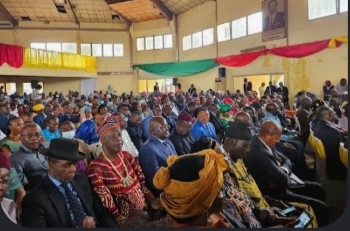
On April 16, Pope Leo XIV traveled to Bamenda, where he met representatives of the community at Saint Joseph’s Cathedral. This was more than a symbolic stop. It brought the Pope directly into a region profoundly affected by the armed conflict. He listened to testimonies and acknowledged the suffering of the population. In his official address, the Pope described the region as having suffered greatly and recognized the courage of those working for peace.
He praised cooperation among Christian and Muslim leaders seeking to mediate between opposing sides. He also condemned the exploitation of religion for political, military, or economic advantage. His warning was especially significant in a conflict where moral language can be employed by competing political actors to justify incompatible positions.
For those advocating Southern Cameroons’ self-determination, the Pope’s presence in Bamenda carried profound symbolic significance. The suffering of the population was placed before an international religious audience. However, an honest assessment must acknowledge the limits of that symbolism. The Pope did not endorse Ambazonian independence. He did not prescribe a referendum. Nor did he announce a political settlement. What he did was affirm the moral urgency of peace, justice, and reconciliation. That distinction strengthens the credibility of his intervention. It also prevents either side from claiming an endorsement that his public statements did not provide.
CANTERBURY’S CHALLENGE: WHO IS MISSING FROM THE TABLE?
On August 4, Archbishop Sarah Mullally concluded her historic visit to Cameroon with a farewell service at St John’s Anglican Church in Yaoundé. She had visited the Southwest Region and witnessed the work of Anglican communities affected by displacement, insecurity, and hardship. Her sermon recognized the prolonged suffering of Cameroonians. But her most politically significant message concerned the nature of dialogue.

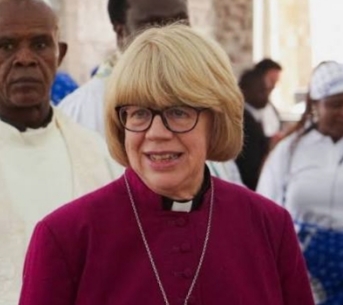
She declared: “Peace requires genuine and inclusive dialogue – it needs to have everyone around the table.” Those words contain a challenge that reaches beyond religious institutions. They raise a fundamental question about every proposed settlement of the Southern Cameroons conflict. Who determines who deserves a seat at the negotiating table? Can dialogue be described as inclusive when parties whose participation is necessary for a settlement are absent?
Can a government genuinely resolve a conflict through a process whose essential political conclusions have already been determined? And can a peace initiative command legitimacy if significant sections of the affected population do not recognize its representatives or outcomes?
The Archbishop did not prescribe the constitutional future of Southern Cameroons. She did, however, articulate a principle that any credible dialogue must confront. Inclusion cannot be merely ceremonial. It must be substantive.
THE 2019 NATIONAL DIALOGUE AND THE PROBLEM OF POLITICAL LEGITIMACY
In September and October 2019, President Paul Biya’s government convened the Major National Dialogue, presenting it as a response to the Anglophone crisis. The initiative produced recommendations, including proposals concerning decentralization and special status for the Northwest and Southwest Regions.
Yet the conflict continued. That reality does not, by itself, prove that every element of the dialogue was worthless. It does demonstrate that the initiative did not achieve the durable settlement its supporters had hoped for. A crucial distinction therefore emerges. Dialogue is an activity. Legitimacy is a condition. And peace is an outcome.
A government can organize dialogue without necessarily securing the confidence of those whose grievances gave rise to the conflict. Likewise, international religious leaders can encourage dialogue without endorsing the structure, participants, or predetermined limits of a particular government initiative. The 2026 visits should be assessed against this distinction.
Neither Pope Leo XIV nor Archbishop Mullally, in the official statements examined, explicitly endorsed the 2019 Major National Dialogue or a particular subsequent government dialogue framework. Presenting their general appeals for peace as endorsement of such a process would therefore exceed the available documentary evidence.
THE DIPLOMATIC VALUE OF A VISIT—AND THE DANGER OF MISINTERPRETATION
International diplomacy often operates through symbolism. When a Pope arrives in a national capital, meets the president, and addresses government officials, the visit generates international visibility. When the Archbishop of Canterbury meets senior officials, the encounter likewise conveys the importance of diplomatic engagement.
Such visits can offer a government an opportunity to demonstrate that it remains engaged with influential international institutions. That diplomatic benefit is real. But it carries an equally important limitation. Diplomatic engagement is not the same as political endorsement. The presence of a religious leader at a presidential palace does not establish approval of the government’s record.
A courtesy meeting does not constitute acceptance of its constitutional position. An appeal for reconciliation does not automatically validate a government-directed reconciliation process. Yaoundé may legitimately point to the visits as evidence of international religious engagement. It cannot reasonably treat that engagement, without further evidence, as proof that the visitors endorsed its preferred political settlement.
The same standard applies to Ambazonian independence advocates. They may properly highlight the religious leaders’ calls for justice, inclusion, and protection of civilians. They cannot honestly portray those statements as explicit recognition of independence. Responsible political analysis demands that both distinctions be maintained.
THE SOUTHERN CAMEROONS QUESTION CANNOT BE ERASED BY THE LANGUAGE OF PEACE
The Southern Cameroons conflict involves competing interpretations of history, sovereignty, political identity, constitutional authority, and self-determination. The Cameroonian government regards the Northwest and Southwest Regions as integral parts of the Republic of Cameroon.
Southern Cameroons independence advocates contest the legitimacy of the existing political relationship and seek recognition of a distinct national destiny. These positions are fundamentally different. Their differences cannot be eliminated by replacing political questions with humanitarian language alone. Civilian protection is indispensable. Humanitarian assistance is urgent. An end to violence is necessary. But a sustainable settlement must also address the political grievances underlying the conflict.
From the perspective of Southern Cameroons self-determination advocates, meaningful dialogue must permit the political future of the territory to be discussed rather than exclude that question before negotiations begin. That is an editorial position, not a claim that the Pope or Archbishop endorsed a particular constitutional outcome.
It rests on a broader principle: negotiations are unlikely to command lasting confidence if a central grievance is declared inadmissible from the outset. Credible negotiations would therefore need to address representation, the safety of participants, the protection of civilians, the treatment of conflict-related detainees, accountability for abuses, and confidence-building measures.
They would also require a framework accepted as sufficiently fair by the principal parties. Without these conditions, repeated appeals for dialogue risk becoming substitutes for the difficult political decisions necessary to achieve peace.
WHAT THE TWO VISITS REVEALED
The Pope and the Archbishop of Canterbury approached Cameroon from different institutional traditions. Their messages nonetheless converged on essential principles. The Pope emphasized justice, human dignity, accountability, and responsible authority.
The Archbishop insisted on genuine inclusion and the participation of all necessary parties. Together, their statements provide a demanding moral standard for assessing future peace initiatives. The significance of their visits should not be measured solely by whether international religious leaders were welcomed in Yaoundé.
It should be measured by whether the principles they articulated influence subsequent political conduct. Will the parties accept meaningful negotiations? Will those affected by the conflict be represented? Will civilians receive effective protection? Will opposing political claims be addressed honestly? And will the pursuit of peace move beyond ceremonial language to verifiable commitments?These questions remain unanswered.
CONCLUSION: A BLESSING IS NOT A BALLOT, AND A VISIT IS NOT A VERDICT
There is an old temptation in politics: to convert the presence of respected international figures into an impression of political approval. The visits of Pope Leo XIV and Archbishop Sarah Mullally must not become victims of that temptation. Their presence in Cameroon was real. Their calls for peace were unmistakable. Their recognition of human suffering was significant. But their public statements did not confer political legitimacy upon a particular settlement of the Southern Cameroons question.
Nor did they determine the constitutional future of the territory. That future remains contested. For Yaoundé, the challenge is to demonstrate that appeals for dialogue can be translated into credible political engagement. For Southern Cameroons independence advocates, the challenge is to articulate and pursue their political objectives through a credible framework that respects human dignity, civilian protection, and the requirements of a lasting peace.
For the international community, the challenge is to recognize that diplomatic ceremonies cannot substitute for genuine conflict resolution. The central lesson of 2026 is therefore clear. The Pope’s visit cannot be used to silence demands for justice. The Archbishop’s call for inclusion cannot be reduced to an endorsement of exclusion.
If the Southern Cameroons question is to be resolved peacefully, the underlying political dispute must be addressed honestly, with meaningful participation by those whose future is at stake. No presidential reception can accomplish that. No diplomatic photograph can establish it. No religious ceremony can replace it. Rome called for justice. Canterbury demanded inclusion. Neither gave Yaoundé a blank cheque. And until genuine dialogue confronts the unresolved political future of Southern Cameroons, peace will remain a promise awaiting fulfillment.
As Amazon associate this site earns from qualifying purchases
Buy your copies of books on the Ambazonian revolution By Martin Mungwa on Amazon
Ali Dan Ismael
Editor-in-Chief, The Independentist
Documentary references
Holy See Press Office. Meeting for Peace with the Community of Bamenda, April 16, 2026.
Vatican News. Pope to Cameroonian Authorities: Peace Must Be Embraced and Lived, April 15, 2026.
Office of the Archbishop of Canterbury. Archbishop Calls for Peace in Cameroon on Final Day of Historic Visit, August 4, 2026.
Office of the Archbishop of Canterbury. Sermon at St John’s Church, Yaoundé, August 4, 2026.