

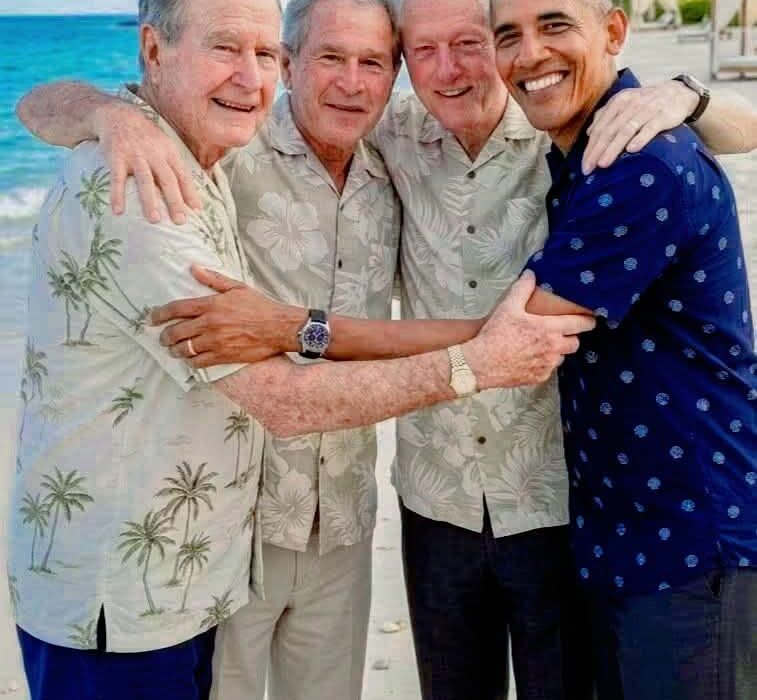


The photograph of four former American presidents offers a simple but profound reminder. Power can be exercised. Power can be surrendered. Political opponents can disagree without treating one another as permanent enemies. And a country can continue after its most powerful leader has departed. That must become the Ambazonian standard.
By Lester Maddox
Guest Contributor, The Independentist News
Oakland, California
October 27, 2026
As Amazon associate this site earns from qualifying purchases.
Buy your copies of books on the Ambazonian revolution by Martin Mungwa on Amazon
Looking carefully at the photograph, Four men who once occupied the highest office in the United States of America stand together, sharing a moment of friendship, civility, and mutual respect. Each once commanded the enormous powers of the American presidency. Each made decisions affecting millions of citizens and shaping events far beyond American borders. Yet, they left office.
They surrendered the powers entrusted to them and made room for others to lead. The significance of that image goes beyond political friendship. It represents a constitutional principle every nation aspiring to democratic government must understand: the presidency belongs to the people, not to the person temporarily occupying it.
No president owns a country. No political party possesses a permanent title to power. And no leader, however celebrated or accomplished, should become indispensable to the survival of a nation. This is one of the most important lessons Ambazonians must absorb as we struggle to restore our independence and establish the institutions of a sovereign state.
THE AMERICAN LESSON: POWER MUST HAVE AN EXPIRATION DATE
The American constitutional system is far from perfect. Its history includes political conflict, institutional failures, disputed elections, and moments when democratic principles have been severely tested. Nevertheless, the Twenty-Second Amendment establishes a fundamental restriction: no individual may be elected president more than twice.
That restriction reflects a larger democratic understanding. Political authority must remain transferable, and the temporary holder of executive power must never become the permanent owner of the state.
Nigeria also provides a useful constitutional example. Its presidential system generally limits an elected president to two terms. Although Nigeria continues to confront serious governance challenges, the restriction establishes an important boundary against indefinite presidential tenure.
The lesson is not that America or Nigeria has perfected democracy. The lesson is that constitutional democracies must develop rules capable of surviving the ambitions of powerful individuals. A constitution that cannot restrain its most powerful officeholder is little more than a ceremonial document.
A president who can change the rules whenever those rules threaten his continued occupation of office has effectively placed personal ambition above constitutional government. Ambazonia must never permit that political culture to become its inheritance.
THE CAMEROON EXPERIENCE: WHEN THE CONSTITUTION BECOMES AN INSTRUMENT OF PERSONAL RULE
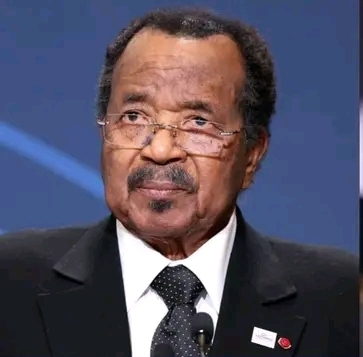
Consider the political experience of La République du Cameroun (LRC). Paul Biya succeeded Ahmadou Ahidjo in November 1982. More than four decades later, he remains in power. In 2008, Cameroon amended its constitution to remove the restriction on presidential reelection. What had been a constitutional limitation on executive tenure became an open invitation to prolonged personal rule.
In October 2025, Biya was officially declared the winner of another presidential election, securing an eighth term amid opposition challenges to the results. This experience illustrates the danger of allowing constitutional arrangements to be redesigned around the political survival of one individual. When presidents become more powerful than the institutions they are supposed to serve, the distinction between government, ruling party, and state begins to disappear.
Public administration becomes increasingly dependent on political loyalty. Succession becomes a source of anxiety. Political disagreement is treated as personal hostility. Institutions that should restrain authority risk becoming instruments for protecting it. For Ambazonians, this is not simply a matter for political discussion. It is a warning.
We cannot struggle against centralized authoritarian power only to establish another system in which a president becomes untouchable, criticism becomes disloyalty, and constitutional restrictions can be discarded whenever they inconvenience those in office. The greatest betrayal of our struggle would be to reproduce, under an Ambazonian flag, the very political abuses we have condemned under LRC rule.
OUR OWN HISTORY: ENDELEY AND FONCHA DEMONSTRATED ANOTHER POSSIBILITY
Ambazonians need not look exclusively to America for examples of political succession. Our own history offers an important precedent. In January 1959, the British Southern Cameroons experienced a remarkable political transition when the opposition Kamerun National Democratic Party, led by John Ngu Foncha, defeated the governing political alliance associated with Dr. E. M. L. Endeley.
Endeley relinquished the premiership, and Foncha assumed leadership. Whatever their political disagreements, that transition demonstrated something extraordinary: political competition need not end in permanent hostility, military confrontation, or the destruction of democratic institutions.
A government could lose an election. An opposition leader could assume office. And the political community could continue. This example deserves a prominent place in Ambazonian civic education. It challenges the notion that African political culture must inevitably revolve around rulers who cling indefinitely to office.
Our historical experience demonstrates that the peaceful transfer of authority was not an unfamiliar political idea imposed upon us from elsewhere. It was part of our own democratic development. If the Southern Cameroons could demonstrate that capacity in 1959, why should a future Ambazonia accept anything less?
A WARNING FROM THE TRAGIC LEGACY OF AHMADOU AHIDJO
The experience of Ahmadou Ahidjo presents a different lesson. After presiding over Cameroon for more than two decades, Ahidjo resigned in November 1982, allowing Paul Biya to succeed him. Yet the transfer of presidential authority did not produce lasting political reconciliation. Their relationship deteriorated, and Ahidjo eventually went into exile. He died in Dakar, Senegal, on November 30, 1989, and was buried there.
Whatever judgments history may render about his own exercise of power, the circumstances surrounding his final years demonstrate the dangers of personalizing political succession. When institutions are weak and political relationships determine personal security, even a former president may find himself vulnerable to the very system he once controlled. This is precisely the political culture Ambazonia must reject.
A departing president should not fear political persecution merely because he has surrendered office. Equally, leaving office must never provide immunity from legitimate investigation or accountability for misconduct. The answer lies in independent courts, due process, constitutional protections, and institutions that distinguish lawful accountability from political revenge. Former leaders should be able to live as ordinary citizens under the same laws that protect everyone else.
AMBAZONIA MUST SET THE STANDARD BEFORE INDEPENDENCE
We must ask ourselves an uncomfortable question. Are we preparing to establish a genuinely democratic republic, or are we merely preparing to replace one political ruling class with another? This question must not be postponed until independence. The political habits cultivated during a liberation struggle frequently influence the institutions that emerge afterward.
If leaders become accustomed to exercising authority without consultation, resisting criticism, treating public resources as private possessions, or remaining in office without transparent accountability, those habits can survive the transition to statehood. A liberation movement does not automatically become a democratic government simply because its cause is just.
Political legitimacy must be accompanied by constitutional discipline. Patriotism cannot substitute for accountability. Sacrifice cannot become a permanent entitlement to public office. And participation in the independence struggle must never confer a lifetime right to govern. Those who lead today must help establish the rules that will eventually require them to step aside. That would be genuine statesmanship.
SEVEN CONSTITUTIONAL PRINCIPLES FOR A FUTURE AMBAZONIA
If Ambazonia is to build a country fundamentally different from the system against which its people have struggled, we must establish clear institutional safeguards.
First, presidential term limits must be unambiguous. A future constitution should establish a maximum of two presidential terms, with carefully defined rules preventing an incumbent from extending tenure through constitutional manipulation or emergency declarations.
Second, elections must be genuinely competitive. An independent electoral commission, transparent vote counting, impartial dispute resolution, and equal political rights must be essential features of our democracy.
Third, the judiciary must be independent. Judges must uphold the constitution and protect citizens against abuses of executive authority. Their independence must not depend on presidential goodwill.
Fourth, the legislature must exercise meaningful oversight. Parliament should possess the authority and institutional capacity to examine public expenditure, investigate misconduct, scrutinize executive appointments, and hold government officials accountable.
Fifth, public resources must belong to the people. Government contracts, public appointments, national revenues, and state assets must be administered transparently. Political office must never become a pathway to personal enrichment.
Sixth, political opposition must be constitutionally protected. A future Ambazonia must recognize that disagreement with the president is not disagreement with the nation. Opposition parties, journalists, civil society organizations, and ordinary citizens must be free to criticize government policies without intimidation or arbitrary punishment.
Seventh, peaceful leadership succession must become a national obligation. Every president must enter office knowing that departure is inevitable. The constitution must provide clear succession procedures, and outgoing leaders must respect lawful electoral outcomes.
These principles cannot remain attractive statements in a founding document. They must become enforceable rules.
THE DANGER OF THE INDISPENSABLE LEADER
One of the most destructive political ideas in postcolonial Africa has been the belief that a particular individual is indispensable to national survival. The argument often begins innocently. A leader is described as uniquely experienced, exceptionally patriotic, or essential to stability. Gradually, political loyalty becomes personal loyalty. Criticism is portrayed as betrayal. Leadership succession is treated as a threat. Before long, the leader is presented not merely as the head of government, but as the embodiment of the nation itself.
Ambazonia must resist this temptation from the beginning. No revolutionary leader, political organization, military commander, or future president should be permitted to convert personal contributions into permanent political ownership. We may honor those who sacrifice for freedom without surrendering our constitutional rights to them. We may respect leaders without worshipping them. We may recognize exceptional service without granting exceptional immunity. A strong country does not require an irreplaceable president. It requires institutions capable of functioning regardless of who occupies the presidency.
INDEPENDENCE MUST PRODUCE A DIFFERENT POLITICAL CULTURE
Our struggle has demanded tremendous sacrifices. Lives have been lost. Families have been displaced. Communities have suffered. Opportunities for education, enterprise, and productive development have been disrupted. Such sacrifices must not culminate merely in a change of national symbols. A flag cannot guarantee justice. A national anthem cannot establish accountability. A presidential palace cannot create democracy. And international recognition, important as it may be, cannot by itself guarantee constitutional government.
The ultimate purpose of independence must be to establish a political system in which citizens possess enforceable rights, leaders remain accountable, and institutions serve the public interest. That includes responsible management of national resources, equal protection under the law, freedom of expression, credible public institutions, and opportunities for citizens to participate productively in national development. The nation must be greater than its government. The constitution must be greater than its president. And the people’s sovereignty must be greater than the ambitions of any political organization.
LET US WRITE THESE VALUES INTO OUR POLITICAL DNA
The photograph of four former American presidents offers a simple but profound reminder. Power can be exercised. Power can be surrendered. Political opponents can disagree without treating one another as permanent enemies. And a country can continue after its most powerful leader has departed. That must become the Ambazonian standard.
Let us teach these principles to our children. Let us demand them from our political leaders. Let us insist upon them within our organizations and institutions even before independence. Let us reject the dangerous belief that leadership belongs permanently to those who first acquired it. And let us remember that a constitution is meaningful only when those exercising power are willing—and compelled by functioning institutions—to obey it.
No president should become the state. No political party should become the nation. No individual should become indispensable to the survival of a people. We are not struggling merely to exchange one set of rulers for another. We are struggling for the opportunity to build a political order in which authority originates with the people, remains accountable to the people, and returns peacefully to the people.
The ultimate measure of our independence will not be merely whether we govern ourselves, but whether we govern ourselves differently. Let us therefore build an Ambazonia where the presidency is an office of temporary public trust, not a lifetime possession. An Ambazonia where constitutional limitations are respected, even by the most powerful. An Ambazonia where former presidents can stand together, disagree freely, and recognize that the country belongs to none of them individually.
That is the Ambazonia we must build. That is the political culture we must defend. And that is the legacy we must leave to future generations.
As Amazon associate this site earns from qualifying purchases
Buy you copies of books on the Ambazonian revolution by Martin Mungwa on Amazon
Lester Maddox is a guest contributor to The Independentist News, writing from Oakland, California.