



The international community, human rights organizations, and independent journalists should insist upon credible evidence whenever crimes are attributed to parties in the conflict. Official allegations should be scrutinized. Claims made by armed organizations should be examined. Statements obtained from suspects should be independently corroborated. And the suffering of civilians should never be subordinated to political convenience.
By Carl Sanders
Guest Writer, The Independentist News
Soho, London
As Amazon associate this site earns from qualifying purchases
Buy your copies of books on the Ambazonian revolution By Martin Mungwa on Amazon
BUEA – October 28, 2026 –The latest kidnapping allegations emerging from Konye raise a disturbing question that Ambazonians, human rights investigators, and the international community cannot afford to ignore: are all those committing kidnappings in the name of the Ambazonian independence struggle genuinely members of Ambazonian armed groups, or are some criminals and operatives linked to La République du Cameroun (LRC) masquerading as Ambazonian fighters?
This is not a question that can be answered through political accusations, speculation, or propaganda. It requires credible evidence, independent investigation, and the identification of those responsible. The distinction is fundamental. If a genuine member of the Ambazonian State Army (ASA), or any other armed group, kidnaps a civilian for ransom, that individual must be held accountable. No political cause provides immunity from criminal responsibility.
But if an LRC security operative or an ordinary criminal disguises himself as an Ambazonian fighter, commits atrocities against civilians, and deliberately directs suspicion toward the independence movement, the implications are equally serious. Such conduct, if established, would represent not merely criminality but potentially a calculated attempt to manipulate public perceptions of the conflict. The people of Konye deserve to know who is terrorising their communities, who is financing these crimes, and who is benefiting from them.
THE KONYE INCIDENT: ALLEGATIONS THAT DEMAND ANSWERS
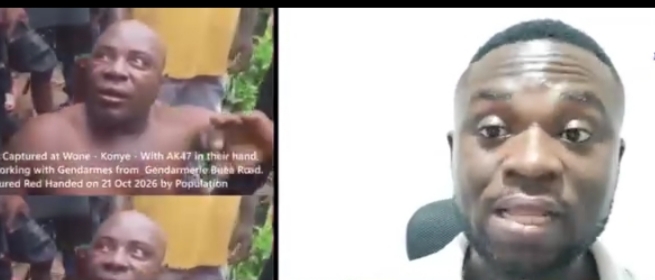
According to accounts circulating after the events of October 21, 2026, residents of Wone, in Konye Subdivision, apprehended suspected kidnappers following the reported abduction of a businessman and a businesswoman. The accounts allege that approximately 17 million CFA francs had been paid as ransom in connection with the businessman’s release. More troubling are allegations reportedly made during questioning.
One suspect allegedly claimed that members of a kidnapping network had collaborated with gendarmes. A local vigilante leader also reportedly described circumstances involving a military officer allegedly impersonating a gendarmerie commander. These are serious accusations.
However, the identities of the suspects, the authenticity of their alleged statements, and the precise roles of any security personnel have not been independently established. If credible evidence ultimately confirms the involvement of serving security officials in kidnapping operations, the implications would be profound. Those entrusted with protecting civilians would have been implicated in the very crimes they were expected to prevent.
Equally disturbing would be any evidence that perpetrators deliberately impersonated Ambazonian fighters to conceal their identities or manipulate responsibility for their actions. The question is straightforward: were these kidnappings the work of genuine armed separatists, criminal opportunists, compromised security personnel, or a network involving individuals from more than one category? Until the evidence is examined, none of these possibilities should be treated as an established conclusion.
WHO BENEFITS WHEN EVERY KIDNAPPING IS BLAMED ON AMBAZONIAN FIGHTERS?
The political consequences of kidnappings attributed to Ambazonian armed groups are considerable. Every ransom demand blamed on the independence movement damages public confidence. Every civilian abducted by individuals claiming to fight for Ambazonia creates fear, resentment, and mistrust.
Every reported atrocity strengthens the perception that armed groups have abandoned political objectives in favour of criminal enrichment. For the Biya regime, such incidents can provide powerful material for portraying the independence struggle as an enterprise driven by lawlessness rather than political grievances. But political advantage is not proof of operational responsibility.
The fact that Yaoundé may benefit politically from crimes attributed to separatist fighters does not, by itself, establish that government operatives committed those crimes. That distinction must remain central to any serious investigation. At the same time, allegations of impersonation or security-force involvement should not be dismissed merely because they contradict an established official narrative.
A criminal’s identity cannot be determined by the uniform he wears, the political slogans he repeats, or the organization he claims to represent. Evidence must establish who committed the offence and whether others directed, financed, facilitated, or concealed it.
THE POSSIBILITY OF INFILTRATION MUST BE INVESTIGATED
The Konye allegations raise legitimate questions about infiltration, impersonation, and criminal collaboration within the wider conflict environment. – Could individuals connected to LRC security institutions be operating within criminal kidnapping networks? – Could criminals be presenting themselves as Ambazonian fighters to exploit the conflict? – Could individuals belonging to armed separatist organizations be collaborating with unaffiliated criminals or corrupt officials for financial gain? – Could competing armed networks be exploiting confusion over organizational identities to evade responsibility?
These possibilities deserve investigation, but none should be presented as proven without corroboration. A credible inquiry should seek to establish:
- The identities and affiliations of the suspects: Were they serving security personnel, former combatants, members of armed separatist groups, or unaffiliated criminals?
- The circumstances of the kidnappings: Who organized the abductions, selected the victims, and negotiated the alleged ransom?
- The reported payment of 17 million CFA francs: Can the payment be documented, and is there evidence identifying its recipients?
- The alleged involvement of gendarmes: Are there credible witnesses, records, communications, or other independently verifiable evidence supporting the accusation?
- The reported impersonation of a security commander: Who allegedly assumed that identity, and what evidence establishes the impersonation?
- The possible misuse of official resources: Were government-issued weapons, vehicles, uniforms, identification documents, or other state resources involved?
- The broader pattern: Are there independently documented incidents involving the same individuals, methods, or networks?
These questions must be answered through lawful investigation and the preservation of credible evidence. Suspects must not be subjected to torture, coerced confessions, or extrajudicial punishment. Such practices would undermine the credibility of the investigation and further endanger civilians.
NO GOVERNMENT AND NO ARMED GROUP SHOULD ESCAPE ACCOUNTABILITY
The Ambazonian independence question concerns political rights, self-determination, historical grievances, governance, and the future of the former British Southern Cameroons. Kidnapping innocent civilians for ransom is not a legitimate expression of those aspirations. It is criminal conduct.
No genuine commitment to liberation can justify abducting businesspeople, terrorising families, extorting communities, or treating civilians as sources of private income. An armed individual’s declared political affiliation does not excuse such conduct.
Equally, the state must not be permitted to use unverified accusations against unidentified perpetrators as a substitute for establishing individual responsibility. The same principle applies to allegations against security personnel.
If LRC soldiers, gendarmes, intelligence operatives, or their collaborators are implicated in kidnappings, credible evidence should be investigated and those responsible held accountable through lawful proceedings. If genuine Ambazonian fighters are implicated, they too must face accountability.
If unaffiliated criminals are exploiting the conflict by impersonating either side, their identities and conduct must be exposed. Justice cannot depend on which political camp an accused person claims to represent. The standard must remain the same: evidence, responsibility, due process, and accountability.
THE DANGER OF CRIMINAL NETWORKS OPERATING BEHIND POLITICAL IDENTITIES
One of the most destructive consequences of prolonged armed conflict is the opportunity it creates for criminal networks to exploit insecurity. Where authority is fragmented, institutions are weakened, and civilians fear retaliation, criminals may find opportunities to operate behind competing political identities. A uniform can become a disguise. A political slogan can become a cover.
An accusation of collaboration can become a pretext for extortion. And a genuine grievance can be exploited by individuals whose interests have little connection to the political aspirations they publicly invoke. This is precisely why the Konye allegations deserve careful scrutiny.
If the criminal identities of perpetrators are deliberately concealed behind political labels, victims may be denied justice while entire communities become trapped between competing accusations. The danger extends beyond reputational damage to any political movement.
It includes the destruction of public trust, the normalization of extortion, the weakening of community institutions, and the growing vulnerability of ordinary families. When criminals are allowed to hide behind political identities, the first casualty is often the truth. The next is civilian security.
THE PEOPLE OF KONYE MUST COME FIRST
The political implications of the allegations are important, but they must not overshadow the immediate suffering of the victims. A businessman and a businesswoman were reportedly abducted. Families allegedly endured fear and uncertainty. A substantial ransom was reportedly demanded or paid. These allegations concern real people whose safety, livelihoods, and dignity must remain at the centre of public attention.
The victims must not become mere instruments in a contest between competing political narratives. Their experiences deserve careful documentation, protection from retaliation, and access to justice. Witnesses should also be protected so that fear does not prevent them from providing relevant information.
Community members who suspect criminal activity should be encouraged to preserve evidence and report it through credible, safe channels. Suspicions must not become a justification for mob violence or collective punishment. The protection of civilians must remain non-negotiable.
Whether a kidnapping is carried out by an armed separatist, a corrupt security operative, or an ordinary criminal, the resulting harm to the victim is real. And that harm must never be minimized because of the perpetrator’s political identity.
KONYE HAS RAISED A QUESTION THAT CANNOT BE ANSWERED BY PROPAGANDA
The allegations emerging from Wone must not be converted into established facts before they have been independently verified. The reported statements linking suspected kidnappers to gendarmes require corroboration. The allegation involving an impersonated security commander requires investigation.
The reported ransom payment requires documentary confirmation wherever possible. And any broader claim that LRC operatives are systematically disguising themselves as Ambazonian fighters to discredit the independence struggle would require evidence demonstrating such a pattern. Nevertheless, the absence of verified conclusions is not a reason to abandon legitimate questions. It is a reason to investigate them responsibly.
The international community, human rights organizations, and independent journalists should insist upon credible evidence whenever crimes are attributed to parties in the conflict. Official allegations should be scrutinized. Claims made by armed organizations should be examined. Statements obtained from suspects should be independently corroborated. And the suffering of civilians should never be subordinated to political convenience.
Ambazonia needs the truth, not narratives designed to protect preferred conclusions. If serving LRC personnel have participated in kidnappings or impersonated Ambazonian fighters, their involvement must be established and exposed. If members of the ASA or other separatist armed groups have committed such crimes, their responsibility must likewise be established. If criminal networks are exploiting both identities, they must be investigated without allowing either side to evade accountability for its own conduct.
The central question is not simply who carried the weapon or wore the uniform. It is who committed the crime, who organized it, who benefited from it, and who must answer for the harm inflicted upon civilians. The Konye allegations have placed those questions before the public. The answers must come from evidence, not political assumptions.
No government official, armed fighter, or criminal opportunist should be allowed to hide behind the conflict to prey upon innocent civilians. And no person or organization should be condemned for a crime without credible evidence establishing responsibility. The people of Konye deserve more than competing accusations. They deserve protection, truth, and justice.
As Amazon associate this site earns from qualifying purchases
Buy your copies of books on the Ambazonian revolution By Martin Mungwa on Amazon
Carl Sanders
Guest Writer, The Independentist News — Truth, Accountability, and the Ambazonian Question