










Commentary

We are home to news on Cameroon and the CEMAC region. We are dedicated to honest and reliable reporting. We are the voice of the Cameroonian people and their fight for freedom and democracy at a time when the Yaoundé government is silencing dissent and suppressing democratic voices.

A significant segment of the Ambazonian movement no longer views the conflict through the lens of minority rights within Cameroon. Instead, it views the crisis as a question of national self-determination and political separation.
By Carl Sanders
Guest Writer, The Independentist News, Soho, London
9 May 2026
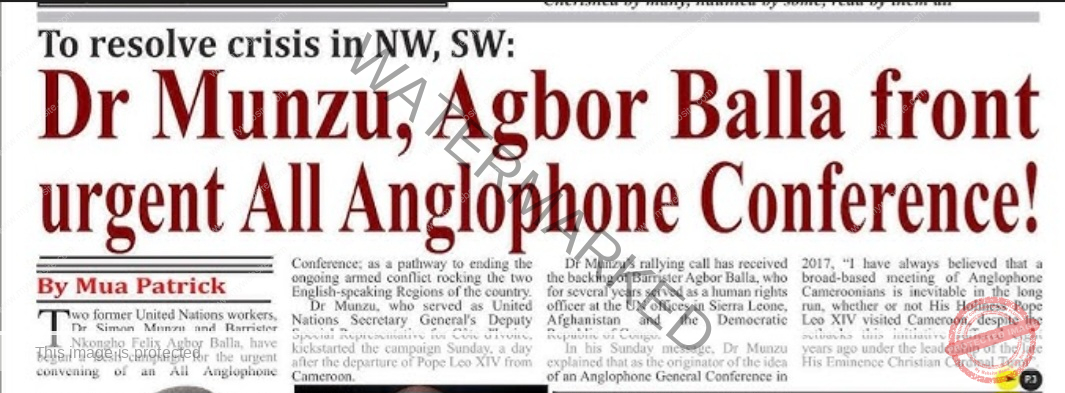
At moments of political uncertainty, old political formulas often return disguised as “new solutions.” That appears to be precisely what is unfolding following renewed calls for an “Anglophone General Conference” amid growing uncertainty surrounding the future of the Cameroonian state.
To many Ambazonians, these proposals are not signs of genuine transformation, but attempts to redirect a decade-long struggle for self-determination back into the familiar language of minority accommodation within the Cameroonian system..
The timing is not accidental.
As succession anxieties intensify in Yaoundé and the long-standing post-independence political order faces mounting biological and institutional pressures, new initiatives are emerging that seek to redefine the conflict once again through the framework of “Anglophone grievances.” For many supporters of Ambazonian independence, however, that framework itself is the problem.
Beyond the “Anglophone” Label
The term “Anglophone problem” has dominated international discussions about the conflict for years. Yet among many Ambazonians, there is increasing rejection of the label altogether. Their argument is straightforward: The conflict is not fundamentally about language. It is about sovereignty, political identity, historical statehood, and the unresolved legacy of the union between the former British Southern Cameroons and Cameroon.
From this perspective, describing Ambazonians merely as “Anglophones” reduces a political and historical struggle to a linguistic minority issue.
Critics argue that such terminology subtly reframes demands for self-determination into requests for administrative reform, decentralization, or cultural accommodation inside the existing Cameroonian state. That distinction matters deeply to many within the independence movement. To them, the language of “Anglophone conferences” risks transforming a decolonization dispute into a domestic policy discussion.
The Question of Representation
A second major concern involves legitimacy and representation. Supporters of the Government of the Federal Republic of Ambazonia argue that structures already exist to represent Ambazonian political aspirations internationally and diplomatically. Under that view, any major political consultations concerning the future of Ambazonia should emerge through institutions tied directly to the struggle itself, rather than through independently convened conferences involving activists, civil society actors, or political moderates perceived as detached from events on the ground.
This explains the sharp criticism directed toward some proponents of broad “Anglophone” dialogue initiatives.
For hardline supporters of independence, such gatherings risk creating parallel leadership structures that dilute the authority of the existing Ambazonian political framework. More importantly, many fear that external actors may prefer negotiating with softer, more flexible interlocutors rather than with actors firmly committed to outright independence.
Fear of a Managed Transition
Underlying much of the skepticism is a broader fear: that future political transitions in Yaoundé could attempt to stabilize the Cameroonian state by introducing controlled reconciliation initiatives without fundamentally addressing the sovereignty question. In this interpretation, conferences, dialogues, and reconciliation processes could become instruments for preserving state continuity while projecting the image of reform to the international community. That fear is amplified by the current succession climate surrounding President Paul Biya’s aging administration.
As discussions intensify about post-Biya political arrangements, many Ambazonian activists worry that pressure will grow for a compromise settlement centered on decentralization or federal restructuring rather than full separation. For supporters of Ambazonian independence, that would represent not resolution, but containment.
The Internal Divide
The debate also reflects a deeper internal divide within the broader Southern Cameroons political space. Not all actors share the same objectives.
Some continue advocating for constitutional reform, federalism, or negotiated coexistence within a restructured Cameroon. Others insist that the conflict has already passed the point where reintegration remains politically or psychologically possible after years of violence, displacement, and mistrust. This divide is increasingly shaping political rhetoric on all sides. Moderates are often accused of seeking accommodation with Yaoundé.
Hardliners are accused of rejecting compromise and prolonging conflict. Yet beneath the rhetoric lies a painful reality: years of war have fundamentally transformed political identities across the region.
Sovereignty as the Central Question
For many Ambazonians, the central issue now is no longer reform, but recognition. Recognition of identity. Recognition of political history. Recognition of the right to determine their own future. This explains why terms such as “Southern Cameroons Conference” or “Ambazonia Conference” carry far greater emotional and political significance than “Anglophone Conference.” To supporters of independence, names are not symbolic details. They define the framework of the struggle itself.
Conclusion
As Cameroon enters a period of heightened uncertainty and political transition, debates over dialogue, representation, and identity are likely to intensify. Calls for broad conferences and reconciliation initiatives will continue emerging from multiple directions — civil society groups, political moderates, religious actors, diaspora networks, and international mediators. But one reality has become increasingly clear: A significant segment of the Ambazonian movement no longer views the conflict through the lens of minority rights within Cameroon. Instead, it views the crisis as a question of national self-determination and political separation.
Whether one agrees or disagrees with that position, ignoring the depth of that transformation risks misunderstanding the conflict itself. The language of reform may still resonate in some circles. But for many Ambazonians, the political vocabulary has already changed permanently.
Carl Sanders
Guest Writer, The Independentist News
Share This Post:
THE LACK OF FOUNDATION LEADS TO DRIFT: Why the Ambazonian Quest Must Be Rooted in Moral, Spiritual, and Strategic Consciousness
The Falling Baobabs: Nature’s Coup and the Succession Shadow-Play in Yaoundé
Related Post
IS THE WORLD LISTENING: THREE DAYS FOUR FRONTLINES, ASA
SEPTEMBER 24, 1965, THIS DAY IN HISTORY: From Equal
AMBAZONIA’S WAR- IS BIGGER THAN YAOUNDÉ: BRITAIN, FRANCE AND
THE DAY SEPTEMBER 22 1961: — WHAT AMBAZONIA CAN
TRUMP’S “SUPER INTELLIGENCE” ERA: WHAT IT REALLY MEANS —
Why Is Ambazonia More Powerful Than many Imagine.