



Southern Cameroons’ political future requires serious engagement with the political-status question itself. Until that happens, changing the vocabulary of dialogue will not, by itself, resolve the underlying disagreement.
By Timothy Enongene
Editor-in-Chief, The Independentist News
As AMAZON associate this site earns from qualifying purchases
Get copies of varied publications By Martin Mungwa on Amazon
YAOUNDÉ – 2 November 2026 – The recent visit of Prince Albert II of Monaco to Yaoundé has revived discussions about Monaco’s relationship with France, with some commentators drawing parallels between that arrangement and the political history of Southern Cameroons (Ambazonia).
Among those reflecting on the subject is Prince Agbor Gilbert Ebot, whose commentary revisits the 1961 Foumban Conference and considers whether Southern Cameroons might have prospered under a genuinely autonomous two-state federation rather than the unitary constitutional structure that subsequently emerged.
Such historical comparisons can stimulate useful debate. They may illuminate alternative constitutional arrangements, expose missed opportunities, or encourage reflection on political relationships between unequal partners. But cannot resolve the fundamental question at the heart of the Southern Cameroons conflict:
Who possesses the legitimate authority to determine the political future of Southern Cameroons, and through what process should that determination take place?
HISTORICAL ANALOGIES HAVE THEIR LIMITS
Monaco is a sovereign principality with its own constitutional institutions, international legal personality, and distinct relationship with France. That relationship developed through treaties and political arrangements rooted in a particular European history.
Hong Kong presents an entirely different constitutional experience, shaped by British colonial administration, the 1984 Sino-British Joint Declaration, and the transfer of sovereignty to China in 1997.
Neither example can be transplanted into the Southern Cameroons question as though the historical circumstances, legal status, political arrangements, and questions of legitimacy were identical.
The experiences of Monaco and Hong Kong may provide useful comparative insights, but they cannot determine the appropriate constitutional future of Southern Cameroons.
For Ambazonians who advocate independence, the central issue is not simply whether a federation could have functioned in 1961. It is whether the political status and aspirations of Southern Cameroons can legitimately be settled through another arrangement designed and administered within La République du Cameroun. That distinction must remain central to the discussion.
FOUMBAN AND THE UNRESOLVED CONSTITUTIONAL QUESTION
The Foumban Conference of July 1961 remains one of the most consequential and contested episodes in the political history of Southern Cameroons.
The conference followed the United Nations-supervised plebiscite of February 1961, in which Southern Cameroons voters chose between achieving independence by joining Nigeria or by joining the already independent Republic of Cameroon.
The subsequent constitutional arrangements established a federal structure comprising West Cameroon and East Cameroon. The federation, however, did not endure. In 1972, a referendum replaced the federal constitutional framework with a unitary state. The legality, legitimacy, and political consequences of that transformation remain central subjects of disagreement between supporters of Cameroon’s territorial unity and advocates of Southern Cameroons independence.
For independence-oriented Ambazonians, these developments raise questions about the original political understanding, the protection of Southern Cameroons’ distinct institutions, and the authority under which subsequent constitutional changes were implemented.
Others maintain that the constitutional evolution took place within the framework of an internationally recognized Cameroonian state. These competing interpretations cannot be settled merely by imagining how a different federation might have performed.
A retrospective argument that a two-state federation could have succeeded is not equivalent to establishing that such an arrangement commands legitimate political acceptance today.
The issue is not simply whether a federation might once have worked. It is whether any proposed settlement today can address the underlying dispute over political status and legitimacy.
THE LIMITATIONS OF ANOTHER INTERNAL DIALOGUE
Over the years, different initiatives have been advanced under the descriptions of All-Inclusive Dialogue, National Dialogue, Community Dialogue, and other forms of consultation. These processes have generally focused on political grievances, governance, decentralisation, development, reconciliation, or institutional reform within the existing Cameroonian state.
Such discussions may address important practical concerns. They may also produce reforms with consequences for affected communities. However, from the standpoint of independence-oriented Ambazonian actors, they do not necessarily resolve the fundamental political disagreement.
The objection concerns the institutional framework within which the discussions occur. When a government convenes and administers a dialogue under its own constitutional authority, the process may begin by presuming the very political relationship that one party contests.
Changing the name of a consultation does not automatically transform its political character. Neither does increasing the number of participants necessarily establish that the process has an agreed mandate to address the political-status question.
A discussion about local development or decentralisation is not necessarily equivalent to negotiations over the future political relationship between Southern Cameroons and La République du Cameroun. Conflating these processes risks generating expectations that the discussions were never designed to fulfil.
THE SWISS FACILITATION EXPERIENCE
The Swiss facilitation initiative remains an important reference point because it reflected efforts to establish an externally supported process involving the Cameroonian government and pro-independence representatives. Beginning in 2019, Switzerland undertook preparatory engagement and sought to create conditions for negotiations.
The initiative encountered significant obstacles, including disagreements over participation, representation, political objectives, and the willingness of the parties to proceed. Despite sustained preparatory efforts, it did not develop into an enduring, mutually accepted formal negotiation process capable of addressing the conflict’s central political questions.
Academic assessments have documented the difficulties surrounding the initiative, including the Cameroonian government’s eventual withdrawal from the process in 2022. Its limitations nevertheless offer an important lesson.
International facilitation cannot by itself produce an agreement. Effective negotiations require an accepted framework, identifiable representatives, political commitment, credible guarantees, and a willingness to consider the issues that divide the parties.
For independence-oriented Southern Cameroons representatives, the Swiss experience reinforces the argument that a credible external facilitator remains important. But future initiatives must also confront the practical challenges that prevented earlier mediation efforts from advancing.
TWO PARTIES, A CREDIBLE NEGOTIATING FRAMEWORK
From an Ambazonian independence-oriented perspective, a meaningful settlement requires the competing political positions to be acknowledged rather than dismissed before negotiations begin. The government of La République du Cameroun maintains the territorial unity of Cameroon as a central constitutional principle.
Independence-oriented Southern Cameroons representatives dispute the legitimacy of the existing political relationship and seek recognition of their claim to separate statehood. These positions are fundamentally different. A credible negotiating process must provide a structured means of addressing that disagreement.
Independence-oriented actors therefore advocate internationally facilitated negotiations involving representatives of Southern Cameroons and La République du Cameroun, with mutually agreed procedures, meaningful participation, and an agenda that does not exclude the political-status question in advance.
Procedural equality does not automatically establish equality of international legal status. Rather, it concerns the ability of negotiating participants to present their positions, respond to proposals, and engage without having the outcome predetermined.
International mediation does not guarantee agreement, nor does it dictate that independence, federation, autonomy, or another arrangement must emerge. Its function is to create conditions in which disputed claims can be examined through a credible process.
For such a process to carry legitimacy, it must also take seriously the security, political rights, humanitarian needs, and meaningful representation of the populations affected by the conflict. The objective should be a peaceful and durable settlement rather than another exercise in constitutional terminology.
WHAT PRINCE ALBERT II’S VISIT ACTUALLY REPRESENTED
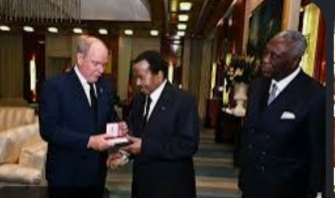
Prince Albert II visited Cameroon on 30–31 October 2026. According to the Cameroonian Presidency, his meeting with President Paul Biya on October 30 focused on bilateral friendship, humanitarian cooperation, environmental matters, and strengthening relations between Monaco and Cameroon.
The visit also included an engagement with the Edimar Princesse Grace Centre in Yaoundé, an institution associated with humanitarian support for vulnerable children. There is no indication in the official account that the visit constituted negotiations over Southern Cameroons’ political status.
Nevertheless, the comparisons arising from the visit invite a broader reflection on sovereignty, constitutional identity, and relationships between politically distinct entities. Monaco’s sovereignty does not establish a legal precedent that automatically resolves the Southern Cameroons question. Nor does the historical existence of a federation provide sufficient grounds for prescribing another federal arrangement today.
Each situation must be examined according to its particular history, legal instruments, institutional development, and the political claims involved.
THE QUESTION THAT CANNOT BE AVOIDED
The political future of Southern Cameroons cannot be determined by historical analogy alone. It cannot be settled merely by invoking Monaco’s relationship with France, Hong Kong’s constitutional experience, or an imagined alternative outcome of the Foumban Conference.
Nor can the legitimacy of a contemporary settlement be established simply by convening another internally administered dialogue while excluding the issue that remains fundamentally contested.
For independence-oriented Ambazonians, the required starting point is recognition that a political-status dispute exists and that a credible process must allow competing positions to be addressed.
For those committed to preserving Cameroon’s territorial unity, the challenge is to explain how their preferred constitutional arrangement could command legitimacy among those who reject the current relationship.
These disagreements must be confronted through evidence, political engagement, and a process capable of addressing the central questions. A constitutional arrangement cannot substitute for political legitimacy, and a dialogue cannot resolve a dispute whose central issue it is not permitted to examine.
The lesson of Prince Albert II’s visit is therefore not that Southern Cameroons should become another Monaco, nor that it should return automatically to the federation of 1961. It is that questions of constitutional identity, political authority, and legitimate consent cannot be answered by analogy alone.
Southern Cameroons’ political future requires serious engagement with the political-status question itself. Until that happens, changing the vocabulary of dialogue will not, by itself, resolve the underlying disagreement.
As Amazon associate this site earns from qualifying purchases
Get copies of varied publications By Martin Mungwa on Amazon
Timothy Enongene
Editor-in-Chief, The Independentist News