



The people of Southern Cameroons deserve historical clarity, institutional accountability, civilian security, and a peaceful political future. Britain has an opportunity to contribute to that process by opening its records, engaging the evidence, and supporting responsible dialogue.
By Ali Dan Ismael
Senior Editor-in-Chief, Independentist News
October 31, 2026
As Amazon associate this site earns from qualifying purchases
Buy your copies of books on Ambazonia’s productive Sovereignty and statecraft By Martin Mungwa on Amazon
The Ghosts of Empire Follow King Charles to the Caribbean
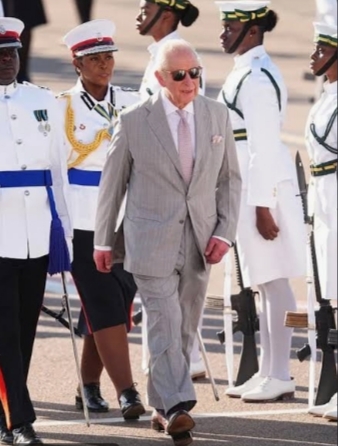
King Charles III is in the Caribbean carrying more than the ceremonial responsibilities of the British monarchy. He also carries the historical burden of an empire whose political and economic power was built, in significant part, upon colonial exploitation, racial subjugation, and the enslavement of millions of Africans.
His visits to the Bahamas, Guyana, and Antigua and Barbuda have reopened questions that Britain has struggled to answer: Can a former imperial power acknowledge the suffering caused by its institutions without accepting meaningful responsibility for the consequences?
According to an October 28 Associated Press report by Danica Kirka, the British monarchy faces renewed demands for an apology and reparations for its historical connections to slavery.
The King has acknowledged slavery as a profound historical atrocity, but the British government has resisted calls for formal apologies and financial reparations. For Caribbean nations, the distinction between expressions of regret and institutional accountability is becoming increasingly difficult to ignore.
For the people of Southern Cameroons, internationally known to many as Ambazonia, this debate raises another historical question. If Britain can be called upon to examine the consequences of slavery in the Caribbean, should it not also examine the political consequences of its administration of Southern Cameroons under the United Nations trusteeship system?
The circumstances are different. The historical principle, however, is closely related: colonial responsibility cannot be adequately examined by celebrating the achievements of empire while leaving its contested legacies unanswered.
Southern Cameroons: The Colonial Question Britain Left Behind
Between the end of the First World War and 1961, Britain administered Southern Cameroons, initially under a League of Nations mandate and subsequently under a United Nations trusteeship. The territory developed political, judicial, educational, and administrative institutions influenced by British governance.
Its eventual constitutional future became the subject of a United Nations-supervised plebiscite on February 11, 1961. The people were presented with two options: achieving independence by joining the Federation of Nigeria or achieving independence by joining the already independent Republic of Cameroun.
Separate independence was not offered as a third option. This omission remains central to Southern Cameroonian historical grievances. Nevertheless, historical accuracy requires acknowledging that the United Nations accepted the plebiscite as a valid expression of the voters’ preferences within the choices presented. The Southern Cameroons electorate voted by a substantial majority to join the Republic of Cameroun.
The dispute therefore cannot responsibly be reduced to the claim that the plebiscite never occurred or that its recorded outcome was rejected by the United Nations. The more substantial questions concern the restricted constitutional choices, the arrangements envisioned for the union, and the manner in which those arrangements were subsequently established and implemented. Those questions deserve serious consideration rather than political dismissal.
Resolution 1608: A Document Britain Cannot Ignore
On April 21, 1961, the United Nations General Assembly adopted Resolution 1608 (XV). The resolution endorsed the plebiscite results and provided for the termination of Britain’s trusteeship over Southern Cameroons on October 1, 1961. Most Importantly, it also invited the administering authority, the Government of Southern Cameroons, and the Republic of Cameroun to initiate urgent discussions to finalize arrangements implementing their agreed and declared policies. This provision is indispensable to an honest examination of the transition.
What negotiations took place? What constitutional assurances were discussed? Which commitments were documented, and how were they translated into enforceable institutional arrangements? Did the parties possess sufficient time and political independence to address the profound differences between their inherited legal and administrative systems?
These are legitimate historical questions. They should be answered through parliamentary records, diplomatic correspondence, constitutional documents, United Nations archives, and the testimony of those involved.
Resolution 1608 should not be misrepresented as a judicial ruling declaring the subsequent union invalid. It was a General Assembly resolution addressing the plebiscite outcome and the termination of trusteeship. Equally, its endorsement of the plebiscite should not be treated as proof that every subsequent constitutional arrangement was satisfactory or faithfully implemented.
A defensible historical argument must distinguish what the documentary record establishes from what remains contested. That distinction strengthens the Southern Cameroons case rather than weakening it.
British Parliament Recognized the Difficulties in 1961
The concerns surrounding Southern Cameroons were not discovered decades after the event. They were raised in the British Parliament before the trusteeship ended. During a House of Commons debate on August 1, 1961, members discussed the difficulties of bringing together territories with different administrative languages, political institutions, and legal traditions. The debate also addressed the limited period available to settle arrangements before the scheduled October transition.
British officials acknowledged the considerable challenges presented by the proposed union. These parliamentary proceedings are important because they demonstrate that the difficulties were foreseeable. Britain was not an uninformed spectator. It was the administering authority responsible for guiding the territory through the final stage of trusteeship, within the framework established by the United Nations.
Recognizing this responsibility does not automatically establish that Britain violated international law. Such a conclusion would require a careful examination of the applicable obligations, decisions, agreements, and subsequent conduct. But it does establish a compelling reason for Britain to participate in an open historical accounting. The people of Southern Cameroons are entitled to ask how a transition involving their political future was prepared, negotiated, and completed.
Caribbean Reparations and the Meaning of Accountability
The Caribbean reparations movement offers an important example of how historical grievances can enter contemporary diplomatic discussions. Caribbean governments, civil society organizations, historians, and reparations advocates have increasingly demanded recognition of the enduring effects of slavery and colonial exploitation.
Their demands are not restricted to financial compensation. They also concern education, public acknowledgment, institutional reform, cultural restoration, development, and the correction of historical inequalities. Southern Cameroons should study this approach carefully.
The historical experiences are not interchangeable. Transatlantic slavery and the constitutional transition of a United Nations trust territory involve different legal frameworks, affected populations, and possible remedies. Nevertheless, both raise questions about whether historical acknowledgment should carry practical responsibilities.
A serious Southern Cameroons initiative could seek the declassification of relevant colonial records, an independent historical inquiry, academic cooperation, and international dialogue on the unresolved constitutional grievances that have contributed to the present conflict. Such measures would not predetermine a political outcome. They would establish a more credible factual basis upon which competing interpretations could be examined.
The Commonwealth Cannot Afford Selective Historical Memory
King Charles’s Caribbean tour coincides with the 2026 Commonwealth Heads of Government Meeting in Antigua and Barbuda. The Commonwealth presents itself as a voluntary association committed to cooperation, development, democracy, and shared values. Those commitments should permit its members to confront difficult aspects of their common history.
The Commonwealth Secretary-General, Shirley Botchwey, has publicly supported serious discussion of reparatory justice and the historical legacy of empire. This creates an opportunity to consider how the organization might encourage historical clarification and peaceful dialogue beyond the Caribbean.
Southern Cameroons is not presently an independent Commonwealth member state. It therefore cannot be assumed to possess the same institutional standing as a member government. That limitation should be understood rather than ignored.
Nevertheless, Commonwealth institutions, scholars, parliamentarians, and civil society networks can contribute to understanding the historical questions surrounding Britain’s former trusteeship. A credible initiative would require a carefully prepared documentary submission, clearly defined requests, and engagement with the relevant authorities.
The objective should be to secure examination of the historical record and encourage peaceful, rights-respecting approaches to the present conflict. Colonial Accountability Must Include Present Human Suffering. The Southern Cameroons question is no longer solely a matter of historical interpretation.
The armed conflict that began in 2016 has caused civilian deaths, displacement, educational disruption, destruction of livelihoods, and profound social suffering. Serious human rights concerns have been raised regarding conduct by Cameroonian state security forces and by armed separatist groups.
Any genuine commitment to justice must recognize the rights and dignity of civilians regardless of their political positions. Historical grievance cannot excuse kidnapping, attacks on civilians, or other abuses. Likewise, the responsibility of the authorities of La République du Cameroun to protect civilians cannot be set aside through appeals to territorial integrity or national security. Accountability must be consistent.
The protection of civilians, independent investigation of abuses, humanitarian access, and meaningful political dialogue are urgent necessities. A historical examination of Britain’s role in 1961 would not, by itself, resolve these immediate challenges. It could, however, contribute to a more informed understanding of the constitutional grievances underlying the conflict and help identify avenues for durable political accommodation.
What Britain Should Do Now
Britain need not wait for a definitive international judicial determination before undertaking constructive historical measures. Five practical steps deserve consideration.
First, the British government should facilitate comprehensive access to diplomatic and administrative records concerning the final years of the Southern Cameroons trusteeship.
Second, qualified historians and legal scholars should undertake an independent examination of the negotiations and constitutional arrangements surrounding the 1961 transition.
Third, the British Parliament should consider a historical review of the concerns raised in its own debates before the trusteeship terminated.
Fourth, Commonwealth institutions and relevant international partners should encourage peaceful discussion of Southern Cameroons’ historical and contemporary constitutional grievances.
Fifth, any international engagement should place civilian protection, accountability, and the freely expressed aspirations of affected communities at its center.
These are reasonable requests for institutional transparency. They do not require Britain to endorse a predetermined constitutional settlement. They require Britain to acknowledge that its historical involvement deserves careful and public examination. A Question King Charles Cannot Answer With Ceremony Alone
As King Charles III meets Caribbean leaders, the debate surrounding his visit reveals a fundamental truth about historical responsibility. Empires may disappear, but the institutional consequences of their decisions can endure for generations.
For the Caribbean, the question concerns slavery and its continuing legacies. For Southern Cameroons, it concerns the constitutional transition of 1961 and the unresolved grievances that have followed. The two histories should not be confused. Neither should one be excluded from serious examination merely because it attracts less international attention.
The people of Southern Cameroons deserve historical clarity, institutional accountability, civilian security, and a peaceful political future. Britain has an opportunity to contribute to that process by opening its records, engaging the evidence, and supporting responsible dialogue.
The real test of Britain’s willingness to confront its imperial past is whether its commitment to historical justice extends beyond the places and occasions where the cameras happen to be focused. For Southern Cameroons, that question remains unanswered. And it deserves an answer.
Documentary Sources
Danica Kirka, Associated Press, October 28, 2026, King Charles III Can’t Escape Britain’s Role in Slavery as He Tours the Caribbean.
United Nations General Assembly, Resolution 1608 (XV), April 21, 1961, The Future of the Trust Territory of the Cameroons under United Kingdom Administration.
UK House of Commons, Southern Cameroons, Parliamentary Debates, August 1, 1961.
United Nations Dag Hammarskjöld Library, Cameroons under British Administration: Trusteeship Documentation.
UK House of Commons Library, The King’s 2026 Autumn Tour, October 26, 2026.
The Royal Household, The King and Queen’s Autumn Tour, official announcements, August–October 2026.
As Amazon associate this site earns from qualifying purchases
Buy your copies of books on Ambazonia’s productive Sovereignty and statecraft By Martin Mungwa on Amazon
Ali Dan Ismael
Senior Editor-in-Chief, The Independentist News | International Affairs and Historical Accountability
Editorial note: The views expressed in this editorial reflect the author’s analysis of the historical record and contemporary developments.