








Editorial commentary

We are home to news on Cameroon and the CEMAC region. We are dedicated to honest and reliable reporting. We are the voice of the Cameroonian people and their fight for freedom and democracy at a time when the Yaoundé government is silencing dissent and suppressing democratic voices.

The future of Ambazonia will not be determined solely by events within our homeland. It will also be influenced by the broader transformations reshaping Africa and the international system. Macron’s visit to Ghana is one small piece of that larger story.
By Ali Dan Ismael Editor-in-Chief The Independentist News
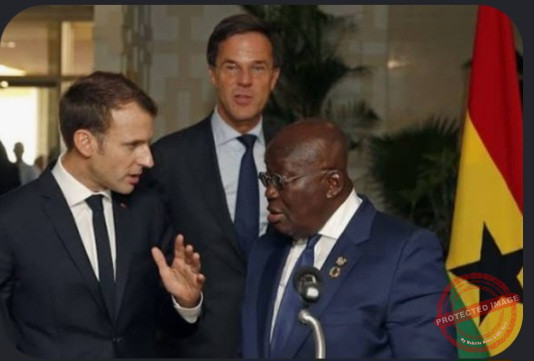
French President Emmanuel Macron’s projected visit to Ghana for the High-Level Conference on Reparatory Justice has generated considerable debate across Africa. Critics have been quick to point out the apparent contradiction: France abstained from the recent United Nations resolution recognizing the transatlantic slave trade as a crime against humanity, yet Macron is now traveling to Accra to participate in discussions surrounding reparatory justice.
For many Africans, the question is obvious: if France declined to support the resolution, why the sudden interest in attending a conference dedicated to the very principles behind it? The answer lies not in reparations alone, but in the rapidly changing geopolitical landscape of Africa.
The End of an Era
For decades, France maintained an unparalleled sphere of influence across Africa through a system commonly referred to as Françafrique. Military partnerships, political alliances, economic arrangements, and monetary influence through the CFA franc allowed Paris to shape and reshape events across much of the continent. That era is now under unprecedented pressure.
French forces have been expelled from Mali, Burkina Faso, and Niger. Anti-French sentiment has grown across West and Central Africa. Calls for monetary independence are challenging the future of the CFA franc. Meanwhile, new actors—including China, Russia, Türkiye, the Gulf States, and emerging African powers—are competing for influence in regions once considered firmly within France’s orbit.
Macron’s trip to Ghana must therefore be understood within this broader context. France is not merely attending a conference. It is attempting to reposition itself in an Africa that is increasingly asserting its independence and redefining its partnerships.
Why This Matters to Ambazonia
For Ambazonians, this development should not be viewed as a distant diplomatic event. France has historically been one of the most important external partners of the Cameroonian state. Successive governments in Yaoundé have benefited from close political, economic, and security relations with Paris. While France has often spoken the language of democracy and human rights, its practical approach toward Cameroon has generally prioritized stability and state continuity.
As long as the traditional structures of influence remained intact, meaningful international pressure on Cameroon regarding the conflict in Ambazonia was always likely to remain limited. However, the continent is changing.
As France seeks to rebuild credibility and preserve influence in Africa, it may eventually be compelled to adopt a more nuanced approach toward conflicts that have long been treated as internal affairs. The erosion of old power structures creates opportunities for new conversations, new diplomatic engagements, and new political realities.
Ghana’s Rising influence
Macron’s choice of Ghana is equally significant. Unlike many countries historically associated with French influence, Ghana has increasingly emerged as a respected voice on democratic governance, Pan-African cooperation, and African self-determination. It has positioned itself as a bridge between different regions of the continent and as an advocate for a more assertive African role in global affairs.
The conference on reparatory justice is not simply about historical compensation. It is about historical accountability, political sovereignty, economic fairness, and the right of peoples to shape their own future. These themes resonate far beyond the reparations debate itself. For Ambazonians, whose struggle is rooted in questions of political identity, historical agreements, governance, and self-determination, such discussions are worthy of careful attention.
A Shifting International Environment
The significance of Macron’s visit becomes even clearer when viewed alongside other global developments. The ongoing G7 Summit has highlighted growing competition among major powers. At the same time, efforts by the United States and Iran to move toward diplomatic engagement after years of confrontation demonstrate that international politics remains fluid and subject to change.
These developments reinforce a critical lesson for Ambazonia: geopolitical environments are not static. All political struggles operate within broader international contexts. Opportunities that seem impossible today can become realistic tomorrow when strategic interests shift, alliances evolve, and new diplomatic openings emerge. The challenge for Ambazonians is to recognize these changes before others do.
Beyond Military Calculations
One of the greatest mistakes liberation movements can make is to focus exclusively on military developments while neglecting geopolitical transformations. History shows that many national struggles have advanced not only because of events on the ground but because international conditions eventually became favorable to their aspirations.
Today, Africa is experiencing one of the most significant geopolitical realignments since the end of the Cold War. Traditional powers are losing influence. New partnerships are emerging. African states are demanding greater autonomy in shaping their future. These changes create uncertainties, but they also create possibilities.
The Strategic Imperative
Ambazonians should therefore view Macron’s visit to Ghana not as a story about France alone, nor merely as a debate about reparations. It is a signal that the old African order is being challenged.
Whenever established political structures begin to shift, opportunities emerge for causes that were previously ignored, marginalized, or dismissed. Whether those opportunities translate into meaningful gains depends on preparation, diplomacy, organization, and strategic vision.
The future of Ambazonia will not be determined solely by events within our homeland. It will also be influenced by the broader transformations reshaping Africa and the international system. Macron’s visit to Ghana is one small piece of that larger story.
For Ambazonians, the message is clear: pay attention. The geopolitical map of Africa is changing, and those who understand these shifts early will be best positioned to shape the future rather than merely react to it.
— Ali Dan Ismael The Independentist News
Share This Post:
Africa’s New Era of Sovereignty and the Ambazonian Question
Ambazonia Must Understand the New Recolonization of Africa
Related Post
Dr. Martin Mungwa publishes Southern Cameroons 2050 : why
Adelle Nazarian of the Western Journal calls on the
NKAMOUNA, WASHINGTON, AND THE NEW POLITICS OF AFRICA’S STRATEGIC
When Conflict Becomes an Economy The Political Economy of
THE POLITICAL ECONOMY OF THE SOUTHERN CAMEROONS CONFLICT: Who
WHEN HISTORY DEMANDS AN ANSWER: Jamaica’s Legal Challenge to