

Football, like national development, rises when productive assets are nurtured and falls when they are captured by corruption, politics, and narrow interests. The lesson for Ambazonia and Africa is clear: talent is not enough. Productive assets must be protected by honest institutions, transparent leadership, fair competition, and a culture that rewards merit over loyalty.
By Ali Dan Ismael
Atlanta, Georgia — On FIFA World Cup Assignment
Productive Assets Win Nations, Not Slogans
The Round of 16 clash between Egypt and Argentina offered a powerful lesson beyond football. Egypt’s 3–2 loss to Argentina was not a defeat without meaning. It was an example of resilience, teamwork, coordination, discipline, and the nurturing of productive assets throughout the game. Against one of the world’s most talented football nations, Egypt showed that excellence is not built by slogans. It is built through preparation, trust, movement, sacrifice, tactical awareness, and the ability of every player to understand his role within a larger system.
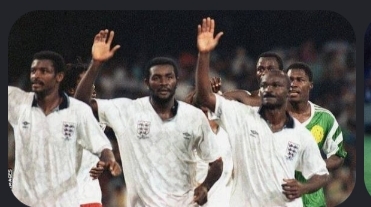
That lesson is not new to Africans. In the 1990 FIFA World Cup, French Cameroun faced England with the same spirit of tenacity. Officially, Cameroon lost 3–2 after extra time, but the world remembers that match not as humiliation, but as proof that an African team could challenge a global football power with courage, coordination, belief, and collective discipline. The scoreline was painful, but the performance was historic. It showed that when productive assets are nurtured, internalized, coordinated, and trusted, even the supposedly weak can force the powerful to fight for survival.
These football examples carry a national lesson. Nations rise the same way strong teams compete: by identifying talent early, training it patiently, organizing it intelligently, and giving every productive asset a role in the national game plan. Egypt did not frighten Argentina by accident. French Cameroun did not shake England in 1990 by accident. Such resilience comes from habits practiced over time until they become culture. The same principle applies to Ambazonia, Africa, and every people seeking dignity: productive assets must not be wasted, insulted, divided, or abandoned. They must be developed, coordinated, protected, and deployed with purpose.
Football teaches what politics often forgets. A people may be outmatched in resources, surrounded by stronger opponents, and dismissed by the world, but if they build teamwork, discipline, coordination, and belief, they can change how history sees them. The African struggle for dignity requires the same internalized tenacity: not emotional reaction alone, but organized capacity; not scattered talent, but coordinated national purpose; not dependency, but the patient nurturing of productive assets until resilience becomes a way of life.
When Productive Assets Are Destroyed by Corruption
Sadly, the lesson of 1990 has not been protected. Today, Camerounian football appears far removed from the discipline, unity, sacrifice, and national purpose that once made the Indomitable Lions a symbol of African pride. The game that once nurtured productive assets has become entangled in allegations of corruption, political interference, tribal control, administrative confusion, and institutional decay. Even under the leadership of Samuel Eto’o, one of Africa’s greatest footballers, the system has not recovered the moral clarity and developmental discipline required to build the next generation.
This is the tragedy. A great player does not automatically become a great institution builder. Talent on the field is not the same as governance off the field. The productive assets that once made Cameroun feared and respected have been weakened by patronage, factionalism, ego, and political manipulation. Young players may still possess ability, but ability without structure is wasted. Talent without trust becomes frustration. National pride without institutional discipline becomes nostalgia.
The future of Camerounian football looks bleak because the foundations have been neglected. The problem is not the absence of talent. The problem is the destruction of the ecosystem that discovers, trains, protects, coordinates, and rewards talent fairly. When football becomes a battlefield for politics, tribe, money, and personal control, the national team stops being a productive institution and becomes a mirror of the state itself: rich in human potential, but poor in governance.
That is why the comparison with 1990 is so painful. The Cameroun team that challenged England showed what could happen when courage, coordination, and productive assets are brought together in one disciplined national effort. Today, that lesson appears forgotten. The country still celebrates the memory of greatness, but it has not protected the systems that produce greatness. And because decline has become expected, few people are shocked. They simply accept failure as normal.
But nations should never normalize decay. Football, like national development, rises when productive assets are nurtured and falls when they are captured by corruption, politics, and narrow interests. The lesson for Ambazonia and Africa is clear: talent is not enough. Productive assets must be protected by honest institutions, transparent leadership, fair competition, and a culture that rewards merit over loyalty. Otherwise, even the richest human potential will be wasted.
Ali Dan Ismael
Editor-in-chief Atlanta, Georgia