



A peaceful Southern Cameroons–Ambazonia could become more than the site of another unresolved African conflict. It could become a democratic Atlantic partner, a contributor to secure supply chains, a platform for productive investment, an advocate for responsible resource development and an example of how a smaller African nation can convert sovereignty into institutions, human development and shared prosperity.
By Martin S. Mungwa, PhD, MBA, P.E., F.ASCE, contributor to the Independentist News, and Commissioned Secretary of State for Communications and Diplomacy, Government-in-Exile of the Federal Republic of Southern Cameroons–Ambazonia
As Amazon associate this site earns from qualifying purchases
Get you back to school essentials with Amazon
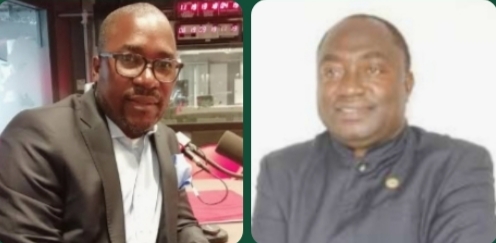
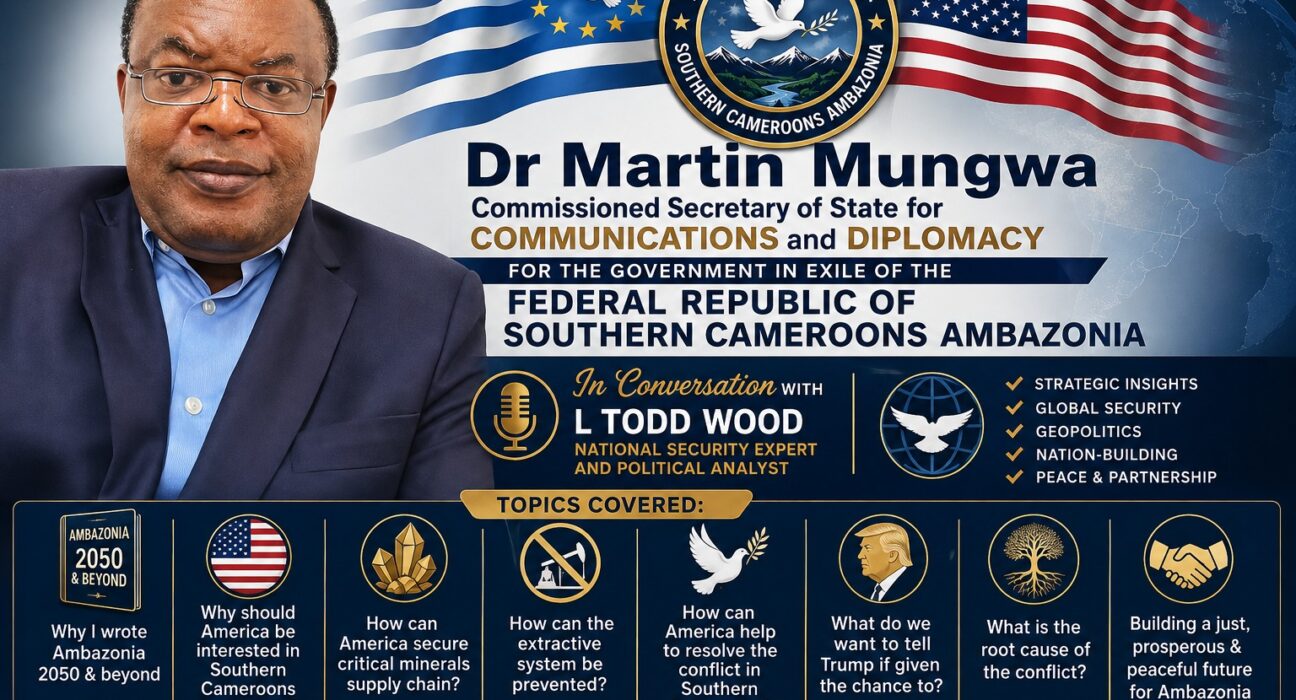
My recent conversation with national security expert and political analyst L. Todd Wood provided an opportunity to move the discussion to of Southern Cameroons–Ambazonia beyond grievance alone and toward a more demanding question: What kind of country are we trying to build, and why should the United States care about the answer? That distinction matters because, for too long, the Southern Cameroons question has been presented internationally almost exclusively through images of conflict, displacement, political disagreement and humanitarian suffering.
Those realities cannot be minimized, but a people cannot define their future only by what has happened to them. At some point, they must also explain what they intend to build. That is the purpose behind Ambazonia 2050 & Beyond, and it became the central thread running through my discussion with Todd Wood.
I explained that I did not write Ambazonia 2050 & Beyond simply to make another argument for independence. I wrote it because liberation capacity is not the same thing as governing capacity. Political freedom by itself does not generate electricity, operate ports, finance hospitals, educate children, collect taxes, enforce contracts, protect forests, manage cities, build industries or maintain infrastructure.
Those responsibilities require functioning institutions. The four-volume work therefore asks the question that must eventually follow every liberation struggle: What happens the morning after political freedom? Who runs the country? Who keeps the lights on? Who maintains the roads and bridges? Who protects civilians? Who manages public finances? Who builds industries? Who trains the next generation? Who signs? Who pays? Who owns the productive source? And does the capital generated by the country circulate through its people and institutions, or does it simply disappear elsewhere? Ambazonia 2050 & Beyond is therefore an attempt to move the conversation from survival to significance, from protest to institutional design, and from liberation capacity to governing capacity.
One of the most important issues in our conversation was the root cause of the conflict. The Southern Cameroons problem is frequently reduced internationally to an “Anglophone crisis,” but that description is inadequate. The deeper issue concerns the constitutional and political arrangements surrounding 1961. Southern Cameroons was a former British-administered United Nations Trust Territory. It entered an association with the already independent Republic of Cameroun under circumstances in which the much smaller Southern Cameroons did not possess effective international guarantees capable of protecting its institutions, autonomy and political identity against eventual absorption.
That structural imbalance matters. When a smaller political entity enters a relationship with a much larger neighbor without enforceable safeguards protecting its constitutional position, the architecture of the arrangement becomes as important as the promises surrounding it. The federal structure was abolished in 1972 and centralization subsequently deepened. The resulting dispute is therefore about much more than the use of English or French. It concerns consent, constitutional order, political identity, self-government and the consequences of an arrangement that did not provide Southern Cameroons with durable protection against absorption. Unless that historical and constitutional problem is taken seriously, efforts to resolve the conflict merely as an administrative or linguistic issue are unlikely to address its foundations.
I also made the case that American interest in Southern Cameroons–Ambazonia should not be understood as charity. There is a strategic argument. Southern Cameroons–Ambazonia occupies potentially important geography along the Gulf of Guinea and the Atlantic approaches to West and Central Africa. It lies beside Nigeria, Africa’s most populous country and one of its largest economies. Its English-speaking and common-law heritage provides another potential point of institutional compatibility with the United States, while its diaspora includes professionals, academics, engineers, entrepreneurs, healthcare practitioners, financial specialists and others with experience across advanced economies. America should therefore ask a straightforward question: Could a peaceful, democratic, economically productive and institutionally credible Southern Cameroons–Ambazonia become a dependable American partner in a strategically important part of Africa?
That question deserves serious study because the United States is increasingly concerned with secure supply chains, maritime security, energy, critical minerals, reliable commercial partners and strategic competition for influence across Africa. Southern Cameroons–Ambazonia should not approach that reality by asking America simply, “What will you give us?” The more serious question is what America and Southern Cameroons–Ambazonia can build together that makes both stronger. That is the difference between partnership and dependency. A credible relationship must rest on mutual interest, reciprocal value and institutions capable of converting political goodwill into durable economic and strategic cooperation.
Our discussion also addressed America’s growing concern about critical minerals and strategic supply chains. Africa possesses enormous natural wealth, but possession of natural resources has too often failed to produce corresponding prosperity for African communities. The traditional extractive model is familiar. The mineral leaves. The timber leaves. The agricultural commodity leaves. The crude resource leaves. The producing country receives a fraction of the final value while processing, technology, financing, intellectual property, manufacturing, branding and the highest-value employment remain elsewhere. That cannot be the development model of Ambazonia. If future American companies participate in critical-mineral, energy or resource development, the relationship should be based on transparent contracts, environmental responsibility, technology transfer, local skills development, domestic processing where economically viable, infrastructure investment, enterprise creation and meaningful local participation.
The central question should not simply be how much material can be removed from the ground. It should be what productive capability remains after the resource leaves. If a billion dollars of mineral wealth leaves a region and the surrounding communities remain poor, the schools remain inadequate, infrastructure deteriorates and local citizens possess no greater technological, financial or productive capability than before extraction began, then development has failed regardless of the export figures.
Resources must feed productive capacity rather than exhaust it. This is the essence of what I describe as productive sovereignty. Sovereignty should not be measured only by ownership of territory or the flying of a flag. It should also be measured by who controls the productive source, who possesses the knowledge to transform it, who owns the technology and intellectual property, who receives recurring economic returns, and whether enough value circulates within society to build the next generation of productive capacity.
Todd and I also explored what the United States could realistically do to help resolve the conflict. My position is not to begin by asking Washington for military intervention. I am not asking for a blank check, and I would not make immediate American recognition the opening demand. The first request is more practical: give Southern Cameroons–Ambazonia a serious strategic hearing. Study the history. Study the constitutional problem. Study the geography. Study the humanitarian consequences. Study the economic potential. Study the regional implications.
Then help create a credible political process. A realistic pathway would involve structured dialogue between representatives of Southern Cameroons–Ambazonia and La République du Cameroun through a mutually acceptable mediator or facilitator, without preconditions, supported by an international guarantor or guarantor group capable of helping ensure that whatever agreements emerge are implemented. The purpose of mediation cannot simply be to bring people into a room. It must create a process capable of producing an enforceable and durable peace. A settlement that exists only until the stronger party changes its mind is not a durable settlement.
One of the questions raised in our discussion was what I would say if given several minutes with President Donald Trump. I would not begin with a long historical lecture. I would ask him to study Southern Cameroons–Ambazonia seriously. Study its position in the Gulf of Guinea. Study its proximity to Nigeria. Study its people and diaspora. Study its resource and agricultural potential. Study whether a peaceful and productive Southern Cameroons could become a reliable American partner. Then help create the diplomatic space necessary for the parties to talk seriously.
America does not necessarily have to choose between principle and national interest. Sometimes the two can reinforce each other. A durable settlement could reduce human suffering while contributing to regional stability, stronger commercial relations, more resilient supply chains and reduced pressures that drive displacement and migration. That is a better strategic outcome than allowing another African conflict to remain unresolved until the political, humanitarian and security consequences become more expensive.
Partnership, however, cannot be a one-way demand. If Southern Cameroons–Ambazonia expects the international community, and particularly the United States, to take its case seriously, its Government-in-Exile and the wider national movement must demonstrate more than political aspiration. We must demonstrate constitutional legitimacy, administrative effectiveness, civilian protection, productive capacity and responsible external relations. We must show that institutions can become stronger than personalities, that human rights and the rule of law will be respected, that contracts will be honored, that public finances will be transparent and that corruption will not simply reproduce itself beneath a different flag.
We must explain how minorities and political opponents will be protected. We must demonstrate that national resources will not simply pass from one extractive elite to another. Independence must therefore be understood not merely as replacing one flag with another but as constructing a functioning Republic whose people can see, experience and defend the institutions created in their name.
The international community is entitled to ask difficult questions, and so are Ambazonians themselves. Who will be accountable when institutions fail? Who controls public money? Who audits public institutions? Who can remove an incompetent official? Who protects a citizen against the state? Who owns public assets? Who maintains the infrastructure after the ribbon-cutting ceremony? Who controls the technology? Who benefits repeatedly from national resources? Where is the single point of failure? These are not secondary questions to be asked after independence. They are the questions through which political aspiration becomes institutional credibility.
My conversation with L. Todd Wood ultimately returned to five words displayed prominently on the flyer announcing our discussion: peace, sovereignty, justice, development and partnership. Those ideas should not compete with one another. Peace without justice may merely postpone conflict. Sovereignty without governing capacity can become symbolism. Development without ownership can become extraction. Justice without institutions can become rhetoric. Partnership without mutual interest can become dependency. A durable national project must therefore bring these ideas together.
The future I describe in Ambazonia 2050 & Beyond is not a Republic waiting to be rescued by America. It is a Republic preparing itself to become useful to its own citizens, valuable to its neighbors and credible to international partners. The strongest argument Southern Cameroons–Ambazonia can ultimately make to the United States is not simply that we have suffered, although that history deserves to be heard. The larger strategic argument concerns what we are capable of becoming.
A peaceful Southern Cameroons–Ambazonia could become more than the site of another unresolved African conflict. It could become a democratic Atlantic partner, a contributor to secure supply chains, a platform for productive investment, an advocate for responsible resource development and an example of how a smaller African nation can convert sovereignty into institutions, human development and shared prosperity. That is the conversation I wanted to have with L. Todd Wood, and it is the conversation I believe Ambazonia must increasingly have with America.
We are not asking the United States simply to choose our side. We are asking America to examine seriously whether our future interests can meet, whether peace can create a platform for mutual prosperity, and what Southern Cameroons–Ambazonia and the United States might be capable of building together when they do.
Author, Speaker, Producer, Publisher CD Media
L Todd Wood has reinvented himself for the third time after being at the heart of the U.S. Special Operations world and a long career on Wall Street. Now he thrills with real world experience via novels and journalism.
As a Special Operations pilot, L. Todd Wood flew missions for Seal Team 6 and Delta Force. He’s on a new mission now — to protect the American way of life and rescue it from the destructive grip of the socialist ideology that threatens its sovereignty and everything that makes this country
As Amazon associate this site earns from qualifying purchases
Get your back to school essentials with Amazon
Martin S. Mungwa, PhD, MBA, P.E., F.ASCE, contributor to the Independentist News, and Commissioned Secretary of State for Communications and Diplomacy, Government-in-Exile of the Federal Republic of Southern Cameroons–Ambazonia