

By Martin S. Mungwa, Ph.D., F.ASCE
Prepublication book review By The Independentist News education desk
Approximately 550 pages | 11 Chapters | 9 Interludes | Case Studies | Maps | Figures | Documentary and Audit Boxes | Open Windows | Open Horizons
As Amazon associate this site earns from qualifying purchases
Get books on productive Sovereignty and statecraft By Martin Mungwa from Amazon
https://www.amazon.com/s?k=Book+by+Martin+mungwa&i=specialty-aps&srs=121082092011&crid=31ZNM3LO2LYZ&sprefix=book+by+martin+mungwa%2Cspecialty-aps%2C356&linkCode=ll2&tag=njokings-20&linkId=1b27d38f35a7a4cc044008b29fe377d8&language=en_US&ref_=as_li_ss_tl
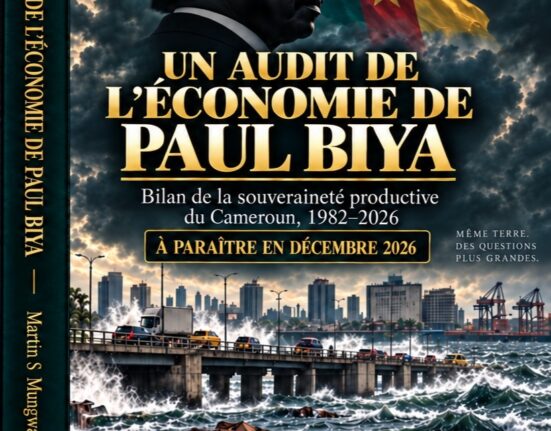
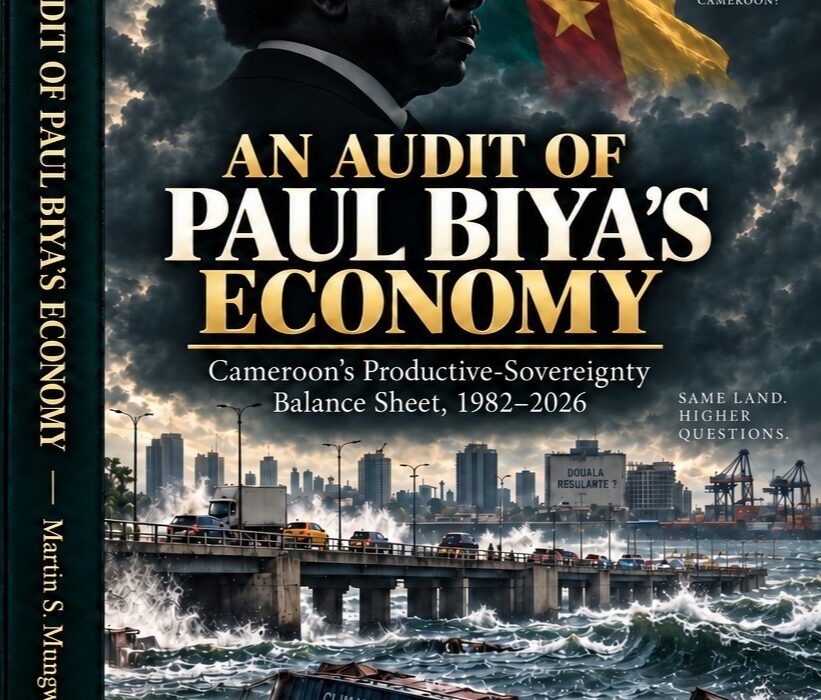
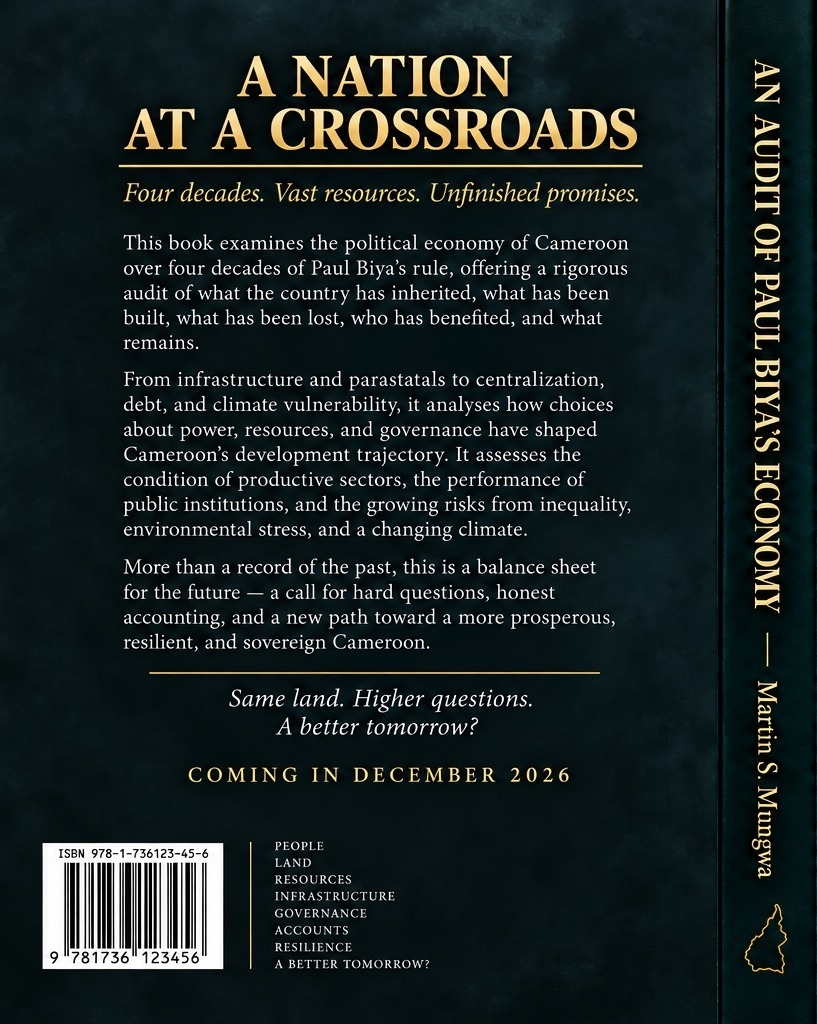
An Audit of Paul Biya’s Economy is a long-range political-economic examination of Cameroon from 1982 to 2026. Rather than asking simply whether the economy grew under Paul Biya, the book asks a more demanding question: What did Paul Biya inherit, what did forty-four years of political continuity build, what was lost, who benefited, which regions advanced or declined, and what productive economy will the next era inherit?
The audit begins before Paul Biya.
The Introduction, “What Ahidjo Left Behind,” reconstructs the economic balance sheet of Cameroon on 6 November 1982. It examines the agriculture, plantations, public corporations, industries, oil production, infrastructure, transportation systems, financial institutions, human capital, and regional productive assets already in place when Ahmadou Ahidjo transferred power.
That baseline permits the book to distinguish clearly between inheritance and achievement, inherited vulnerability and subsequent policy failure, and what existed before Biya from what developed during his presidency. The book then follows Cameroon through the major economic transformations of the Biya era.
MAJOR THEMES:
THE ECONOMIC CRISIS AND STRUCTURAL ADJUSTMENT
The book examines the collapse of the mid-1980s boom, falling commodity revenues, fiscal crisis, banking distress, public-sector wage reductions, IMF and World Bank adjustment programs, trade liberalization, privatization, and the 1994 CFA franc devaluation. It asks what resulted from international economic shocks and what resulted from domestic policy and institutional choices.
THE RISE AND FALL OF THE PARASTATAL ECONOMY
A major chapter reconstructs the fate of Cameroon’s state-owned enterprises. It follows enterprises including: CELLUCAM, CAMAIR, SOTUC, REGIFERCAM, CAMSHIP, CAMTAINER , SNEC, CAMSUCO, SOCAPALM, HEVECAM, ONAPHARM and major public financial institutions. The audit distinguishes companies that were liquidated from those that were privatized, concessioned, restructured, recapitalized, or replaced.
It asks a deeper question: When a public enterprise disappeared, did Cameroon merely lose an inefficient company—or did it also lose skills, technology, supplier networks, industrial knowledge, employment, productive land, and strategic national capability?
AGRICULTURE AND FOOD SOVEREIGNTY
The book audits cocoa, coffee, cotton, bananas, palm oil, rubber, timber, livestock, fisheries, staple food production, plantation agriculture, smallholder farming, irrigation, mechanization, storage, agricultural finance, food imports, and agro-industrial development. It asks how much value remains with the producer and whether Cameroon has successfully transformed agricultural abundance into food security and industrial capability.
OIL, GAS, MINERALS, AND RESOURCE SOVEREIGNTY
Petroleum, natural gas, refining, SONARA, iron ore, bauxite, cobalt, nickel, gold, diamonds, timber, and strategic minerals are examined through a common test: Who extracts? Who finances? Who processes? Who owns? Who controls the technology? And how much value remains in Cameroon? The book asks one of its central questions: What did petroleum actually build?
INDUSTRIALIZATION AND THE FACTORY QUESTION
The book examines whether Cameroon has moved sufficiently from extraction and primary production toward: processing, manufacturing, engineering, technology, maintenance capability, branding, intellectual property, and domestic ownership. It evaluates agro-processing, aluminium, cement, construction materials, pharmaceuticals, textiles, metals, wood processing, SMEs, and industrial zones.

ENERGY, PORTS, ROADS, RAILWAYS, AND CORRIDORS
Major infrastructure is audited not simply by asking whether it was constructed, but whether it became productive. The book examines: Nachtigal, Lom Pangar, electricity generation and reliability, Douala Port, Kribi Deep-Sea Port, railways, national roads, airports, digital infrastructure, the Douala–N’Djamena corridor, the Douala–Bangui corridor, Nigeria-facing trade routes. and Cameroon’s position on the Gulf of Guinea. A recurring question is: Did Cameroon construct infrastructure, or did it build an integrated productive system?
HUMAN CAPITAL, MIGRATION, AND THE DIASPORA
Education, universities, TVET, engineering, scientific research, employment, youth unemployment, informal labor, immigration, emigration, remittances, brain drain, brain circulation, and diaspora capability are examined as part of the productive economy.
The book asks whether Cameroon trains people whom other economies subsequently employ—and how diaspora capital, expertise, and technology might become part of national productive development.
CENTRALIZATION, PUBLIC FINANCE, DEBT, AND OWNERSHIP
One of the book’s central analytical themes is economic centralization. The audit asks: Who collects revenue? Who determines expenditure? Who decides where infrastructure is built? Who controls strategic enterprises? How much economic authority remains with regions and councils? Where is public capital reinvested?
The book develops a Centralization Ledger comparing revenue generation, population, infrastructure, public investment, education, health, electricity, industrial investment, and regional transfers. It also examines public debt, banking, the CFA franc, BEAC, CEMAC, domestic enterprise, foreign investment, and the difference between local content and local ownership.
THE PRESIDENCY AS AN ECONOMIC INSTITUTION
A distinctive chapter examines the presidency itself as part of Cameroon’s political economy. It considers: centralized executive authority, presidential appointments, major economic decisions, public corporations, borrowing, strategic projects, governing through the Presidency, extended overseas stays, governance from abroad, delegation, succession, and institutional continuity.
The book does not speculate about or diagnose Paul Biya’s health. Instead, it examines documented absences, official statements, presidential acts, constitutional arrangements, and whether a highly centralized state possesses sufficient institutional depth to function effectively when its president is physically absent.
FRANCE AND THE POSTCOLONIAL ECONOMIC AND SECURITY ARCHITECTURE
The book examines the historical relationship between France and Cameroon, including: the postcolonial cooperation architecture, the 1974 Accords de coopération, military cooperation, technical assistance, judicial and administrative cooperation, the CFA monetary framework, commercial relationships, and the 2009 France–Cameroon defense partnership.
Rather than assuming causation, the book distinguishes between documented agreements, French policy, Cameroonian sovereign decisions, economic relationships, military cooperation, and claims that require independent verification.
THE SHRINKING NORTHWEST AND SOUTHWEST ECONOMY
One of the most consequential sections of the book audits the economy of the Northwest and Southwest regions, historically associated with British Southern Cameroons and referred to as Ambazonia by separatist movements and supporters.
The book reconstructs the productive economy before the present conflict: CDC plantations, rubber, banana, oil palm, cocoa, coffee, highland agriculture, Bamenda commerce, Buea’s education and service economy, Victoria/Limbe, Tiko, Kumba, Mamfe, Nigeria-facing trade, universities, human capital, roads, regional infrastructure, and public investment.
It then examines: centralization,, regional fiscal authority,, public-investment allocation, perceptions and evidence of marginalization, the 2016 political crisis, armed conflict, plantation disruption, business closure, business relocation, school interruption, displacement, road insecurity, checkpoints, lost agricultural production, lost formal employment, lost public revenue, investment deterrence, and destruction of productive capacity.
The book carefully separates three questions: What economic weaknesses existed before 2016? What losses were directly associated with the conflict? What role, if any, did long-term centralization and unequal allocation play in creating the underlying economic and institutional conditions?
WHAT DID FORTY-FOUR YEARS BUILD?
The final chapter brings the evidence together through three national balance sheets: 1960 — What Independence Inherited. 1982 — What Ahidjo Left Behind. 2026 — What the Biya Era Leaves Behind.
The concluding audit asks: What was built? What disappeared? What was privatized? What remains publicly owned? What productive capabilities were lost? What new capabilities were created? What happened to public debt? Who owns Cameroon’s productive assets? What happened to industrial capacity? How have regions shared in national development? What did foreign partnerships leave behind? What did conflict cost? And what will the next political era inherit?
BEYOND THE AUDIT
The book includes several Open Horizons looking beyond 2026: Cameroon 2035 — From Vision to Measurable Capability. The Economics of Peace. Cameroon After the Biya Era. From Centralization to Productive Regions.
The Next Inheritance
The purpose is not merely to document the past. It is to ask what economic architecture Cameroon will need after one of the longest presidencies in modern African history.
THE CENTRAL QUESTION
Ultimately, An Audit of Paul Biya’s Economy asks: When the length of the presidency is finally separated from the personality of the president, what productive economy will remain?
COMING UP IN THE MONTH OF DECEMBER 2026 Authored By Martin S. Mungwa, Ph.D., F.ASCE,
As Amazon associate this site earns from qualifying purchases
Get books on productive sovereignty and statecraft By Martin Mungwa from Amazon
The Independentist News education desk