











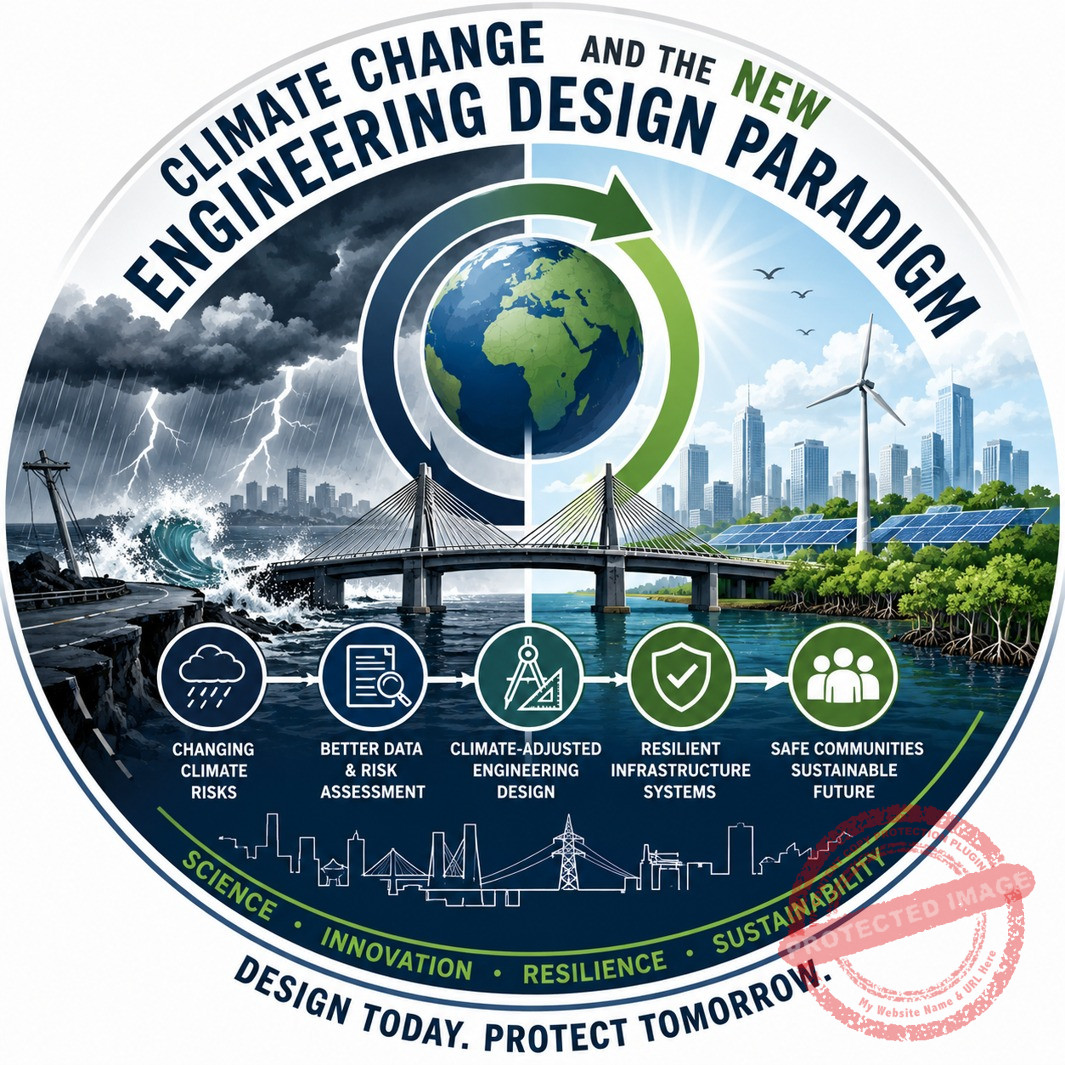
The objective of modern engineering is not simply to ensure that infrastructure survives extreme weather. It is to ensure that infrastructure continues serving society during and immediately after extreme weather. That is the essence of resilience.
By Martin Mungwa, PE, PhD, F.ASCE
Fellow of the American Society of Civil Engineers
“Climate change has not changed the laws of physics. It has changed the assumptions engineers can safely make.” Martin Mungwa
The Great Engineering Challenge of the Twenty-First Century
Every generation of engineers inherits a defining challenge that reshapes the profession. The nineteenth century-built railways that connected nations. The twentieth century delivered highways, airports, dams, power stations, ports, and modern cities. The twenty-first century confronts a challenge unlike any before it: designing infrastructure capable of surviving a rapidly changing climate.
For more than one hundred years, civil engineers designed roads, bridges, drainage systems, ports, airports, buildings, electrical substations, and coastal infrastructure using historical rainfall records, historical flood elevations, historical sea levels, and historical storm frequencies. These assumptions formed the foundation of engineering design because the future generally resembled the past. That assumption is no longer valid.
Climate change has fundamentally altered the engineering environment. Rising sea levels, stronger storm surges, increasingly intense rainfall, changing river hydrology, coastal erosion, and more frequent extreme weather events have changed the risks that infrastructure must withstand throughout its service life. This is no longer simply an environmental issue debated at international climate conferences. It is now one of the greatest engineering challenges confronting Africa.
For a continent expected to experience some of the world’s fastest rates of urbanization over the coming decades, the decisions made today will determine whether future cities become engines of prosperity or recurring victims of climate-related disasters. The infrastructure Africa builds over the next thirty years will shape economic growth for generations. If designed properly, it will provide resilience, attract investment, create employment, and protect lives. If designed using outdated assumptions, it may require costly reconstruction long before the end of its intended service life. Climate resilience is therefore no longer an environmental aspiration. It is an engineering necessity.
Africa’s Wake-Up Call
The warning signs are already visible.
Across Africa, major floods have become increasingly frequent and increasingly destructive. Cities in Cameroon, Ghana, Nigeria, Mozambique, Libya, Kenya, South Africa, and many other countries have experienced devastating floods that overwhelmed drainage systems, submerged highways, damaged bridges, disrupted airports, destroyed homes, interrupted commerce, and displaced entire communities. These events have imposed enormous economic and social costs while exposing weaknesses in infrastructure that was never designed for today’s climate realities.
Too often, attention focuses on the disaster itself rather than on the engineering lessons it reveals.
Every flooded highway raises important questions. Was the drainage system adequately designed? Were culverts sized for future rainfall rather than historical rainfall? Was development permitted within natural floodplains? Were stormwater systems properly maintained? Was critical electrical equipment installed below flood level? Could these losses have been reduced through better engineering?
In many cases, the answer is yes. Floods cannot always be prevented. Disasters can often be mitigated. There is an important distinction between a natural hazard and a national catastrophe. Heavy rainfall is a natural phenomenon. The collapse of bridges, the failure of electrical substations, the shutdown of hospitals, the contamination of drinking water, and the paralysis of transportation systems are frequent failures of planning, design, maintenance, or governance. Engineering cannot control the weather. Engineering can determine how society responds to it.
The Climate Has Changed—Engineering Must Change Too
Engineering has always evolved in response to new knowledge. When earthquake science advanced, engineers introduced seismic design standards. When aviation expanded, airport engineering evolved accordingly. When vehicle ownership increased, highway design standards were revised. Climate change now demands a similar transformation. Many engineering standards currently used across Africa remain based upon assumptions developed decades ago, when rainfall patterns were more predictable and sea levels more stable. Those assumptions no longer reflect the conditions infrastructure is expected to face over the next fifty to one hundred years.
Modern engineering must move beyond designing for historical averages toward designing for future risk. This requires engineers to incorporate projected sea-level rise, anticipated changes in rainfall intensity, watershed development, urban expansion, storm surge, and evolving climate conditions into the design process. Infrastructure should be designed not only to withstand today’s climate but also the conditions likely to exist throughout its operational life.
This represents one of the most significant shifts in engineering philosophy since the introduction of modern building codes. It requires governments to revise national engineering standards, universities to modernize engineering curricula, professional societies to update design manuals, and consulting engineers to adopt climate-informed design methodologies as standard practice. The cost of updating engineering standards today is insignificant compared with the economic losses associated with rebuilding failed infrastructure tomorrow.
The question is no longer whether climate change is occurring. The engineering question is whether our infrastructure is being designed to withstand it.
Engineering for the Hundred-Year Storm
One of the most important reforms African governments should adopt is the modernization of national flood-design criteria. Historically, engineers have relied upon statistical analyses of historical rainfall and streamflow records to estimate the probability of flooding.
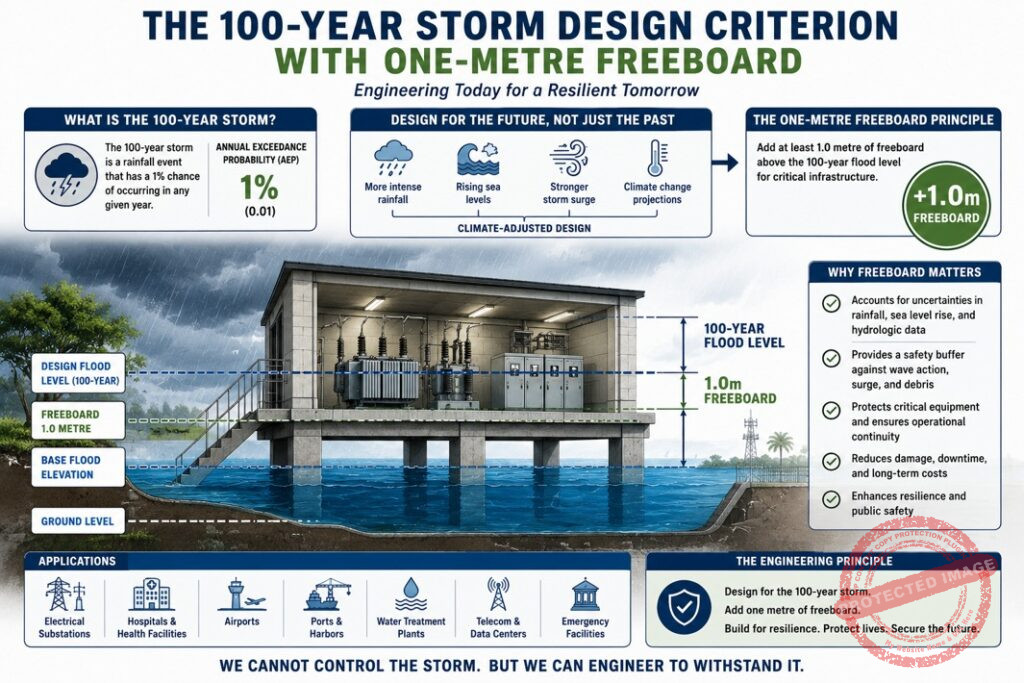
The 100-Year Storm Design Criterion with One-Metre Freeboard
One commonly used benchmark is the 100-year flood, often misunderstood by the public.
A 100-year flood does not mean such a flood occurs only once every hundred years.
It simply means there is approximately a one percent probability that a flood of that magnitude will occur in any given year. Two such events may occur within a decade—or even within the same year. As climate conditions change, the historical probability of extreme flooding may no longer represent future reality. This is why African engineering practice must evolve.
Critical infrastructure—including ports, airports, electrical substations, hospitals, water-treatment plants, wastewater facilities, emergency operations centres, transportation hubs, and communication systems—should be designed using climate-adjusted flood criteria rather than relying exclusively on historical records.
Equally important is the concept of freeboard—the additional vertical safety margin provided above the calculated flood elevation.
For critical infrastructure, engineers should consider locating electrical switchgear, emergency generators, communication systems, mechanical equipment, and other mission-critical facilities above the climate-adjusted 100-year design flood elevation, with an additional freeboard of approximately one metre where supported by site-specific engineering analysis and applicable design standards.
That additional metre can make the difference between operational continuity and catastrophic failure. A hospital whose emergency generators remain above floodwater continues treating patients. A substation whose electrical equipment remains dry continues supplying electricity. A water-treatment plant whose control systems remain protected continues producing safe drinking water. An airport whose critical systems remain operational continues receiving emergency relief flights.
The objective of modern engineering is not simply to ensure that infrastructure survives extreme weather. It is to ensure that infrastructure continues serving society during and immediately after extreme weather. That is the essence of resilience.
(Part II) will examine how resilient infrastructure should function during disasters, lessons from New York City’s storm-hardening program, the integration of engineering with nature, and why Africa’s engineers must lead the continent’s climate adaptation strategy.
Martin Mungwa, PE, PhD, F.ASCE







Leave feedback about this