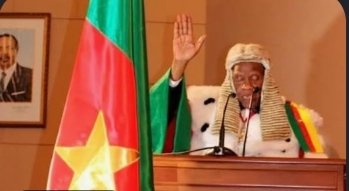


Clement Atangana is gone. Paul Biya will also go. We will all go. But the question that survives every funeral is brutally simple: What did you build when you had the power to build? That is the question LRC must now answer — not for Clement Atangana alone, but for an entire political culture.
By Veritas Network, for The Independentist News
As Amazon associate this site earns from qualifying purchases
Get books on productive Sovereignty and statecraft. By Martin Mungwa on Amazon.
YAOUNDE – October 5, 2026 – Do citizens of La République du Cameroun know that there is life after death? If they do, then the death of Clement Atangana should be more than another occasion for official condolences, funeral speeches and photographs of dignitaries standing solemnly around a coffin. It should force LRC to confront an uncomfortable question: after a lifetime at the highest levels of public service, what exactly does a man leave behind?
Atangana Clement, was not an ordinary civil servant. He rose to become one of the country’s most senior judicial figures and eventually President of the Constitutional Council. His profession placed him among the supposed guardians of the Constitution and the republic.
Yet across LRC social media, instead of an overwhelming public celebration of a great constitutional statesman, one encounters a much harsher verdict: that Clement Atangana did not live up to the highest standard of his profession because he became more useful to the protection of Paul Biya and the Biya system than to the protection, defence and promotion of La République du Cameroun and its institutions.
Critics go further, arguing that he protected and promoted Biya partly because of their Beti tribal connection. Whether one accepts every aspect of that accusation or not, the fact that such a judgment is now so openly expressed after the man’s death tells us something profoundly uncomfortable about the political culture he represented. And this is where the real conversation must begin.
There is a fundamental difference between serving a country and serving a regime. A president is temporary; the republic is supposed to be permanent. A government comes and goes; institutions are supposed to survive. Yet the political culture inherited from France has too often produced a state-centred, hierarchical system in which public officials rise through their loyalty to the administrative and political centre, while independent institution-building, philanthropy and civic legacy remain secondary.
The official becomes identified with the office, the office becomes identified with the government, and the government becomes identified with the man at the top. That is the tragedy of the Francophone model when it degenerates into personality politics: the public servant spends his life serving power and then discovers, in death, that power cannot bury him with the institution he never built. Look instead at the broader Anglo-Saxon political tradition. Whatever its own contradictions, it has developed a powerful culture of creating institutions that deliberately outlive their founders.
Shehu Musa Yar’Adua has been dead since 1997, yet the Shehu Musa Yar’Adua Foundation continues to carry his name and ideals into public life. Olusegun Obasanjo has built a foundation and a presidential library designed to preserve experience, ideas and history. Goodluck Jonathan has likewise established a foundation. The principle is simple: the man dies, but the mission continues; the politician disappears, but the institution keeps speaking. That is what legacy looks like.
Now look at LRC. Where are the foundations? Where are the presidential libraries? Where are the major scholarship programmes established by the political class? Where are the independent research institutes, civic archives, leadership centres and public institutions through which generations can encounter the ideas and values of those who spent decades in power? Too often there is nothing beyond the government biography, the official portrait, the state funeral and a few days of newspaper tributes. Clement Atangana is gone; the office he occupied remains. Andze Tsoungui is gone; the state moved on. Alexis Dipanda Mouelle is gone after decades at the summit of the judiciary; the courts remain, but where is the enduring public institution that makes his life’s work accessible to the next generation?
The same question can be asked of countless officials who spent their productive years inside the Biya establishment. They served the state, but did they build for society? Even the controversial Solomon Tandeng Muna has a foundation carrying his name. That should tell LRC something. A public servant’s legacy cannot simply be the number of years he spent near the presidency or the number of important offices he occupied. If, after death, the only thing that survives is the position he held, then the position — not the man — was the legacy.
This is why the Clement Atangana debate is bigger than Clement Atangana. It exposes a fundamental weakness in the political culture of LRC: the tendency to confuse loyalty to the ruler with loyalty to the republic. A constitutional jurist should defend the Constitution; a judge should defend the law; a public servant should defend the public interest. The ultimate test is not whether he pleased the president but whether he protected the institution from the president when necessary.
If the criticism is that Atangana protected, defended and promoted Biya more faithfully than he protected, defended and promoted the republic, then that is not merely a political criticism — it is an indictment of what his profession was supposed to represent. And this is precisely why the Anglo-Saxon comparison matters. The strongest public cultures understand that political life is temporary but institutional life can be permanent. Their leaders prepare for the morning after themselves. LRC too often prepares only for the next appointment, the next decree, the next promotion and the next instruction from above.
Perhaps that is also why the death of senior officials repeatedly exposes the emptiness of the system’s political memory. The state can manufacture importance while a person is alive, but history is much less generous after death. History does not care how many times you sat beside the president. It asks what you built when you had power. It does not care how many decrees carried your signature. It asks whether the ordinary citizen was better served by your existence. It does not care whether you were a minister, judge, ambassador or constitutional councillor. It asks what remains after your office has been handed to somebody else.
This is the lesson LRC should take from Clement Atangana’s death — and eventually from Paul Biya’s departure. For more than four decades, the Cameroonian political system has revolved around one man. But there will come a morning when Biya is no longer there, and the person who has always been expected to speak for the system cannot speak anymore. What then remains?
That question takes us directly to October 1, 2017. Ambazonia’s farewell to La République du Cameroun was not simply a disagreement over administrative arrangements. It was, among other things, a rejection of a political order that many Ambazonians had concluded could not give them the institutional culture, political accountability and national future they desired. It was a rejection of a system in which loyalty to the centre could become more important than loyalty to the citizen. And Clement Atangana’s death, ironically, gives us another opportunity to examine that difference.
Ambazonia has its own political failures and contradictions; nobody needs to pretend otherwise. But the principle remains universal: when a public servant dies, the people should inherit something from him. A foundation. A scholarship. A library. An archive. A research centre. An institution. An idea that continues to educate. Something that belongs to the generations yet unborn.
Because there is life after death. There is life after office. There is life after the presidency. There is life after the Constitutional Council. There is life after Paul Biya. The great public servants understand this and build accordingly. Those who spend their entire lives protecting the man above them may discover too late that when both men are gone, there is very little left to defend their place in history.
Clement Atangana is gone. Paul Biya will also go. We will all go. But the question that survives every funeral is brutally simple: What did you build when you had the power to build? That is the question LRC must now answer — not for Clement Atangana alone, but for an entire political culture.
As Amazon associate this site earns from qualifying purchases
Get books on productive Sovereignty and statecraft. By Martin Mungwa on Amazon
Veritas Network, for The Independentist News