









Commentary

We are home to news on Cameroon and the CEMAC region. We are dedicated to honest and reliable reporting. We are the voice of the Cameroonian people and their fight for freedom and democracy at a time when the Yaoundé government is silencing dissent and suppressing democratic voices.

Britain was late in securing durable safeguards around the 1961 transition. It was late in responding to the consequences of centralization. It was late to the humanitarian catastrophe. Canterbury arrived after Rome had already directed the world’s attention toward Bamenda. If Britain wishes to become consequential, it must do more than arrive after everyone else. It must finally confront, with honesty and political courage, the consequences of what it helped bring into being.
By Ali Dan Ismael, Editor-in-chief The
Independentist News
As Amazon Associate this site earns from qualifying purchases
Get your back to school stuff via Amazon
https://www.amazon.com/s?k=back+to+school+stuff&i=specialty-aps&srs=121082092011&crid=2LCGQZKX579XO&sprefix=back+to+school+stuff%2Cspecialty-aps%2C545&linkCode=ll2&tag=njokings-20&linkId=a865a2fd534c013a455b03a4d0251f40&language=en_US&ref_=as_li_ss_tl
LONDON – August 16, 2026 – Britain’s recurring problem in Southern Cameroons is not that it is entirely absent. It is that it arrives late, speaks cautiously, misreads the political identity of the people and departs without confronting the consequences of its own history.
The pattern stretches from the 1961 termination of trusteeship to Cameroon’s admission into the Commonwealth, and from humanitarian diplomacy to the recent visit of the Archbishop of Canterbury. Britain tends to appear after French Cameroun’s preferred political arrangement has already been established, normalized or internationally packaged. It then offers symbolism where political courage is required and cultural familiarity where historical accountability is overdue.
The memory of empire acts like jet lag on British foreign policy. London knows that it once administered Southern Cameroons, but it behaves as though the responsibilities arising from that history belong to a distant time zone from which it has not fully awakened.
Following La Francophonie into Cameroon
Cameroon entered the institutional orbit of La Francophonie before it joined the Commonwealth. According to the International Organisation of La Francophonie, Cameroon became an associate participant in 1975 and a full member in 1991. Four years later, in November 1995, it was admitted to the Commonwealth. International Organisation of La Francophonie, Commonwealth analysis of Cameroon’s admission. The sequence was politically revealing.
France had already secured Cameroon’s place within its linguistic, diplomatic and postcolonial network. Britain followed by supporting the admission of a predominantly Francophone state into the Commonwealth, relying substantially on the historical connection provided by the former British Southern Cameroons.
France secured the relationship. Britain supplied the appearance of balance.
Yet Britain still misunderstood—or chose not to confront—the political identity of Southern Cameroons. It treated the territory principally as an English-speaking minority within Cameroon rather than as a former United Nations Trust Territory with a distinct administrative history, inherited institutions and a particular path through the international decolonization process.
Southern Cameroons became an admission credential rather than a people whose political history deserved protection. The territory supplied the English-speaking connection. Yaoundé received Commonwealth legitimacy. Britain obtained the appearance of continued relevance while avoiding the difficult question of what had become of the former trust territory it once administered.
Cameroon’s admission was controversial even at the time. Yet Commonwealth membership was not made conditional upon the restoration of a federal system, enforceable protection for Southern Cameroons’ inherited institutions or demonstrable compliance with the democratic standards the organization proclaimed. Britain followed France into Cameroon’s institutional diplomacy—and still got the identity of Southern Cameroons wrong.
What the United Nations Record Actually Says
Historical criticism must begin with an accurate account of the formal international record. The United Nations supervised separate plebiscites in the Northern and Southern Cameroons in February 1961. Southern Cameroons voted to achieve independence by joining the Republic of Cameroun, while Northern Cameroons voted to join Nigeria. United Nations General Assembly Resolution 1608 (XV), adopted on April 21, 1961, endorsed those results and provided for the termination of the British trusteeship over Southern Cameroons on October 1, 1961, upon its joining the Republic of Cameroun. United Nations trusteeship record, United Nations Yearbook for 1961.
The formal trusteeship therefore ended in international law. It would be inaccurate to claim that Britain continues to exercise the legal powers or duties of an administering authority. But that does not extinguish historical scrutiny or moral responsibility. The enduring Ambazonian argument is that the political destination anticipated in 1961 was not protected by a sufficiently durable constitutional settlement. A federal state was created, but that federation was abolished in 1972. The country’s name was subsequently changed in 1984 to the Republic of Cameroon—the name used by French Cameroun before the 1961 union.
Whether those developments amount to an incomplete or failed decolonization is contested. Ambazonians and their critics do not interpret the legal consequences in the same way. What cannot reasonably be disputed is that Britain participated in a transition whose resulting constitutional safeguards did not endure and whose breakdown contributed to grievances that remain unresolved.
The legal trusteeship ended. The historical consequences did not.
Britain is therefore not being asked to pretend that it still governs Southern Cameroons. It is being asked to acknowledge candidly what it supervised, what it expected the resulting political arrangement to protect and what happened after those protections disappeared. Britain Reduced a Political Identity to a Language Problem Britain’s foundational error has been to reduce Southern Cameroons to language.
Southern Cameroons is not historically significant merely because many of its people speak English. Its identity arises from a separate colonial and trusteeship history, a distinctive common-law and educational inheritance, identifiable territorial boundaries and a specific experience within the United Nations decolonization process.
Describing the conflict exclusively as an “Anglophone crisis” strips the dispute of much of that constitutional depth. It converts a disagreement involving the political evolution of a former trust territory into a domestic controversy over linguistic accommodation. Language is part of the crisis, but it is not the whole of its foundation.
The distinction matters. A linguistic minority may seek language rights, cultural protections and administrative reforms within an existing state. A former trust territory alleging that the constitutional basis of its union was dismantled raises additional questions: What political arrangement was contemplated? What institutions were intended to embody it? What consent sustained it? What occurred when the federal structure disappeared?
Britain’s preference for the terminology of minority rights allows it to address symptoms without confronting origins. It can finance bilingual education, provide humanitarian assistance and call for dialogue without examining how the transition it supervised became the foundation of a conflict. This is how historical responsibility is transformed into contemporary ambiguity.
The Pope Went to Bamenda; Canterbury Did Not
The contrast between two religious visits in 2026 captured Britain’s recurring difficulty with remarkable clarity. On April 16, Pope Leo XIV traveled to Bamenda and held a meeting for peace at Saint Joseph’s Cathedral. He addressed a population traumatized by years of conflict and condemned the manipulation of religion for political and military purposes. His visit placed an international spotlight on the conflict and was accompanied by a temporary cessation of hostilities announced by several Ambazonian groups. The Vatican’s record of the Bamenda meeting, Associated Press coverage.
Several months later, Archbishop of Canterbury Sarah Mullally made her first pastoral visit to Cameroon. She was not an insignificant church leader, as some descriptions have suggested. She was the newly installed Archbishop of Canterbury, the first woman to hold the office and the spiritual leader of the worldwide Anglican Communion.
Her announced itinerary included Yaoundé, Douala, Buea and Limbe—but not Bamenda. On August 1, she visited Buea, met the governor of the South West Region and visited the Biaka Foundation. She later called for genuine and inclusive dialogue and said the people of Cameroon had suffered for too long. Official announcement of the Archbishop’s itinerary, Anglican account of the Buea visit. Her message of peace deserves recognition. She is also not personally responsible for decisions taken by British governments during colonial administration.
Nevertheless, the geography and sequence of the visits carried unavoidable symbolism. The Pope went to Bamenda, confronted the suffering directly and placed the conflict before a global audience. Canterbury arrived several months later and visited Buea, Limbe, Douala and Yaoundé—but not Bamenda.
There is no publicly available evidence proving that Yaoundé designed the Archbishop’s itinerary as a deliberate balancing act against the Pope’s visit. That interpretation should therefore be presented as analysis, not fact. Even so, the result fitted Yaoundé’s administrative framing remarkably well. The Pope’s presence in Bamenda was followed by a prominent British religious visit centered elsewhere, including Buea and Limbe. The arrangement created geographical balance without producing political consequence.
Once again, Britain arrived after another international figure had acted more decisively. Once again, British presence was symbolically valuable but politically limited. Once again, engagement with the territory avoided a direct examination of Britain’s historical role. Too little. Too late. Too carefully contained to alter anything fundamental.
Pidgin English Is Not a Decolonization Policy
Britain’s diplomatic use of Pidgin English illustrates the same problem. When British diplomats communicate in Pidgin, many citizens understandably welcome the gesture. Language can express respect, reduce diplomatic distance and demonstrate a willingness to engage people outside elite circles. But Pidgin English cannot substitute for policy. A British diplomat may ask, “How wuna dey?” Yet the people are entitled to reply with more difficult questions:
What did Britain expect the 1961 political arrangement to guarantee? What safeguards were intended to protect Southern Cameroons’ inherited institutions? Why did the disappearance of the federation fail to provoke more consequential British engagement? What responsibility does Britain bear today—not as a continuing trustee, but as the former administering authority that helped manage the transition?
Pronunciation cannot replace accountability. Cultural familiarity cannot resolve a constitutional dispute. Speaking the people’s language means little if Britain refuses to engage seriously with what the people are saying in that language. Pidgin-English diplomacy risks becoming a form of imperial nostalgia: Britain receives the warmth of cultural recognition without accepting the burden of historical candor.
Dining with Yaoundé at the Humanitarian Buffet
Britain has contributed humanitarian assistance to civilians affected by the conflict. In 2018, the United Kingdom announced £2.5 million for the United Nations response, including immediate assistance delivered through UNICEF. In 2020, Britain reported that its humanitarian support for crisis-affected populations in Cameroon had reached £13.5 million. UK government’s 2018 announcement, UK parliamentary answer concerning 2020 assistance.
That assistance matters. Food, medicine, shelter and protection can save lives. The suffering of civilians should never be trivialized to make a political argument. But humanitarian assistance cannot substitute for political responsibility.
Britain appears prepared to help feed people displaced by the conflict while maintaining normal diplomatic relations with Yaoundé. It helps treat the injuries without confronting adequately the political structure producing them. It presents the crisis principally as a humanitarian emergency while avoiding the historical and constitutional dispute beneath it. This is the humanitarian buffet: foreign governments gather around the consequences of catastrophe, announce funding, attend conferences, commission reports and display compassion while carefully avoiding the political responsibility required to address the causes.
Victims are counted, categorized, fed and photographed. Humanitarian organizations distribute relief. Diplomats issue statements. Yaoundé retains international legitimacy. The conflict gradually becomes a permanent aid program rather than a political failure requiring resolution. Britain cannot indefinitely speak Pidgin English to Ambazonians with one side of its diplomacy while dining with La République du Cameroun around the humanitarian buffet with the other.
The question is not whether British officials can greet Ambazonians in a familiar language. It is whether Britain is prepared to speak plainly about the former British Southern Cameroons, the disappearance of its federal protections and the need for a credible political process that addresses rather than obscures the underlying dispute. Pidgin English may create familiarity. Humanitarian assistance may alleviate suffering. Neither constitutes a political settlement.
Symbolism Without Political Courage
Britain’s approach illustrates a wider weakness of Western diplomacy. Powerful governments prefer gestures that impose limited political cost: speaking local languages, funding workshops, visiting affected communities and issuing humanitarian statements. These activities may have value. But they become instruments of avoidance when they replace engagement with the foundational political dispute.
The Southern Cameroons question cannot permanently be reduced to a humanitarian emergency or an “Anglophone crisis.” Humanitarian language describes suffering but can conceal its political and historical origins. Nor should aid become a moral-laundering mechanism through which foreign governments finance relief while preserving comfortable diplomatic and commercial relations with Yaoundé.
Britain does not satisfy its historical responsibility merely by financing emergency food after a constitutional arrangement has collapsed into conflict. Nor does it discharge that responsibility by speaking a local language while declining to confront the political questions expressed through it. The people of Southern Cameroons do not need Britain merely to imitate their speech. They need Britain to disclose and explain its record.
Relevant British archives, diplomatic correspondence and legal assessments concerning the 1961 transition should be accessible. Britain should support civilian protection, credible international engagement and an inclusive political process. It should stop behaving as though humanitarian funding has settled the consequences of history.
Southern Cameroons provided Cameroon’s Commonwealth connection. Britain supplied symbolic familiarity. Yaoundé received diplomatic legitimacy. Humanitarian organizations were left to distribute assistance among the ruins. That is not consequential diplomacy. It is historical responsibility standing beside a humanitarian buffet.
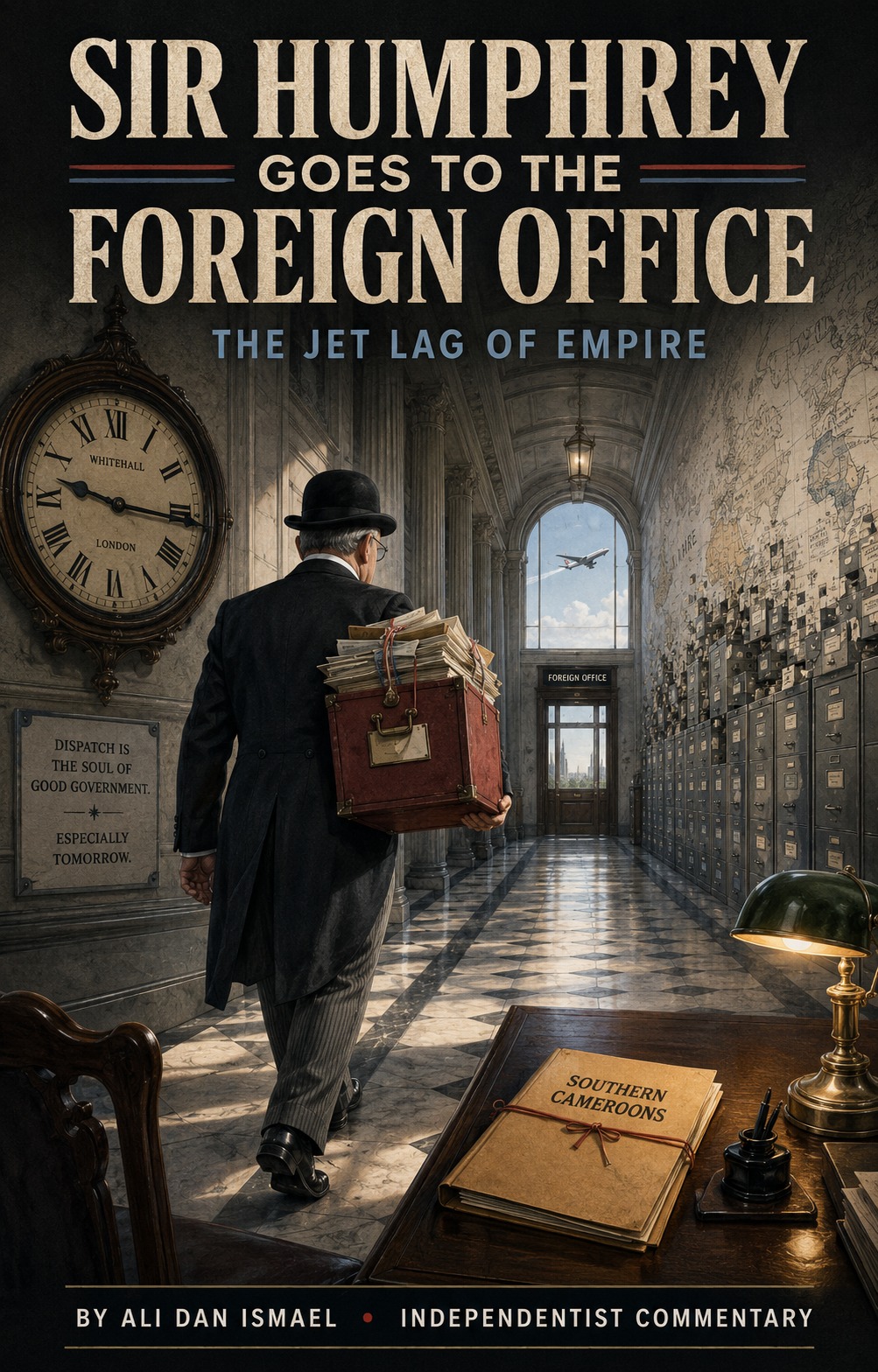
Sir Humphrey Goes to the Foreign Office
The British television satires Yes, Minister and Yes, Prime Minister portrayed Sir Humphrey Appleby as the brilliant, self-protective civil servant who behaved as though government were too important to be left to elected politicians—and certainly too important to be directed by ordinary voters.
The statement that Britain possesses an “aristocratic democracy” in which the electorate becomes progressively irrelevant should be treated as a paraphrase of the program’s satirical worldview, not as a verified quotation from Sir Humphrey. But the parody captures a recognizable governing attitude: politicians and voters come and go, while the permanent machinery of the state preserves what it defines as the national interest.
That mentality appears disturbingly compatible with British policy toward Southern Cameroons. The people may possess a history, but officials possess a file. The people may invoke self-determination, but diplomats prefer stability. The people may suffer, but the Foreign Office must protect bilateral relations. The people may challenge the consequences of the 1961 settlement, but officials insist that the matter belongs entirely within Cameroon’s sovereign jurisdiction.
This is diplomacy conducted from the archives downward rather than from human consequences upward. Inherited state relationships become more important than the people whose political future was being decided.
Southern Cameroonians participated in a plebiscite, but sovereign independence as a separate state was not among the options placed before them. Their British inheritance later supplied part of the justification for Cameroon’s Commonwealth admission, yet their consent was not sought when the federal system was abolished. The British bureaucracy placed the matter under “Cameroon” and behaved as though the history had been settled. Sir Humphrey would have understood the procedure perfectly.
The Jet Lag of Empire
Britain’s policy remains trapped between imperial memory and post-imperial hesitation. It remembers enough to use Pidgin English, visit the territory and invoke Commonwealth connections. But it appears unwilling to accept that its administration of Southern Cameroons created a historical record that cannot be erased merely because the formal trusteeship ended.
The resulting diplomacy is perpetually delayed. Britain accepted Cameroon into the Commonwealth after the country had already become embedded in La Francophonie. It spoke about democratic values after Yaoundé had centralized the state. It provided humanitarian assistance after communities had been destroyed and populations displaced.
Its diplomats embraced Pidgin English after Southern Cameroons’ political identity had been reduced internationally to an “Anglophone problem.” The Archbishop of Canterbury visited Buea after the Pope had already gone to Bamenda and placed the conflict before the world. At each stage, Britain appeared. At no stage did its appearance decisively alter the political reality. That is the jet lag of empire: arriving in the present while continuing to think according to assumptions inherited from the past.
What Consequential British Diplomacy Would Require
Britain can still become relevant, but only by abandoning symbolism as a substitute for responsibility. It should support comprehensive access to British records concerning the administration, plebiscite and 1961 termination of trusteeship for Southern Cameroons. It should distinguish clearly between a linguistic-minority dispute and the historical-constitutional claims arising from the former trust territory.
Britain should support an inclusive and credibly facilitated political process rather than repeat vague calls for dialogue whose terms remain controlled by Yaoundé. It should connect diplomatic engagement with measurable expectations concerning civilian protection, humanitarian access, constitutional accountability and respect for human rights.
Humanitarian relief must continue, but relief cannot replace resolution. Above all, British officials should listen to Southern Cameroonians as political subjects—not merely as humanitarian beneficiaries, English-speaking inhabitants of another state or audiences for Pidgin-English diplomacy.
Britain Must Wake Up
Southern Cameroons does not need another delayed British gesture. It does not need symbolic balance cautiously distributed between Bamenda and Buea. It does not need Pidgin English without political candor or humanitarian generosity without historical accountability. It needs Britain to awaken from the jet lag of empire.
The question is no longer whether London can remain politely engaged while avoiding controversy. The question is how long Britain can claim fidelity to democracy, self-determination and the rule of law while treating the people of a former trust territory as increasingly irrelevant to the resolution of their political future. The Foreign Office may believe that history has been filed away. Southern Cameroons is living proof that it has not.
Britain was late in securing durable safeguards around the 1961 transition. It was late in responding to the consequences of centralization. It was late to the humanitarian catastrophe. Canterbury arrived after Rome had already directed the world’s attention toward Bamenda. If Britain wishes to become consequential, it must do more than arrive after everyone else. It must finally confront, with honesty and political courage, the consequences of what it helped bring into being.
As Amazon Associate this site earns from qualifying purchases
Get your back to school stuff via Amazon
https://www.amazon.com/s?k=back+to+school+stuff&i=specialty-aps&srs=121082092011&crid=2LCGQZKX579XO&sprefix=back+to+school+stuff%2Cspecialty-aps%2C545&linkCode=ll2&tag=njokings-20&linkId=a865a2fd534c013a455b03a4d0251f40&language=en_US&ref_=as_li_ss_tl
Ali Dan Ismael, Editor-in-chief The
Independentist News
Share This Post:
Ten Signs Ambazonia Is Moving from a Movement to a Nation
Cameroon’s €274 Million Warning: When Infrastructure Becomes a Debt Chokepoint
Related Post
IF SOMALILAND MATTERS TO WASHINGTON, WHY NOT SOUTHERN CAMEROONS?
A CALL FOR GENERATIONAL RENEWAL: From Individual Leadership to
The Government of the Federal Republic of Ambazonia (in
Sir Abdulkarim’s Opinion of a “JOHN GARANG” for Ambazonia:
THE BIYA PLAYBOOK COMES HOME? As France Confronts Its
1st OCTOBER 1961 AND THE REUNIFICATION LIE: An Open