

Ambazonia’s human ties across the Mungo must not prevent Ambazonians from defending their dignity, their institutions, their identity, and their future. Bloodlines matter in families. Roots belong to biography. Justice matters in nations. Strategic interest belongs to statecraft. And when a people’s survival is at stake, strategic interest must come first.
By Ali Dan Ismael
Editor-in-Chief, The Independentist News
Nations do not survive by sentiment. They survive by understanding their strategic interest and defending it with discipline. This is one of the hardest lessons in world politics, and it is a lesson Ambazonians must learn without apology.
The River Mungo is not merely a geographical marker. It is a historical wound, a political boundary, and a reminder that bloodlines, cultural closeness, religious familiarity, trade relationships, school friendships, intermarriage, and shared colonial geography do not automatically create justice. Across the Mungo, there are families, memories, marriages, friendships, markets, churches, schools, and personal relationships. These human ties matter. They should never be treated with contempt. But they cannot be allowed to confuse the strategic interest of a people seeking survival, dignity, security, and self-government.
The lesson is clear from Britain itself. The British royal family, now known as the House of Windsor, has deep German dynastic roots. The House of Windsor took its present name in 1917, when Britain’s royal family changed its name from the Germanic House of Saxe-Coburg and Gotha during the First World War. Yet when Germany became a strategic threat to Britain, bloodline did not override national interest. Britain did not say, “Germany is family, therefore we must surrender our strategic future.” Britain acted as a state. It defended British interest. That is the brutal honesty of statecraft.
Britain’s royal blood may have had German connections, but Britain’s strategic survival required resistance to German power. The lesson is not hatred. The lesson is realism. Blood may explain history, but it does not govern national strategy. Family ties may soften language, but they do not determine security policy. Dynastic connections may decorate palaces, but they do not replace sovereignty.
This is why Ambazonia must be careful when emotional arguments are used to weaken its political clarity. Some will say that Ambazonians and the people of La République du Cameroun are brothers. Some will point to marriages across the Mungo. Some will point to shared churches, shared markets, shared schools, shared names, shared suffering, and shared African identity. These things are real. But none of them answers the central question: does the existing political arrangement protect Ambazonian dignity, security, identity, justice, and future? If the answer is no, then sentiment cannot be used as a chain.
Bloodlines Do Not Govern Strategic Interest
Ambazonia’s strategic interest transcends bloodlines across the Mungo because the survival of a people cannot be reduced to emotional blackmail. A people may love their neighbors and still reject domination. A people may respect cultural ties and still demand political freedom. A people may have family across a boundary and still insist that their institutions, legal traditions, language rights, educational system, economic assets, and national future must not be swallowed by a state that has repeatedly treated them as expendable.
The House of Windsor teaches this clearly. Britain did not allow German ancestry to paralyze British strategic judgment. When German power threatened British interests, Britain chose Britain. It chose national survival over dynastic sentiment. It chose strategic clarity over bloodline confusion. It chose the state over the family tree. Ambazonia must do the same.
This does not mean hatred toward ordinary people across the Mungo. It does not mean hostility toward families, traders, students, workers, or communities who share human bonds with Ambazonians. It means that political destiny cannot be decided by emotional slogans. The issue is not whether people across the Mungo can be friends, relatives, business partners, classmates, or neighbors. They can. The issue is whether Ambazonia should surrender its strategic future because some people misuse brotherhood to excuse injustice.
Brotherhood without justice is domination dressed as affection. Unity without consent is annexation wearing a smile. Peace without dignity is submission renamed stability. For decades, Ambazonians have been told to endure, adjust, forgive, compromise, and remain silent in the name of national unity. Yet unity has too often meant absorption. Bilingualism has too often meant marginalization. Integration has too often meant assimilation. National belonging has too often meant obedience to a political culture that neither respects Ambazonian history nor protects Ambazonian institutions.
A serious people must know the difference between human relationship and national interest. Human relationships should be protected where possible. Civilians should be respected. Families should not be demonized. Communities should not be taught hatred. But the political destiny of Ambazonia cannot be decided by sentimental appeals from those who benefit from the existing imbalance.
Every serious nation understands this. Britain understands it. France understands it. Germany understands it. America understands it. China understands it. Russia understands it. No serious state sacrifices its strategic interest because of emotional language. States may speak of friendship, but they act according to interest. They may hold ceremonies, exchange royal visits, sign communiqués, and praise historic ties. But when survival is at stake, they defend themselves. Ambazonia must stop apologizing for learning the same lesson.
The American Lesson: Roots Are Not the Same as State Interest
The same lesson can be seen clearly in American politics. Modern America has been led by people with diverse ancestral roots, but when they occupy the presidency or vice presidency, their primary obligation is not to ancestral sentiment. Their primary obligation is to the United States.
Donald Trump has German ancestry through his father’s family and Scottish ancestry through his mother’s family, but his political identity and governing claim are centered on defending American interest. His roots do not make Germany or Scotland his primary political fiefdom. His first political duty is America.
Barack Obama has Kenyan ancestry through his father and Irish ancestry through his maternal line, but when he became President of the United States, his primary responsibility was not Kenya, Ireland, or any sentimental homeland. His primary political duty was America. His oath, his office, his security apparatus, his economic policy, and his global decisions served the United States first.
Joe Biden has long celebrated his Irish roots, but his presidency was not an Irish presidency. It was an American presidency. His Irish heritage may shape personal memory, cultural pride, and diplomatic warmth, but it does not replace American strategic interest.
Kamala Harris has Jamaican and Indian roots through her parents, but her vice presidency was not an extension of Jamaica or India. Her public office belonged to the United States. Her heritage may be part of her personal identity, but the state interest she served was American.
This is the point Ambazonians must understand. Serious states do not confuse ancestry with strategic obligation. They may celebrate roots, but they defend the state they serve. They may honor heritage, but they protect the political order that gives them power. They may speak warmly of ancestral lands, but when decisions are made, national interest comes first.
Ambazonia, do not be fooled.
When people with roots across the Mungo are placed in positions of influence and presented as Ambazonian voices, the question is not whether they have family history, cultural memory, or personal connections. The question is whose strategic interest they serve. Do they defend Ambazonia’s dignity, historical truth, legal identity, and political future? Or do they help protect the architecture of La République du Cameroun while speaking in the language of moderation, unity, and inclusion?
America teaches the lesson clearly. Trump’s roots did not make him German or Scottish in office. Obama’s roots did not make him Kenyan or Irish in office. Biden’s roots did not make his presidency Irish. Harris’s roots did not make her vice presidency Jamaican or Indian. Their public duty was American.
Therefore, Ambazonians must judge political actors by function, not ancestry; by strategic loyalty, not accent; by institutional behavior, not sentimental biography. Roots may explain where a person comes from. They do not prove what political future that person is serving.
A people that cannot distinguish heritage from state interest will be deceived by symbolism. A people that allows ancestry to replace strategy will be represented by those who speak its language while serving another power. Ambazonia must not make that mistake. Roots belong to biography; strategic interest belongs to statecraft.
The Entente Lesson: Peace Among Empires, Not Justice for the Colonized
The Entente Cordiale of 1904 is often celebrated in European history as a diplomatic breakthrough. It reduced tensions between Britain and France and helped prepare the ground for future cooperation between two major imperial powers. But from the perspective of the colonized world, the moral meaning of the agreement is very different.
It was not a humanitarian settlement. It was not a ceasefire to protect Indigenous peoples. It was not a declaration of justice for Africans, Asians, Caribbeans, Indians, or other peoples who had suffered under European expansion. It was, above all, a bargain between empires.
Signed on April 8, 1904, the agreement settled colonial disputes involving Egypt, Morocco, Newfoundland, West Africa, Siam, Madagascar, and the New Hebrides. Britain accepted France’s special position in Morocco, while France agreed not to obstruct Britain’s position in Egypt. The agreement was about imperial interests, not the freedom of colonized peoples.
This matters because Britain and France teach the same lesson repeatedly: historical enemies can become strategic partners when their interests require it. France had been Britain’s historic enemy for centuries. The two powers fought wars, competed for colonies, and distrusted each other deeply. Yet when Germany emerged as the more serious industrial, economic, and military rival, Britain moved closer to France. Yesterday’s enemy became tomorrow’s strategic partner. Blood ties with Germany became less important than the need to contain German power. This is not hypocrisy. It is statecraft.
The problem is that empires often demand realism for themselves while preaching sentiment to the peoples they dominate. Britain may set aside bloodlines to defend British interest. France may set aside past rivalry to defend French interest. But when Ambazonians define their own strategic interest, they are told to think emotionally, forgive endlessly, and surrender politically in the name of brotherhood. That deception must end.
Germany, Brexit, and the Return of Old Strategic Habits
By the late nineteenth century, Germany had become an industrial and economic rival whose rise unsettled both France and Britain. France feared Germany because of military defeat, lost territory, and continental vulnerability after the Franco-Prussian War. Britain feared Germany because German industrial power, naval ambition, and commercial expansion threatened British influence.
The Entente Cordiale was not officially an alliance against Germany, but it helped bring Britain and France closer at a time when German power was becoming harder to ignore. It helped prepare the diplomatic environment in which Britain and France would later cooperate more closely during the crises that preceded the First World War.
That old strategic reflex has not disappeared. Even after Brexit, Britain has realized that geography, security, trade, migration, defense, energy, intelligence, and European diplomacy still bind it to France. Britain may leave the European Union, but it cannot leave Europe. France may claim European leadership, but it still needs British cooperation in defense, intelligence, migration, diplomacy, and global influence. When pressure rises from Germany’s economic weight, American strategic repositioning, Russian aggression, Chinese influence, and instability in Africa, Britain and France often rediscover each other. The old accord is not always named, but its spirit is repeatedly brought back into service.
This is a major lesson for Africa and Ambazonia. Politics is not governed by sentiment alone. Blood, language, religion, colonial memory, cultural familiarity, and emotional appeals can all be used to deceive weaker peoples. What matters in the end is interest. Britain will defend British interest. France will defend French interest. America will defend American interest. Germany will defend German interest. China, Russia, Turkey, the Gulf states, and every serious power will do the same.
Africans must therefore stop mistaking external affection for strategic commitment. A smile from a foreign leader is not policy. A royal visit is not justice. A development speech is not sovereignty. A diplomatic handshake is not liberation. States respect organized power, institutional competence, economic strength, and strategic clarity. They do not permanently sacrifice their interests for emotional friendship.
The Politics of Substitution and the Dilution of Statecraft
There is another method by which Ambazonia’s strategic interest is weakened: the politics of substitution. This happens when individuals who speak English, work comfortably within Anglo-Saxon institutions, or have passed through the Southern Cameroons educational, religious, political, or administrative environment are presented to the world as authentic representatives of Ambazonian opinion, even when their political instincts, family origins, institutional loyalties, or strategic interests are tied to the very system Ambazonians are resisting.
This issue must be understood carefully. It is not an argument against intermarriage, personal ancestry, migration, friendship, education, or human relationship across the Mungo. It is not an argument for ethnic hostility. It is an argument about political legitimacy, strategic representation, and the deliberate dilution of Ambazonian statecraft. A people’s future cannot be defined by substitutes chosen because they are convenient to an occupying structure, acceptable to foreign diplomats, useful to international organizations, or helpful to those who want to reduce the Ambazonian question to a language problem.
The strategy is subtle but effective. People with Francophone ancestry, Francophone political loyalties, or deep links to La République du Cameroun’s power structure may be promoted as moderate Anglophone voices, Commonwealth-facing officials, international spokespersons, opposition figures, religious authorities, technocratic representatives, historians, journalists, or civil-society interpreters of the crisis. Because they speak English or operate within Anglo-Saxon spaces, they are then used to soften, redirect, or neutralize the Ambazonian argument before international organizations, foreign governments, churches, diplomatic forums, academic spaces, and media platforms.
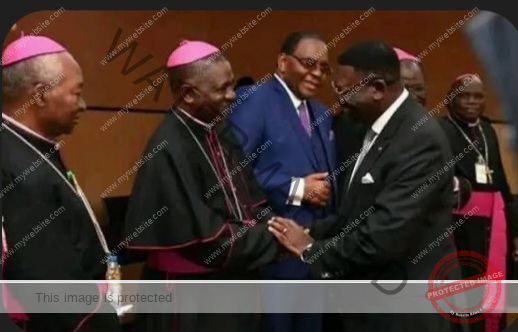
Examples frequently raised in public discussions include Prime Minister Dion Ngute, whose family roots are often associated with Nkongsamba through his father; Felix Mbayu, who served in Commonwealth-facing functions; Simon Nchinda Fobi, a high-ranking SDF figure; Joshua Osih, whose political base and origins are often discussed in relation to the South Region rather than the Ambazonian homeland; Paul Njukang Tasong; Chris Anu; Archbishop Andrew Nkea; Professor Julius Ngoh; journalist Eric Chinje; the late Francis Wete, former Assistant General Manager of CRTV; journalist Njomo Kevin; and many others. The point is not to reduce any individual to ancestry alone. The point is to ask a serious political question: when such figures are presented as Anglophone or Ambazonian voices, whose strategic interest do they ultimately serve? This is not accidental. It is statecraft by substitution.
A colonized or absorbed people can be weakened not only by soldiers, laws, prisons, and propaganda. They can also be weakened by controlled representation. If the world is made to believe that Ambazonia is already represented by people whose strategic loyalties are tied to Yaoundé, then the authentic Ambazonian voice is pushed to the margins. The question of sovereignty becomes reduced to a problem of inclusion. The question of justice becomes reduced to a problem of appointments. The question of historical statehood becomes reduced to a problem of bilingual convenience. That is how the substance of a national question is diluted.
Ambazonians must therefore distinguish between personal identity and political function. A person may grow up in the Anglo-Saxon system and still serve the strategic objectives of the Francophone state. A person may speak English and still defend the architecture of assimilation. A person may hold office in a Commonwealth-facing ministry, an opposition party, a church hierarchy, a university, a media house, or an international institution and still function as a substitute for authentic Ambazonian representation. The question is not merely where a person studied, worshipped, married, worked, or lived. The question is whose strategic interest that person ultimately serves.
France, through its proxy La République du Cameroun, has often done the opposite of what Britain did for itself. Britain took care of its own strategic situation and did not allow sentimental bloodlines to undermine British statecraft. La République, by contrast, has used language, appointments, religion, party politics, academic interpretation, journalism, and international access to create the appearance of representation while diluting the reality of Ambazonian self-determination.
This is the politics of substitution: replacing a people’s authentic voice with acceptable intermediaries; replacing statecraft with symbolism; replacing justice with appointments; replacing sovereignty with managed participation.
Ambazonians must reject this deception without falling into hatred. The issue is not personal ancestry. The issue is political function. The issue is whether those presented as Ambazonian voices truly defend Ambazonia’s strategic interest, or whether they merely help the colonial structure tell the world that the problem has been solved.
A people that allows others to choose its representatives will soon lose control of its destiny. A people that allows substitutes to define its grievances will see its history rewritten. A people that allows symbolic inclusion to replace strategic freedom will be managed indefinitely.
The most dangerous substitute is not the stranger who openly opposes a people, but the familiar voice used to speak against that people’s strategic future in the language of moderation.
Media Substitution and the Mask of Ambazonian Representation
The politics of substitution also extends into the media space. This is where the danger becomes even more subtle. A platform may speak English, recruit from Anglo-Saxon educational spaces, invoke Ambazonian suffering, or present itself as a voice from within the crisis, yet still function in ways that soften, redirect, or protect the strategic interests of Yaoundé.
This is why Ambazonians must judge media actors not by accent, educational background, regional familiarity, or emotional language, but by political function. A Buea University background does not automatically make a journalist or media platform a defender of Ambazonian strategic interest. English fluency does not equal political loyalty. Familiarity with Ambazonian society does not guarantee commitment to Ambazonian dignity. What matters is the consistent direction of the platform’s work: does it expose domination, or does it normalize it? Does it clarify the Ambazonian question, or does it dilute it? Does it defend the people’s historical identity, or does it repackage Yaoundé’s narrative in softer language?
From this perspective, critics of platforms such as MMI-MEFO argue that the problem is not merely what they report, but the strategic effect of how they report. When a media platform appears to speak from within the Anglophone space while repeatedly softening the responsibility of the Yaoundé regime, presenting occupation as administration, reducing state violence to “clashes,” or disguising the Ambazonian question as a problem of disorder rather than political justice, it becomes part of the machinery of substitution. This is not journalism as neutral observation. It becomes narrative management.
The danger is that outsiders may treat such platforms as authentic Ambazonian voices because they sound familiar, use local references, and appear to understand the terrain. But if their framing ultimately protects La République du Cameroun’s strategic position, then their function is not Ambazonian representation. Their function is controlled interpretation.
This is the same lesson seen in the House of Windsor, the American presidency, and serious statecraft everywhere. Roots, accents, schools, and biographies do not determine strategic loyalty. Function does. Trump’s German and Scottish roots did not make his public duty German or Scottish. Obama’s Kenyan and Irish roots did not make his presidency Kenyan or Irish. Biden’s Irish roots did not make his presidency Irish. Harris’s Jamaican and Indian roots did not make her vice presidency Jamaican or Indian. In office, their duty was American.
Ambazonia must therefore be equally clear. A person or platform may have Anglophone experience, Buea University connections, or local familiarity, but the test remains the same: whose strategic interest is being served?
If the reporting repeatedly dilutes Ambazonian identity, disguises Yaoundé’s responsibility, normalizes occupation, or presents Ambazonian resistance as the primary problem while avoiding the root cause of the conflict, then Ambazonians must recognize the danger. That is not representation. That is substitution.
Ambazonia, do not be fooled. The most effective substitute is not always the outsider who openly opposes you. Sometimes it is the familiar voice, the local accent, the university credential, the media platform, or the so-called Anglophone face used to make domination sound reasonable.
The Long Game of Name Duplication
La République du Cameroun did not stumble into confusion by accident. From the beginning, it understood that names are political weapons. Since 1960, its strategy has been to duplicate, imitate, and blur historical names in ways that could eventually confuse outsiders and weaken the distinct identity of British Southern Cameroons. This was part of the long game.
The objective was simple: if the world could be made to forget the difference between British Southern Cameroons and administrative regions inside La République du Cameroun, then the Ambazonian question could be swallowed quietly. Historical identity would be replaced by administrative vocabulary. International memory would be replaced by bureaucratic confusion. A people’s political claim would be buried under similar-sounding names.
That is why the pattern matters. There was West Cameroon, the federal state that emerged from British Southern Cameroons, and then there was Ouest Province in French Cameroun. There was Southern Cameroons, the historic British-administered territory, and then there was the South Province of La République du Cameroun. To the careless outsider, these names may sound similar. To Ambazonians, the difference is existential. West Cameroon was not Ouest Province. Southern Cameroons was not the South Province.
British Southern Cameroons was not a geographical adjective inside French Cameroun. It was a distinct historical and political entity. The danger of name duplication is that it allows an occupying state to tell the world that the issue is merely regional, administrative, linguistic, or local. It turns a question of statehood into a question of provincial management. It turns a historical grievance into a mapping confusion. It turns a people into a footnote. This was the game plan: confuse the name, confuse the history; confuse the history, confuse the claim; confuse the claim, delay justice. But the strategy has failed.
The world now knows that Southern Cameroons Ambazonia is not the South Region of La République du Cameroun. The world now knows that Ambazonia’s claim is not based on a vague southern location, but on the historical identity of British Southern Cameroons and the strategic geography of Ambas Bay. The world now knows that administrative imitation cannot erase historical truth.
The use of Southern Cameroons Ambazonia was therefore a strategic correction. It stopped the name-duplication strategy in its tracks. It restored historical clarity. It reminded diplomats, scholars, journalists, and international observers that the Ambazonian question cannot be dissolved into Yaoundé’s administrative language.
La République du Cameroun tried to swallow British Southern Cameroons by confusing names, regions, and identities. But names carry memory. History has weight. Geography has meaning. And a people who recover the correct name recover the power to explain themselves. The game plan has been exposed. The confusion has failed. Southern Cameroons Ambazonia remains standing as a correction of history, a defense of identity, and a refusal to disappear.
The Politics of Naming and the Southern Cameroons Trap
The politics of substitution is not limited to people, media, or symbolic appointments. It also operates through names, geography, administrative language, and deliberate confusion. One of the clearest examples was the attempt by the Yaoundé regime to describe the South Region of La République du Cameroun as “Southern Cameroon” during discussions around the Canada initiative. This was not innocent language. It was a strategic act of confusion.
The purpose was obvious. To many outsiders unfamiliar with the history, “Southern Cameroon” could easily be confused with British Southern Cameroons. The South Region of La République du Cameroun is not British Southern Cameroons. It does not carry the same historical identity, legal inheritance, colonial experience, international personality, or political grievance. Yet by introducing similar language into diplomatic conversation, Yaoundé sought to blur the distinction and weaken the clarity of the Ambazonian claim. This is why names matter in statecraft.
A people that loses control of its name can lose control of its history. A people whose geography is deliberately confused can find its political identity diluted before international audiences. A people whose historic name is borrowed, twisted, or imitated by an occupying state can be made invisible in the language of diplomacy.
That is why the official identity Southern Cameroons Ambazonia became strategically important. It restored clarity. It anchored the Ambazonian question in the historical reality of British Southern Cameroons while also linking it to Ambazonia’s unmistakable strategic location around Ambas Bay. The South Region of La République du Cameroun cannot claim ownership of Ambas Bay. It cannot claim the historical identity of British Southern Cameroons. It cannot claim the Anglo-Saxon legal, educational, and political inheritance that defines the Ambazonian struggle.
The name Southern Cameroons Ambazonia therefore did more than describe a people. It stopped a diplomatic deception. It told the world that the issue is not the “south” of La République du Cameroun. It is the unresolved question of British Southern Cameroons, whose people were absorbed into a state arrangement that has repeatedly denied their dignity, institutions, and political identity. By joining Southern Cameroons to Ambazonia, the movement removed the ambiguity that Yaoundé wanted to exploit. This is statecraft.
France and La République du Cameroun understand the power of naming. They understand that if they can confuse the name, they can confuse the claim. If they can confuse the claim, they can confuse diplomats. If they can confuse diplomats, they can delay justice. That is why Ambazonians must be disciplined in language. They must not allow outsiders, opponents, or careless commentators to define them out of existence.
The lesson is simple. Ambazonia’s strategic interest transcends bloodlines across the Mungo, but it also transcends manipulated names, borrowed geography, and administrative traps. The struggle is not only fought with speeches, protests, diplomacy, or legal arguments. It is also fought through words. Names are instruments of memory. Names are instruments of legitimacy. Names are instruments of statecraft.
The Yaoundé regime tried to use “Southern Cameroon” to blur the difference between the South Region of La République du Cameroun and British Southern Cameroons. The strategic response was to insist on Southern Cameroons Ambazonia. That clarity stopped La République in its tracks because it exposed the deception at the heart of the language.
A serious people must know who they are, what they are called, where they come from, and why their name matters. Ambazonia cannot allow its identity to be diluted by administrative confusion. Its name must carry history, geography, law, memory, and strategic purpose. The South Region is not Southern Cameroons. British Southern Cameroons is not Yaoundé’s administrative south. Ambas Bay is not an invention of La République du Cameroun. And Southern Cameroons Ambazonia is not a slogan. It is a correction of history and a declaration of political identity.
The River Mungo Must Not Become a River of Deception
The Mungo should not be a river of hatred. But neither should it be used as a river of deception. It should remind Ambazonians that history matters, boundaries matter, institutions matter, and political identity matters. A people who forget these truths can be absorbed in the name of unity, silenced in the name of peace, and exploited in the name of brotherhood.
The Ambazonian question is not a quarrel between families. It is a question of political justice. It is about whether a people with a distinct historical experience, legal tradition, educational culture, linguistic heritage, and political identity can be forced indefinitely into an arrangement that has repeatedly denied their dignity. It is about whether strategic survival can be sacrificed on the altar of emotional convenience. The answer must be no.
Ambazonia’s strategic interest must be defined by Ambazonians themselves. It must be rooted in security, justice, productive ownership, institutional competence, education, diplomacy, economic resilience, community protection, and long-term national survival. It must not be defined by fear, guilt, nostalgia, or sentimental appeals from those who would prefer Ambazonians to remain permanently manageable.
The House of Windsor changed its name because Britain understood the power of perception and the demands of national survival. Britain did not allow German blood to obscure British interest. That is the lesson. Not cruelty. Not hatred. Not tribal hostility. Strategic clarity.
Ambazonia must therefore act with the same seriousness. It must respect people across the Mungo as human beings, but it must never allow cross-Mungo bloodlines, marriages, friendships, appointments, titles, accents, party positions, church offices, academic credentials, media visibility, or diplomatic respectability to erase the political reality of domination. It must reject revenge, but it must also reject surrender. It must seek peace, but never peace without justice. It must value human connection, but never at the expense of national survival.
A people that cannot distinguish love from submission will be conquered by language before it is conquered by force. A people that confuses bloodlines with statecraft will lose its future to those who understand power better. Ambazonia must not make that mistake.
Conclusion: Strategic Clarity Is Not Hatred
The lesson from Britain is simple: when national interest is at stake, serious peoples choose strategic survival over sentimental confusion. The House of Windsor’s German roots did not prevent Britain from defending itself against Germany. Britain protected British strategic interest. It chose statecraft over bloodline paralysis.
The American lesson is the same. Trump’s German and Scottish roots did not make his public duty German or Scottish. Obama’s Kenyan and Irish roots did not make his presidency Kenyan or Irish. Biden’s Irish roots did not make his presidency Irish. Harris’s Jamaican and Indian roots did not make her vice presidency Jamaican or Indian. In public office, their primary obligation was American.
In the same way, Ambazonia’s human ties across the Mungo must not prevent Ambazonians from defending their dignity, their institutions, their identity, and their future. Bloodlines matter in families. Roots belong to biography. Justice matters in nations. Strategic interest belongs to statecraft. And when a people’s survival is at stake, strategic interest must come first.
Ambazonia’s strategic interest transcends bloodlines across the Mungo. It also transcends substitution, symbolic appointments, manipulated names, borrowed geography, media masks, and international deception. The struggle is not against ordinary people. It is against domination, erasure, and the forced dilution of a people’s political identity.
Southern Cameroons Ambazonia must therefore speak with clarity, organize with discipline, and defend its strategic future without apology. No serious nation allows others to define its name, choose its representatives, dilute its history, control its media narrative, or sentimentalize its survival.
La République du Cameroun had a game plan from 1960. It duplicated names, blurred geography, manufactured administrative confusion, and tried to make British Southern Cameroons disappear inside its own vocabulary. But the game has failed. West Cameroon was not Ouest Province. Southern Cameroons was not the South Province. Southern Cameroons Ambazonia is not Yaoundé’s administrative south.
The confusion has failed. The name has survived. The history has returned. That is the lesson of the House of Windsor. That is the lesson of the German connection. That is the lesson of the American presidency. That is the lesson of media substitution. That is the lesson of name duplication. And that is the lesson Ambazonia must now apply to itself.
Ali Dan Ismael. Editor-in-chief The Independentist News